
Encephalartos lanatus
Steep rocky slopes with prairie vegetation, experiencing warm summers and cold, frosty winters.·Arborescent·Near Threatened
Encephalartos lanatus, commonly known as the Olifants River cycad, is a slow-growing cycad species native to Mpumalanga and Gauteng in South Africa. Characterized by its bluish-green, woolly leaves and the unique arrangement of leaflets, this species thrives in rocky, prairie-covered slopes and exhibits remarkable resilience to fire and frost.
Key Facts
- ›Native to Mpumalanga and Gauteng, South Africa, in the Wilges and Olifants River catchment area.
- ›Features bluish-green, almost silvery leaves up to 100 cm long, covered with a thick, woolly coating.
- ›Dioecious, with separate male and female plants producing greyish, ovoid cones.
- ›Tolerates extreme conditions, including fire and frosts down to -10°C.
- ›Listed as near Threatened by the IUCN, though its population is currently stable.
- ›Included in Appendix I of CITES, regulating international trade.

Olifants River Cycad
Mpumalanga, South Africa, Gauteng, South Africa
Can Reach 1-1.5 Meters In Height, 25-35 Centimeters In Diameter, Sometimes Produces Suckers At the Base
- Bluish-green, almost silvery in color
- Around 100 centimeters in length
- Possess a thick, woolly coating
- Leaflets are 10-14 centimeters long
- Leaflets arranged oppositely along the spine
- Leaflet margins are smooth
- Basal leaflets are smaller and often reduced to thorns
- Male and female cones are on different plants
- Cones are greyish and covered with short hairs
- Ovoid shape
- Measure 25-30 centimeters long and 5-6 centimeters wide
- Female cones have a diameter of 12-15 centimeters
- Supported by a 2-3 centimeter long peduncle
- A plant can produce between one and four cones
Oval Or Oblong Shape, Measure 25-30 Millimeters In Length, Covered With A Yellow Sarcotesta
About Encephalartos lanatus
Encephalartos lanatus: The Olifants River Cycad
Encephalartos lanatus, commonly referred to as the Olifants River cycad, is a striking species belonging to the Zamiaceae family. This cycad is characterized by its slow growth and distinctive bluish-green, almost silvery leaves, which are covered in a thick, woolly coating that gives the species its name. The leaflets are arranged oppositely along the rachis, with smooth margins and basal ones often reduced to thorns.
Distribution and Habitat
This species is endemic to a restricted area in South Africa, primarily found in the Mpumalanga and Gauteng provinces, specifically within the Wilges and Olifants River catchment areas. Encephalartos lanatus thrives in challenging environments, inhabiting steep, rocky slopes interspersed with prairie vegetation. These areas experience distinct seasons, with warm summers and cold winters that often bring frost. The cycad grows at altitudes of approximately 1,500 meters above sea level and demonstrates remarkable resilience, able to withstand both fire and severe frosts down to -10°C.
Description and Reproduction
The stems of Encephalartos lanatus can reach a mature height of 1 to 1.5 meters with a diameter of 25 to 35 centimeters. Its leaves typically measure around 100 centimeters in length. The plant is dioecious, meaning individual plants are either male or female. Both sexes produce cones that are ovoid in shape, greyish, and covered in short hairs. Male and female cones measure between 25-30 cm long and 5-6 cm wide, with the female cones having a larger diameter of 12-15 cm. These cones are borne on short peduncles, and a single plant may produce one to four cones.
Conservation
Encephalartos lanatus is listed as Near Threatened on the IUCN Red List. Despite its limited geographical range, its population is currently reported as stable. Due to its conservation status and the need to protect wild populations, the species is included in Appendix I of the Convention on International Trade in Endangered Species (CITES), which strictly regulates international trade.
Cultivation Notes
Cultivating Encephalartos lanatus can be challenging. The species is known to be very difficult to transplant, and individuals often do not survive the process.
Source: Wikipedia ↗
Frequently Asked Questions
What does the scientific name Encephalartos lanatus mean?
The specific epithet 'lanatus' is Latin for 'woolly,' referring to the thick coating on the leaves of this cycad species. The genus name Encephalartos is derived from Greek words meaning 'brain' and 'barley,' alluding to the appearance of the cones.
Where is Encephalartos lanatus found naturally?
Encephalartos lanatus is indigenous to a limited area within the Mpumalanga and Gauteng provinces of South Africa. It is specifically found in the catchment areas of the Wilges and Olifants Rivers.
What is the typical habitat of the Olifants River cycad?
This cycad thrives in steep, rocky slopes covered with prairie vegetation. Its habitat experiences warm summers and cold winters with frequent frosts, at altitudes around 1,500 meters above sea level.
How large can Encephalartos lanatus grow?
Encephalartos lanatus grows slowly, with stems that can reach heights of 1 to 1.5 meters and diameters of 25 to 35 centimeters. Its leaves are approximately 100 centimeters in length.
What are the reproductive characteristics of Encephalartos lanatus?
The species is dioecious, meaning male and female reproductive structures are found on separate plants. Both male and female cones are ovoid, greyish, and covered with short hairs, typically measuring 25-30 cm in length.
What is the conservation status of Encephalartos lanatus?
The International Union for Conservation of Nature (IUCN) Red List classifies Encephalartos lanatus as Near Threatened. Despite its restricted range, its population is currently considered stable.
Is Encephalartos lanatus tolerant of environmental extremes?
Yes, Encephalartos lanatus is known for its resilience. It can withstand fires and severe frosts, even enduring temperatures as low as -10°C, making it well-adapted to its natural habitat.
Related Cycad species

Encephalartos natalensis
Encephalartos natalensis, also known as the Natal cycad or giant cycad, is a species of cycad native to the Eastern Cape and Kwazulu-Natal provinces of South Africa. It is characterized by its large, pinnate leaves and can grow to impressive heights, often leaning or branching from the base. This dioecious species produces distinct male and female cones, with the female cones yielding bright red seeds.

Cycas rumphii
Cycas rumphii, also known as the queen sago, is a dioecious gymnosperm native to Indonesia, New Guinea, and Christmas Island. This palm-like cycad can grow up to 10 meters tall, featuring glossy green fronds and distinctive fissured bark. Its reproductive structures are notable for the male strobilus's orange color and foetid odor, and the female's fleshy, hairy megasporophylls.
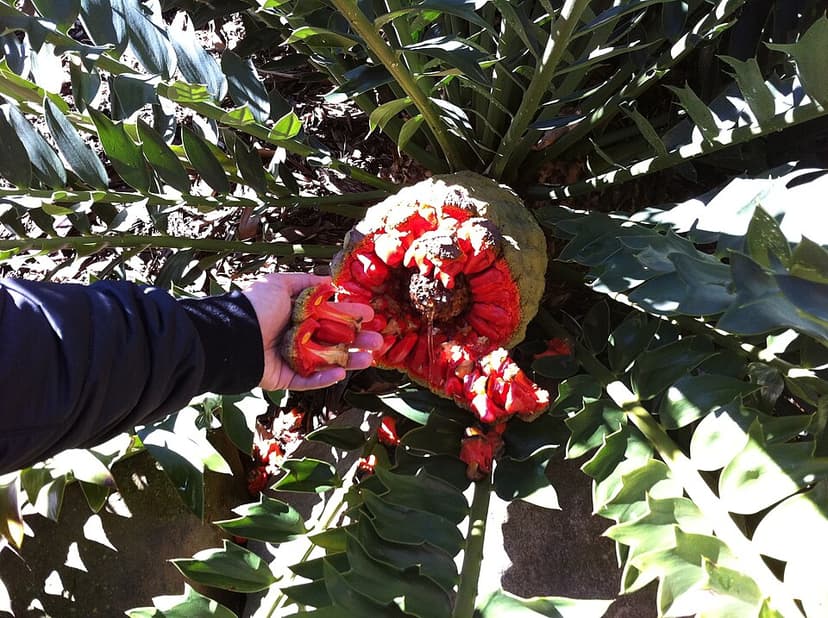
Encephalartos ituriensis
Encephalartos ituriensis, commonly known as the Ituri Forest cycad, is a palm-like cycad species native to the Democratic Republic of the Congo. It is characterized by its tall, robust growth, glossy dark green leaves with spiny, toothed leaflets, and distinctive reproductive cones. Found on granite monadnocks within the Ituri forest, this species is considered Near Threatened.