
Encephalartos horridus
Arid shrublands, Karoo scrub, sourveld, open rocky ridges with shallow or deep fertile soils.·Low-growing cycad with subterranean stems.·Insect pollination·Endangered
Encephalartos horridus, commonly known as the Eastern Cape blue cycad, is a distinctive, low-growing cycad native to the Eastern Cape Province of South Africa. It is recognized for its striking blue-gray, spiny leaves and typically develops a subterranean stem. This species thrives in arid shrublands and rocky ridges, exhibiting a slow growth rate and requiring specific conditions for successful cultivation.
Key Facts
- ›Native to the Eastern Cape Province of South Africa.
- ›Characterized by stiff, spiny, blue-gray leaves.
- ›Mature stems are often largely subterranean.
- ›Listed as an endangered species by the IUCN.
- ›A slow-growing cycad, commonly propagated from seeds or suckers.
- ›Requires full sun, excellent drainage, and slightly acidic soil for cultivation.

Eastern Cape Blue Cycad
Eastern Cape Province, South Africa
- Mature stems are 0.5–1 m long and 20–30 cm in diameter.
- The majority of the stem grows below ground.
- Leaves are up to 1 m long.
- Distinctly blue-gray in color, though coloration varies.
- Stiff and spiny leaflets.
- Younger leaves are silvery-blue, turning green with age.
- Often sharply recurved towards the tip.
- Usually brownish- or blackish-red.
- Single cones with a dense layer of fine hair.
- Female cones are egg-shaped, up to 40 cm long and 20 cm in diameter.
- Male cones are largely cylindrical, narrowing towards the ends, up to 40 cm long and 12 cm in diameter.
- Roughly triangular with three flattened surfaces.
Ornamental
Over-Collection In the Wild
About Encephalartos horridus
Encephalartos horridus, commonly known as the Eastern Cape blue cycad, is a striking and distinctive species of cycad native to a limited region within the Eastern Cape Province of South Africa. This low-growing plant is renowned for its stiff, spiny leaves, which exhibit a unique blue-gray coloration that can vary in intensity among individuals. The species name, 'horridus,' is derived from Latin and means 'bristly,' a fitting description for its sharp foliage.
Description and Distribution
Mature plants of Encephalartos horridus typically possess stems that are largely subterranean, reaching lengths of up to 1 meter and diameters of 20-30 cm. Its leaves, which can grow up to 1 meter long, are a prominent feature, characterized by their sharp, spiny leaflets and a notable blue-gray hue that matures from an initial silvery-blue. The reproductive cones are usually reddish-brown to blackish and covered in fine hair; female cones are egg-shaped and larger than the cylindrical male cones. Naturally, this cycad is found only around the Port Elizabeth and Uitenhage districts, thriving in arid shrublands and on rocky slopes with shallow soils. It prefers full sunlight and can tolerate a range of soil types within its native habitat.
Ecology and Conservation
While cycads generally have few natural predators, wild Encephalartos horridus can be subject to predation by animals like porcupines and baboons. Reproduction typically relies on insect pollination, with seeds dispersally agents being animals that consume the fleshy cones. Encephalartos horridus is classified as an endangered species by the IUCN, a status reflecting historical over-collection from the wild. While commercial propagation in nurseries has somewhat alleviated this pressure, its restricted natural range and specific habitat requirements make it vulnerable.
Cultivation
Encephalartos horridus is known for its slow growth rate, a common trait among cycads. It is cultivated for its ornamental appeal and requires specific conditions to thrive. Ideal cultivation involves deep, fertile, slightly acidic soil enriched with compost, along with full sun exposure and excellent drainage. While it is best suited to temperate and subtropical climates, it can endure light to moderate frosts. Propagation is achievable from seeds or, with patience, from suckers.
Source: Wikipedia ↗
Frequently Asked Questions
What is the scientific name for the Eastern Cape blue cycad?
The scientific name for the Eastern Cape blue cycad is Encephalartos horridus. This name 'horridus' is derived from the Latin word for 'bristly', referring to the plant's stiff, spiny leaflets.
Where can Encephalartos horridus be found naturally?
Encephalartos horridus is naturally found only in the Port Elizabeth and Uitenhage districts of the Eastern Cape Province in South Africa. Its natural habitat includes arid shrublands, open rocky ridges, and areas with shallow soils.
What are the distinctive features of Encephalartos horridus leaves?
The leaves of Encephalartos horridus are its most striking feature, typically displaying a blue-gray coloration that can vary in intensity. They are stiff, spiny, and can be up to 1 meter long, often recurving sharply towards the tip.
What is the conservation status of the Eastern Cape blue cycad?
Encephalartos horridus is listed as an endangered species by the 2003 IUCN Red List. This reflects a decline from its previous listing as vulnerable in the 1997 IUCN Red List of Threatened Plants.
How does Encephalartos horridus reproduce?
Reproduction in Encephalartos horridus commonly requires insect pollination. Once pollinated, seeds are dispersed by animals that consume the fleshy cones. The species can also reproduce via suckering, though this is less common.
What are the ideal conditions for cultivating Encephalartos horridus?
For successful cultivation, Encephalartos horridus requires full sun and excellent drainage. It prefers deep, fertile soil enriched with compost and slightly acidic conditions. While it thrives in temperate and subtropical climates, it can tolerate light to moderate frosts.
Related Cycad species
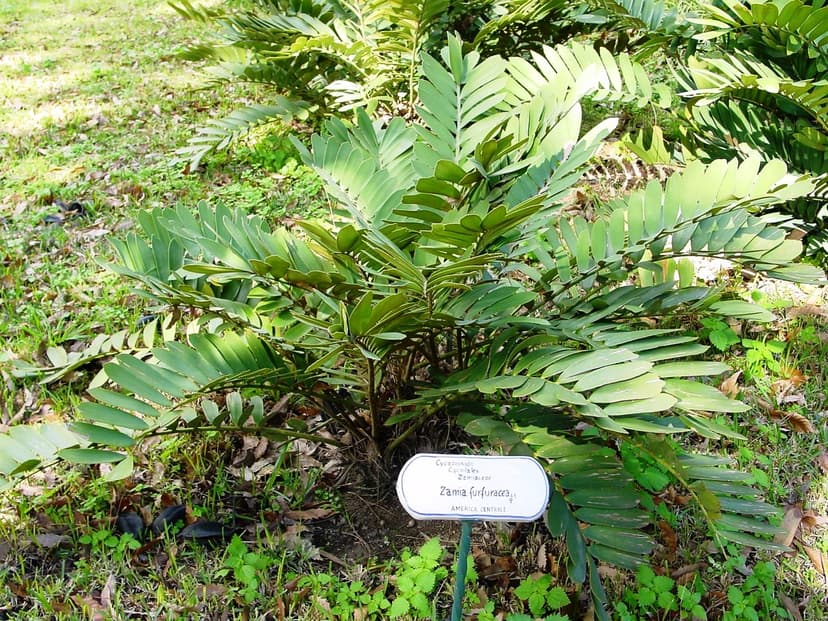
Zamia furfuracea
Zamia furfuracea, commonly known as the cardboard palm or cardboard cycad, is a slow-growing cycad species native to southeastern Veracruz, Mexico. Its distinctive feature is its crown of stiff, fuzzy green leaves that resemble palm fronds, emerging from a short, often subterranean trunk. This dioecious plant is known for its toxicity and has a critically endangered conservation status due to illegal collection for horticulture.

Cycas beddomei
Cycas beddomei is a species of cycad native to a small region in the Andhra Pradesh state of India, specifically the Tirumala Hills. It is characterized by erect, solitary stems topped with a crown of stiff, pinnate leaves and is found in scrubland and brush-covered hills. A unique feature is the fleshy layer within its seeds, which is believed to provide a water source, crucial for its survival in arid conditions.

Macrozamia spiralis
Macrozamia spiralis is a species of cycad endemic to New South Wales, Australia, typically found in sclerophyll forests on low-nutrient soils. This acaulescent plant characteristically lacks an above-ground trunk and features spirally arranged leaves, which can twist up to 360 degrees. Its reproductive cones, both male and female, are notable features, and the species plays a role in symbiotic relationships with nitrogen-fixing cyanobacteria.