
Encephalartos ferox
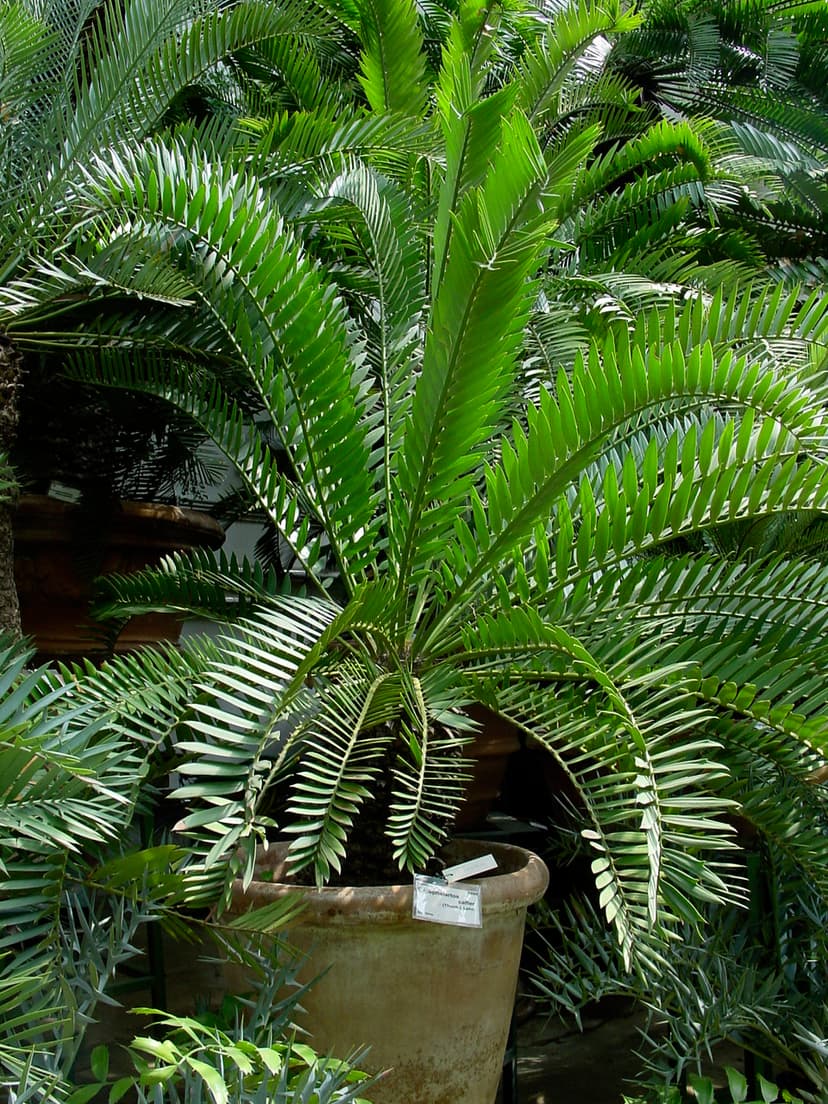
Coastal white beach sand, sand dunes, and evergreen forests, preferring humid conditions.·Subterranean trunk with leaves emerging above ground.
Encephalartos ferox is a small cycad species native to the southeastern coast of Africa, characterized by its subterranean trunk and distinctive spine-tipped leaf lobes. It is highly valued for its starch content and is one of the most popular cultivated cycads, thriving in humid coastal environments and evergreen forests.
Key Facts
- ›Native to the southeastern coast of Africa, including Mozambique and northern Natal.
- ›Features a subterranean trunk that can grow up to one meter in length.
- ›Leaves are pinnately compound, up to two meters long, with spine-tipped lobes.
- ›Reproductive cones are a distinctive dark salmon color, unlike the typical green of other cycads.
- ›Considered relatively fast-growing for a cycad, but slow compared to other plant groups.
- ›Valued by local people for the starch content found in its stem.

Mozambique, Natal, South Africa
- Often subterranean
- Can grow up to a meter in length
- Roots contract, potentially preventing seedling desiccation
- Pinnately compound
- Up to two meters long
- Hard-textured
- Green
- Young leaves are hairy and range from dark green to coppery brown
- Leaflets are about 15 cm long and 3.5 to 5 cm wide
- Leaflets can be flat or twisted
- Leaflets are usually broad with spine-tipped lobes
- Leaflets inserted at about 70° on the rhachis
- Dark salmon color
- Sexually dimorphic
- Male cone: 40-50 cm long, 7-10 cm wide, with a peduncle up to 2-3 cm long
- Female cone: 25-50 cm long, 20-25 cm wide, sessile
- Males can have up to ten cones, females up to five
- Cones emerge in succession
- Shields of megasporophylls are pyramidal shaped with flattened facets
About 4.5 to 5 cm long and 1.5 to 2 cm wide, Red, Narrow, Oblong, Glossy
- Starch content is obtained and consumed by local people
About Encephalartos ferox
Encephalartos ferox is a striking cycad species native to the southeastern coast of Africa, specifically found in Mozambique and the northern Natal region of South Africa. Its name, derived from the Latin word for 'ferocious', alludes to the prominent spine-tipped lobes on its leaves. This species is botanically characterized by a subterranean trunk that can reach up to a meter in length, and its leaves are pinnately compound, growing up to two meters long with a hard texture.
Habitat and Distribution
The natural habitat of Encephalartos ferox is closely tied to coastal environments, where it thrives on white beach sand and within sand dune systems, often found near other vegetation. It also inhabits evergreen forests, preferring areas with high humidity, especially during the summer months, and receiving substantial rainfall. While its winter climate is generally mild, it is uncertain whether the species is ever exposed to frost.
Botanical Features
The cycad's trunk is typically subterranean, with specialized contracting roots that may help prevent seedlings from drying out. Its leaves are a notable feature, being long, hard-textured, and green, with young leaves exhibiting a coppery-brown hue and a hairy surface. Each leaflet is broad, approximately 15 cm long and 3.5 to 5 cm wide, and often possesses spine-tipped lobes. A particularly distinctive characteristic of Encephalartos ferox is the coloration of its reproductive cones, which are a deep salmon rather than the more common green seen in other cycads. Male cones are cylindrical, measuring 40-50 cm long, while the larger female cones are sessile and can be up to 50 cm long and 25 cm wide.
Growth and Reproduction
Encephalartos ferox is considered relatively fast-growing within the cycad family, though still slow-growing compared to many other plant groups. Reproduction occurs via cones, which emerge sequentially rather than all at once. The seeds are red, oblong, glossy, and measure about 4.5 to 5 cm in length.
Human Use and Cultivation
Locally, Encephalartos ferox has been utilized for the starch content found within its stem. It is also highly regarded in cultivation, being one of the most popular cycads grown due to its relative ease of cultivation. It requires ample water, well-drained soil, and moderate temperatures, making it best suited for warmer climates as it shows low tolerance to frost. Propagation can be achieved through seeds or by removing suckers.
Source: Wikipedia ↗
Frequently Asked Questions
What is the scientific name for this cycad species?
The scientific name for this cycad is Encephalartos ferox. It was first described in 1851 from material collected in Mozambique.
Where is Encephalartos ferox found naturally?
Encephalartos ferox is naturally found along the southern coast of Mozambique and in northern Natal, South Africa. It typically grows very close to the ocean on white beach sand and is also found in evergreen forests.
What are the distinctive features of Encephalartos ferox leaves?
The leaves of Encephalartos ferox are pinnately compound and can reach up to two meters in length. They are hard-textured, green, and characterized by broad leaflets with spine-tipped lobes.
What is unique about the cones of Encephalartos ferox?
Encephalartos ferox cones are notable for their dark salmon color, which is unusual as most other cycads have green cones. Male cones are cylindrical, while female cones are larger and sessile.
Is Encephalartos ferox easy to cultivate?
Yes, Encephalartos ferox is considered one of the most popular cultivated cycads because it can be grown fairly easily. It requires plenty of water, well-drained soil, and moderate temperatures, but is not very tolerant to frost.
What is the growth rate of Encephalartos ferox?
Compared to other cycad genera, Encephalartos ferox is reported to grow relatively fast. However, when compared to other plant orders and classes, it is still considered slow-growing.
Related Cycad species

Encephalartos horridus
Encephalartos horridus, commonly known as the Eastern Cape blue cycad, is a distinctive, low-growing cycad native to the Eastern Cape Province of South Africa. It is recognized for its striking blue-gray, spiny leaves and typically develops a subterranean stem. This species thrives in arid shrublands and rocky ridges, exhibiting a slow growth rate and requiring specific conditions for successful cultivation.
Encephalartos afer
Encephalartos afer, commonly known as the Eastern Cape dwarf cycad, is a species of cycad native to South Africa's Eastern Cape Province. This plant is characterized by its typically underground stem, from which emerge long, pinnate, dark green leaves that often have a distinctive ruffled, feathery appearance due to irregularly twisted leaflets. Both male and female plants produce reproductive cones, with females bearing scarlet-colored seeds.

Encephalartos ghellinckii
Encephalartos ghellinckii, commonly known as the Drakensberg cycad, is an evergreen species endemic to South Africa, primarily found in the Natal Drakensberg region. It thrives in diverse habitats from foothills to high elevations, including stream banks, steep grassy slopes, and sandstone outcrops, demonstrating remarkable resistance to veldfires, snow, and frost. Distinctive features include its olive to yellow-green fronds, narrow leaflets with revolute margins, and lemon-colored, woolly cones.