
Encephalartos humilis
Encephalartos humilis is a small cycad species native to the former Transvaal Province of South Africa. It is characterized by its subterranean stem and leathery, pinnate leaves that form a crown. This dioecious species produces distinct male and female cones, with seeds enclosed in colorful flesh.
Key Facts
- ›Native to the former Transvaal Province, South Africa.
- ›Features a small, underground stem typically not exceeding 50 cm in height.
- ›Possesses pinnate leaves, 30–50 cm long, with leathery lanceolate leaflets.
- ›It is a dioecious species, meaning male and female reproductive structures are on separate plants.
- ›Male cones are spindle-shaped (15–20 cm long), while female cones are cylindrical (approx. 25 cm long).
- ›Seeds are ovoid and covered in light yellow to orange flesh.

South Africa
- Underground stem
- Does not grow taller than 50 cm
- Diameter of 15-20 cm
- Sometimes develops secondary stems from basal shoots
- Pinnate
- Numbering 5 to 8
- 30–50 cm long
- Petiole around 10 cm long
- Made up of many pairs of lanceolate, leathery leaflets
- Leaflets up to 13 cm long
- Leaflets have a smooth edge
- About 9 parallel veins on their lower surface
- Connected to a greenish-yellow rachis
- Male Cones Are Spindle-Shaped, 15–20 cm Long and 4–5 cm Wide, Brownish-Gray.
- Female Cones Are Roughly Cylindrical, Solitary, About 25 cm Long and 8–10 cm Wide, Also Brownish-Gray.
Approximately ovoid, 2.5-3.5 cm long, Covered in light yellow to orange flesh
About Encephalartos humilis
Encephalartos humilis is a species of cycad indigenous to the former Transvaal Province of South Africa. This particular cycad is recognized for its diminutive stature, featuring an underground stem that typically does not exceed 50 cm in height and measures 15-20 cm in diameter. It occasionally produces secondary stems from basal shoots, contributing to its overall form.
Botanical Description
The species presents pinnate leaves, numbering between five and eight, which emerge in a crown atop the stem. These leaves can reach lengths of 30–50 cm, with a petiole of approximately 10 cm. They are composed of numerous lanceolate, leathery leaflets, each up to 13 cm long, characterized by smooth edges and roughly nine parallel veins on their lower surface. The rachis, or central stalk of the leaf, is greenish-yellow.
Encephalartos humilis is a dioecious plant, meaning male and female reproductive structures are found on separate individuals. Male plants bear spindle-shaped cones that are 15–20 cm long and 4–5 cm wide, exhibiting a brownish-gray coloration. Female plants produce solitary, roughly cylindrical cones, measuring about 25 cm in length and 8–10 cm in width, also in a brownish-gray hue. The seeds are ovoid, approximately 2.5-3.5 cm long, and are enveloped in flesh that varies from light yellow to orange.
Source: Wikipedia ↗
Frequently Asked Questions
What is the typical size of Encephalartos humilis?
Encephalartos humilis is a small cycad. Its underground stem usually does not grow taller than 50 cm and has a diameter of 15-20 cm. The pinnate leaves add to its overall size, forming a crown at the top of the stem.
What do the leaves of Encephalartos humilis look like?
The leaves are pinnate, typically numbering 5 to 8 and measuring 30–50 cm in length. They are composed of numerous lanceolate, leathery leaflets, each up to 13 cm long, with smooth edges and about 9 parallel veins on their lower surface.
How does Encephalartos humilis reproduce?
This species is dioecious, meaning there are separate male and female plants. Male plants produce spindle-shaped cones, while female plants bear solitary, roughly cylindrical cones. The seeds are ovoid and are enclosed in flesh that ranges from light yellow to orange.
Where is Encephalartos humilis found naturally?
Encephalartos humilis is indigenous to the former Transvaal Province of South Africa. It thrives in its native habitat within this region.
Related Cycad species
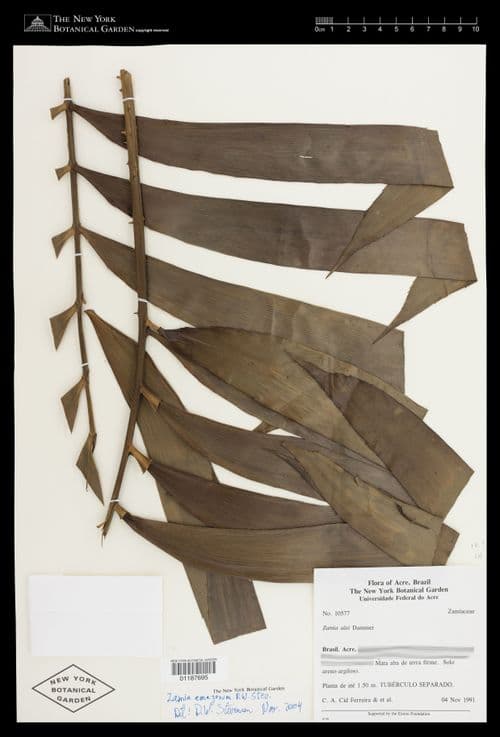
Zamia amazonum
Zamia amazonum is a cycad species found across the Amazon basin in Brazil, Colombia, Peru, and Venezuela, as well as in Colombia's Chocó Department. It is characterized by its subterranean stem and long, prickly petioles bearing numerous leaflets. This species is dioecious, meaning individual plants are either male or female, and produces distinct male and female cones.

Zamia acuminata
Zamia acuminata is a species of cycad found in the tropical forests of Costa Rica and Panama. It is characterized by its subterranean stem, long pinnately compound leaves with acuminate leaflets, and distinctive cream to tan reproductive cones. This species is notably threatened by habitat loss, highlighting the importance of its conservation.
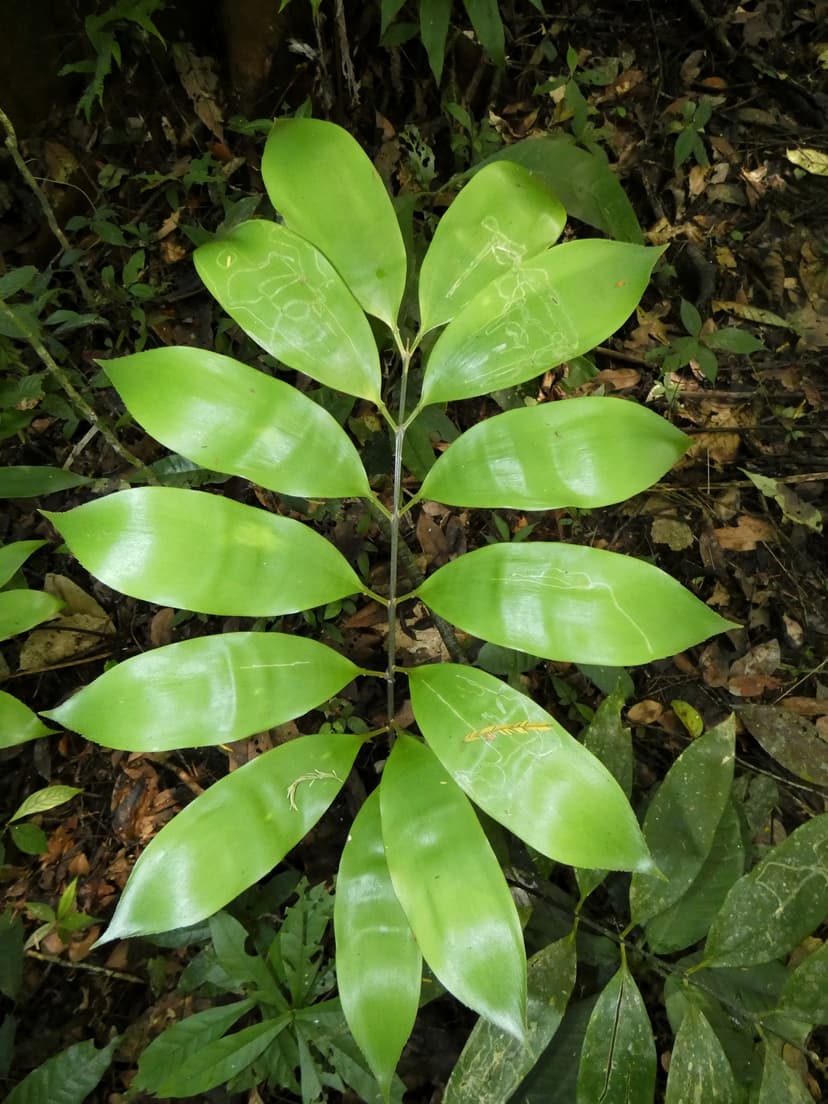
Zamia manicata
Zamia manicata is a species of cycad native to the rainforests of Colombia and Panama. It is characterized by its subterranean stem and distinctive leaves with leaflets that have a unique gland-like collar at their base. This species plays a role in the "Manicata clade," a group of related cycads found in northern Colombia.