
Zamia amazonum
Found in the upper Amazon basin and the Chocó Department on the Pacific coast.·Subterranean stem
Zamia amazonum is a cycad species found across the Amazon basin in Brazil, Colombia, Peru, and Venezuela, as well as in Colombia's Chocó Department. It is characterized by its subterranean stem and long, prickly petioles bearing numerous leaflets. This species is dioecious, meaning individual plants are either male or female, and produces distinct male and female cones.
Key Facts
- ›Subterranean stem ranging from 3 to 8 cm in diameter.
- ›Leaves can grow up to 2.5 meters long on prickly petioles.
- ›Features 10 to 30 oblong-lanceolate to lanceolate leaflets with toothed edges.
- ›Dioecious, with separate male and female plants.
- ›Male cones are cylindrical, while female cones are larger and dark red-brown.
- ›Used by the Chayahuita people for treating leishmaniasis.
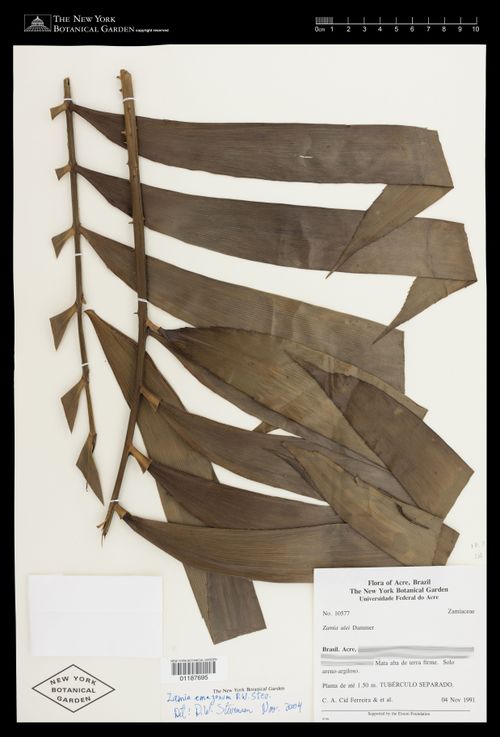
Brazil, Colombia, Peru, Venezuela
Subterranean, 3 To 8 Centimeters In Diameter
- Two to six leaves on a plant
- 0.5 to 2.5 meters long
- 10 to 30 leaflets
- Leaflets are oblong-lanceolate to lanceolate
- Leaflet ends are pointed
- Leaflet edges are toothed along the outer half
- Middle leaflets are 15 to 20 centimeters long and 2 to 4 centimeters wide
- Male cones are cylindrical, 6 to 10 centimeters long and 1 to 2 centimeters in diameter, brown.
- Female cones are 10 to 15 centimeters long and 3 to 5 centimeters in diameter, dark red-brown.
Ovoid, 1 Centimeter Long, 0.5 Centimeters In Diameter, Have A Red Sarcotesta
Treatment For Leishmaniasis
About Zamia amazonum
Zamia amazonum is a species of plant belonging to the Zamiaceae family, distinguished by its subterranean stem and striking foliage. This cycad is native to a significant portion of South America, being found in Brazil, Colombia, Peru, and Venezuela, with a notable presence in the upper Amazon basin and along the Pacific coast of Colombia.
Description and Botanical Features
The plant features a stout, subterranean stem that typically measures between 3 to 8 centimeters in diameter. From this base emerge two to six leaves, which can be remarkably long, extending from 0.5 to 2.5 meters. These leaves are supported by petioles (stalks) that range from 0.5 to 1 meter in length. A distinctive characteristic of the petiole is its reddish-brown color and the presence of prickles, which extend into the lower portion of the leaf axis. Each leaf is composed of 10 to 30 leaflets; these leaflets are oblong-lanceolate to lanceolate in shape, pointed at their ends, and possess toothed edges along their outer half. The leaflets found in the middle section of the leaf are typically 15 to 20 centimeters long and 2 to 4 centimeters wide.
Like other members of the Zamia genus, Z. amazonum is dioecious, meaning that individual plants are either male or female. The reproductive structures, known as strobili or cones, differ between the sexes. Male cones are cylindrical, measuring 6 to 10 centimeters in length and 1 to 2 centimeters in diameter, and are brown in color. They are borne on peduncles (stalks) that are 8 to 15 centimeters long. Female cones are generally larger, ranging from 10 to 15 centimeters in length and 3 to 5 centimeters in diameter, and are a dark red-brown color, supported by stalks of 5 to 8 centimeters.
The seeds of Zamia amazonum are ovoid, approximately 1 centimeter long and 0.5 centimeters in diameter, and are enclosed in a red sarcotesta, which is the outer fleshy coat.
Habitat and Distribution
Zamia amazonum is locally abundant within its native range, which spans the upper Amazon basin across Brazil, Colombia, Peru, and Venezuela. Its distribution also extends to the Chocó Department on the Pacific coast of Colombia. The specific epithet, "amazonum," directly references its widespread occurrence within the vast Amazon basin.
Human Use
There is a documented traditional use of Zamia amazonum by the Chayahuita people of northeastern Peru. They reportedly utilize crushed root of the plant, after it has been soaked in water overnight, as a medicinal treatment for leishmaniasis.
Source: Wikipedia ↗
Frequently Asked Questions
Where is Zamia amazonum found naturally?
Zamia amazonum is indigenous to the upper Amazon basin, with populations found in Brazil, Colombia, Peru, and Venezuela. It also occurs in the Chocó Department on the Pacific coast of Colombia.
What are the characteristics of Zamia amazonum leaves?
The leaves of Zamia amazonum can be quite long, ranging from 0.5 to 2.5 meters, attached to petioles that are 0.5 to 1 meter long. The reddish-brown petioles are covered in prickles, and each leaf has 10 to 30 leaflets that are pointed and toothed along their outer edges.
How are the male and female reproductive structures of Zamia amazonum different?
Zamia amazonum is dioecious, meaning there are separate male and female plants. Male cones (strobili) are cylindrical, measuring 6 to 10 cm in length, and are brown. Female cones are larger, 10 to 15 cm long, and dark red-brown in color.
Does Zamia amazonum have any traditional uses?
Yes, the Chayahuita people of northeastern Peru report using crushed Zamia amazonum root, soaked overnight in water, as a treatment for leishmaniasis.
What is the typical size of the stem of Zamia amazonum?
The stem of Zamia amazonum is subterranean and typically measures between 3 to 8 centimeters in diameter.
Related Cycad species

Zamia acuminata
Zamia acuminata is a species of cycad found in the tropical forests of Costa Rica and Panama. It is characterized by its subterranean stem, long pinnately compound leaves with acuminate leaflets, and distinctive cream to tan reproductive cones. This species is notably threatened by habitat loss, highlighting the importance of its conservation.

Encephalartos humilis
Encephalartos humilis is a small cycad species native to the former Transvaal Province of South Africa. It is characterized by its subterranean stem and leathery, pinnate leaves that form a crown. This dioecious species produces distinct male and female cones, with seeds enclosed in colorful flesh.
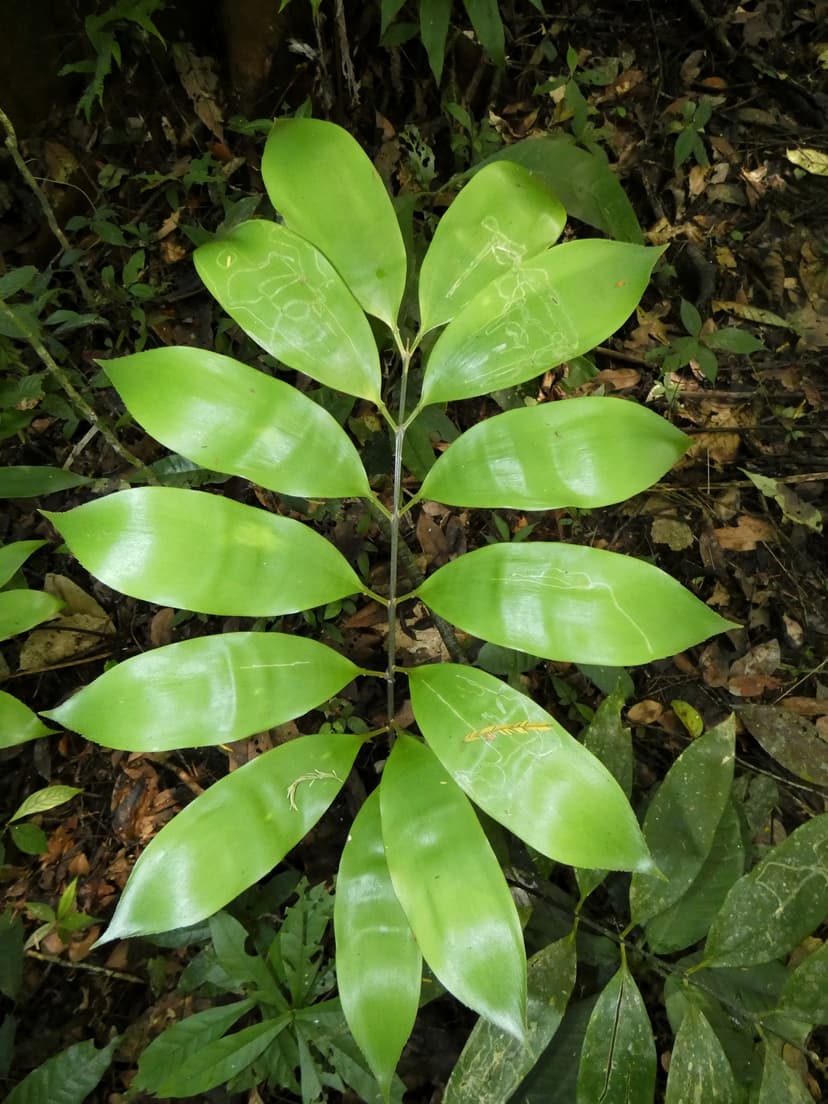
Zamia manicata
Zamia manicata is a species of cycad native to the rainforests of Colombia and Panama. It is characterized by its subterranean stem and distinctive leaves with leaflets that have a unique gland-like collar at their base. This species plays a role in the "Manicata clade," a group of related cycads found in northern Colombia.