
Zamia acuminata
Tropical forests·Subterranean stem·Threatened
Zamia acuminata is a species of cycad found in the tropical forests of Costa Rica and Panama. It is characterized by its subterranean stem, long pinnately compound leaves with acuminate leaflets, and distinctive cream to tan reproductive cones. This species is notably threatened by habitat loss, highlighting the importance of its conservation.
Key Facts
- ›Native to Costa Rica and Panama.
- ›Features a subterranean, subglobose to cylindrical stem.
- ›Possesses compound leaves up to 1 meter long with 6-15 pairs of acuminate leaflets.
- ›Reproductive cones (strobili) are cream to tan in color.
- ›Dioecious, meaning individual plants are either male or female.
- ›Threatened by habitat loss.

Costa Rica, Panama
Subterranean, Subglobose To Cylindrical, Up To 5 cm In Diameter
- Compound leaves up to 1 meter long
- Leaf stalks up to 60 cm long
- Leaf stalks densely covered with prickles
- Leaf axis with 6 to 15 pairs of leaflets
- Leaflets elliptic-lanceolate with very long acuminate tips
- Middle leaflets 20 to 30 cm long and 1 to 3 cm wide
- Male strobili: cylindrical, 5 to 8 cm long, 1 to 1.5 cm in diameter, cream to tan in color
- Female strobili: cylindrical to ovoid, 10 to 20 cm long, 5 to 8 cm in diameter, cream to tan in color
Ovoid, Red
Habitat Loss
About Zamia acuminata
Zamia acuminata is a species of cycad native to the tropical regions of Costa Rica and Panama. This plant is distinguished by its subterranean stem, which can be subglobose or cylindrical and reach up to 5 centimeters in diameter. Its compound leaves are notable for their length, growing up to 1 meter, and are supported by spiny leaf stalks. The leaf axis typically bears 6 to 15 pairs of leaflets, which are elliptic-lanceolate with exceptionally long, pointed tips.
Reproductively, Zamia acuminata is dioecious, meaning individual plants are either male or female. The male reproductive structures, called strobili or cones, are cylindrical and measure between 5 to 8 centimeters in length and 1 to 1.5 centimeters in diameter, presenting a cream to tan coloration. The female cones are larger, ranging from 10 to 20 centimeters in length and 5 to 8 centimeters in diameter, and share the same cream to tan hue. The seeds produced are ovoid and red. Studies suggest that Zamia acuminata is closely related to Zamia fairchildiana and Zamia pseudomonticola, with recent divergence and shared adaptations for both xeric and mesic environments.
Despite its botanical interest, Zamia acuminata faces significant threats, primarily due to habitat loss in its natural range. It is typically found at altitudes between 400 and 1,200 meters. The species was first described by William Turner Thiselton-Dyer in 1884 based on a leaf specimen collected by Anders Sandøe Ørsted, though its exact collection locality remains somewhat uncertain. Later descriptions in 1993 by Dennis Stevenson were based on wild-growing plants in Panama.
Source: Wikipedia ↗
Frequently Asked Questions
Where is Zamia acuminata found?
Zamia acuminata is found in Costa Rica and Panama. It typically grows at altitudes between 400 and 1,200 meters.
What are the characteristics of Zamia acuminata's leaves?
The leaves of Zamia acuminata are compound and can reach up to 1 meter in length. Each leaf stalk is covered in prickles, and the leaf axis contains 6 to 15 pairs of elliptic-lanceolate leaflets with long, pointed tips.
What do the reproductive cones of Zamia acuminata look like?
Both male and female cones of Zamia acuminata are cylindrical, though female cones can also be ovoid. They range in color from cream to tan. Male cones are smaller, measuring 5-8 cm long, while female cones are larger, 10-20 cm long.
Is Zamia acuminata endangered?
Yes, Zamia acuminata is considered a threatened species. Habitat loss is the primary threat to its survival in its natural range.
What is the growth form of Zamia acuminata?
Zamia acuminata has a subterranean stem, meaning it grows mostly underground. This stem is typically subglobose or cylindrical and can be up to 5 centimeters in diameter.
Related Cycad species
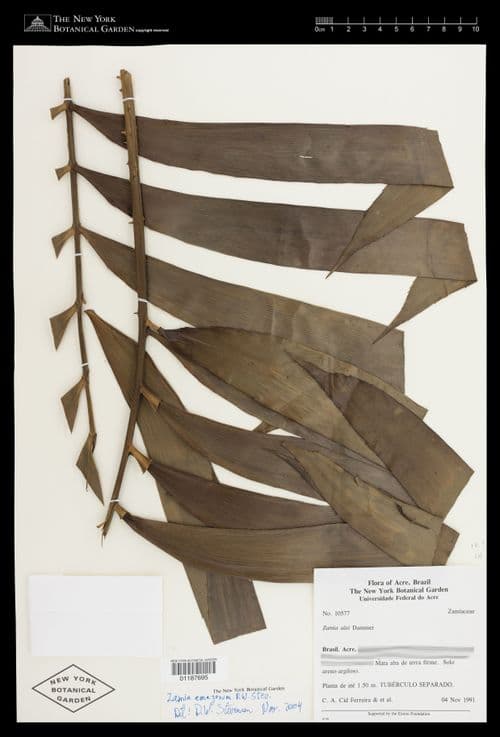
Zamia amazonum
Zamia amazonum is a cycad species found across the Amazon basin in Brazil, Colombia, Peru, and Venezuela, as well as in Colombia's Chocó Department. It is characterized by its subterranean stem and long, prickly petioles bearing numerous leaflets. This species is dioecious, meaning individual plants are either male or female, and produces distinct male and female cones.

Encephalartos humilis
Encephalartos humilis is a small cycad species native to the former Transvaal Province of South Africa. It is characterized by its subterranean stem and leathery, pinnate leaves that form a crown. This dioecious species produces distinct male and female cones, with seeds enclosed in colorful flesh.
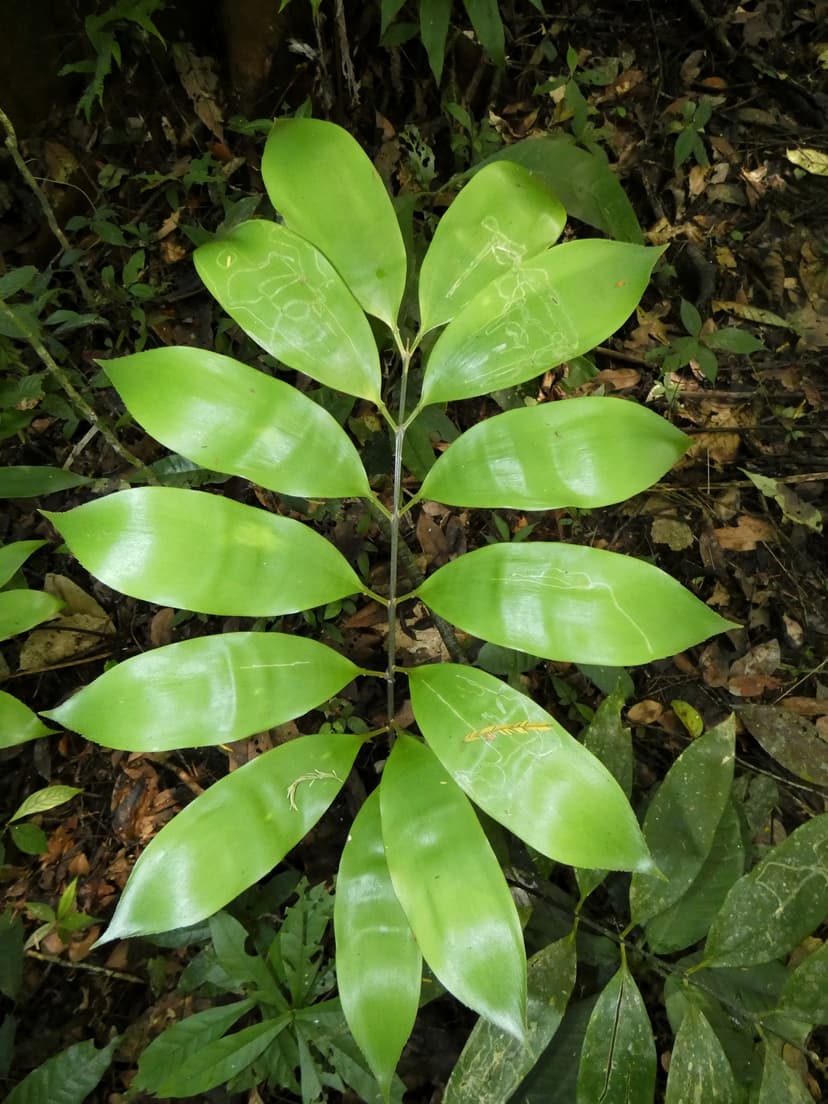
Zamia manicata
Zamia manicata is a species of cycad native to the rainforests of Colombia and Panama. It is characterized by its subterranean stem and distinctive leaves with leaflets that have a unique gland-like collar at their base. This species plays a role in the "Manicata clade," a group of related cycads found in northern Colombia.