
Encephalartos lebomboensis
Sunny positions on cliffs and steep, rocky slopes among sparse vegetation.·Arborescent, often forming clumps with multiple stems.·Endangered
Encephalartos lebomboensis, also known as the Lebombo cycad, is a species of cycad native to the Lebombo Mountains region of South Africa, Mozambique, and Eswatini. This endangered species is characterized by its unbranched trunk, which can reach up to 4 meters in height, and its crown of stiff, pinnate leaves with serrated lanceolate leaflets. It is a dioecious plant, meaning it has separate male and female individuals that produce distinctive yellowish-orange to yellowish-green cones.
Key Facts
- ›Native to the Lebombo Mountains of South Africa, Mozambique, and Eswatini.
- ›Distinctive pinnate leaves are 100-150 cm long with lanceolate, serrated leaflets.
- ›Dioecious species with separate male and female plants producing distinct cones.
- ›Trunks can grow up to 4 meters tall and are often unbranched, though clumping can occur.
- ›Classified as 'Endangered' on the IUCN Red List due to over-exploitation and habitat degradation.
- ›Listed in Appendix I of the CITES Appendices.
Lebombo Cycad
South Africa, Mozambique, Eswatini
Up To 4 Metres Tall, 30 Centimetres Thick, Usually Unbranched, Suckers Often Form At the Base, Sometimes Bears Offsets Part Way Up
- Pinnate leaves
- Stiff
- 100 to 150 cm long
- 20 to 27 cm wide
- Mid to dark green glossy upper surface
- Paler under side
- Densely hairy when young, becoming hairless
- Straight or slightly arched
- Either flat or with a slight keel
- Leaflets are lanceolate with serrated edges
- Leaflets up to 18 cm long and 2 cm wide
- Leaflets held at right angles to the rachis and slightly overlapping
- Leaflets reduced to prickles near the base of the leaves
- Male cones are short-stalked, cylindrical, yellowish-orange, 40 to 45 cm long and 12 to 15 cm wide.
- Female cones are barrel-shaped, yellowish-green, 40 to 45 cm long and 25 to 30 cm wide.
- Usually one, rarely two cones per plant.
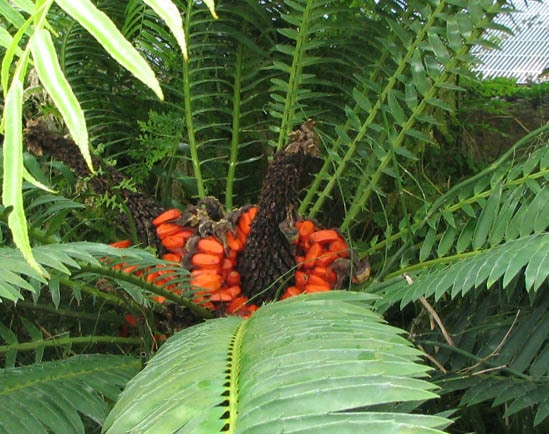
Seed Coats Are Glossy Red.
- Over-exploitation by plant collectors
- Habitat degradation due to encroachment of agricultural land
About Encephalartos lebomboensis
Encephalartos lebomboensis: The Lebombo Cycad
Encephalartos lebomboensis, commonly known as the Lebombo cycad, is a striking species of cycad that originates from the Lebombo Mountains region, spanning parts of South Africa, Mozambique, and Eswatini. This plant is recognized for its robust, arborescent growth form, with trunks that can ascend to heights of up to 4 meters and a thickness of approximately 30 centimeters. While typically unbranched, these trunks often produce basal suckers, leading to the formation of multi-stemmed clumps.
Botanical Features
The crown of Encephalartos lebomboensis is adorned with stiff, pinnate leaves that measure between 100 and 150 centimeters in length. The upper surface of these leaves presents a glossy, mid to dark green hue, contrasting with a paler underside. Initially covered in dense hairs, the leaves soon become hairless. The leaflets are lanceolate, possessing serrated edges, and are arranged at right angles to the central rachis, often with a slight overlap. Near the leaf base, these leaflets are reduced to prickles.
As a dioecious species, Encephalartos lebomboensis features separate male and female plants. Male specimens bear one or occasionally two short-stalked, cylindrical cones that are yellowish-orange, measuring 40 to 45 centimeters in length and 12 to 15 centimeters in width. Female plants produce one or two barrel-shaped cones, also 40 to 45 centimeters long but wider at 25 to 30 centimeters, and are characterized by a yellowish-green coloration. The seeds of this species have glossy red seed coats.
Distribution and Habitat
Encephalartos lebomboensis is found in two distinct populations within South Africa, one near Mananga in Mpumalanga and a southern population centered around Piet Retief in the upper Pongola River Valley. It is also native to Mozambique and Eswatini. The species thrives in sunny, exposed locations, typically found on cliffs and steep, rocky slopes amidst sparse vegetation. The climate in its native habitat is characterized by hot, relatively wet summers and cool, dry winters, often accompanied by mists.
Conservation Status
The Lebombo cycad is considered a very rare and endangered species. With an estimated 5,000 specimens remaining in the wild, its population is threatened by over-exploitation from plant collectors and the degradation of its natural habitat due to the expansion of agricultural land. Consequently, Encephalartos lebomboensis is listed as 'Endangered' on the IUCN Red List of Threatened Species and is included in Appendix I of the CITES Appendices, underscoring the need for conservation efforts.
Source: Wikipedia ↗
Frequently Asked Questions
What is the scientific name for the Lebombo cycad?
The scientific name for the Lebombo cycad is Encephalartos lebomboensis. It belongs to the family Zamiaceae. This species was first described in 1949.
Where is Encephalartos lebomboensis found naturally?
Encephalartos lebomboensis is indigenous to the Lebombo Mountains, with populations in Mpumalanga province in South Africa, and also native to Mozambique and Eswatini. It typically grows in sunny, exposed positions on cliffs and steep, rocky slopes.
What are the characteristics of Encephalartos lebomboensis leaves and cones?
The leaves of Encephalartos lebomboensis are pinnate, stiff, and range from 100 to 150 cm in length, featuring lanceolate leaflets with serrated edges. Male plants produce yellowish-orange cylindrical cones, while female plants bear yellowish-green barrel-shaped cones.
What is the conservation status of Encephalartos lebomboensis?
Encephalartos lebomboensis is listed as 'Endangered' on the IUCN Red List of Threatened Species. This status is due to threats such as over-exploitation by plant collectors and habitat degradation from agricultural encroachment.
What is the difference between Encephalartos lebomboensis and Encephalartos senticosus?
Encephalartos senticosus was previously considered a form of E. lebomboensis but was split into a separate species in 1996. The primary differences lie in the number, size, and shape of their reproductive cones.
Related Cycad species

Encephalartos horridus
Encephalartos horridus, commonly known as the Eastern Cape blue cycad, is a distinctive, low-growing cycad native to the Eastern Cape Province of South Africa. It is recognized for its striking blue-gray, spiny leaves and typically develops a subterranean stem. This species thrives in arid shrublands and rocky ridges, exhibiting a slow growth rate and requiring specific conditions for successful cultivation.

Cycas beddomei
Cycas beddomei is a species of cycad native to a small region in the Andhra Pradesh state of India, specifically the Tirumala Hills. It is characterized by erect, solitary stems topped with a crown of stiff, pinnate leaves and is found in scrubland and brush-covered hills. A unique feature is the fleshy layer within its seeds, which is believed to provide a water source, crucial for its survival in arid conditions.

Cycas micronesica
Cycas micronesica is a medium-sized cycad species native to islands in Micronesia and the Mariana Islands. It is characterized by its straight, palm-like trunk and long, pinnate leaves. Historically a food source, its seeds contain a neurotoxin linked to a neurological disease, and the species is currently threatened by invasive pests.