
Macrozamia communis
Open forests·Arborescent (with a large subterranean tuber)·Not considered to be at risk
Macrozamia communis, commonly known as burrawang, is an Australian cycad species native to the east coast of New South Wales. It is characterized by its large subterranean tuber and its ability to produce seed cones after fires. The species has an extensive distribution across New South Wales, thriving in open forests and playing a role in indigenous diets after proper treatment of its seeds.
Key Facts
- ›Native to the east coast of New South Wales, Australia.
- ›Commonly known as burrawang, derived from the Daruk Aboriginal language.
- ›Possesses a large subterranean tuber, which can grow up to 1.8 meters thick.
- ›Seed cones are produced following fire events.
- ›Seeds are a good source of starch but are poisonous unless treated.
- ›Individual plants take 10-20 years to mature and can live up to 120 years.
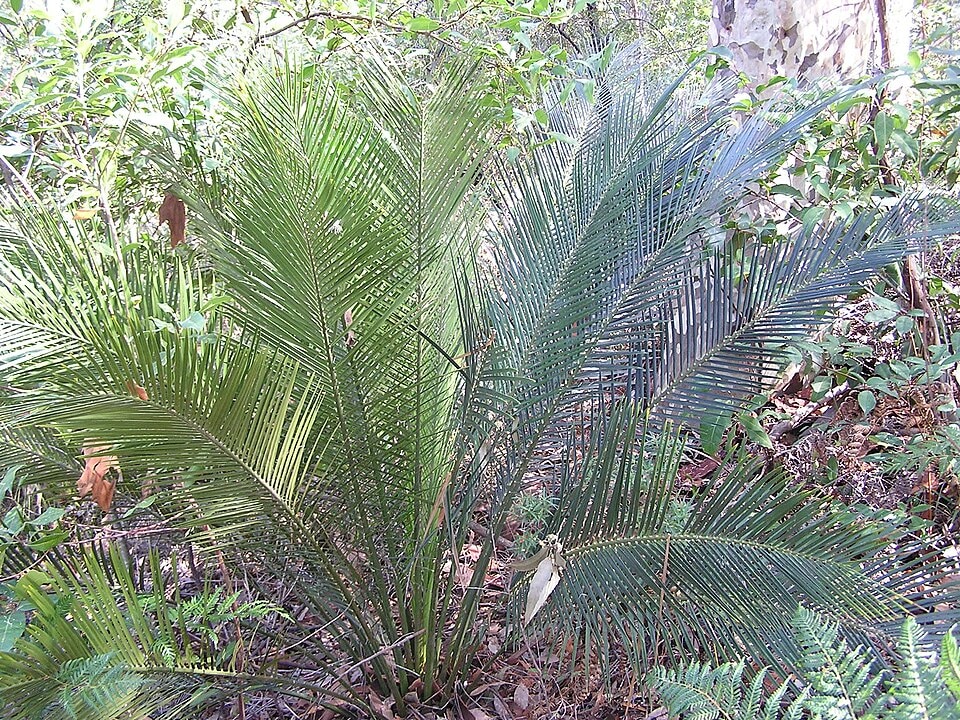
Burrawang
New South Wales, Australia
- Forms a large subterranean tuber, up to 1.8 meters thick in maturity.
- In maturity, the top of the stem is level with the ground.
- Leaves Are Pinnately Compound.
- Leaflets Are Typically Rigid and Have A Distinct Midrib.
- Male and female seed cones are on separate plants.
- Seed cones are formed after fire.
- Large female seeds are ripe when red or yellow.
- Good source of starch.
- Poisonous to eat unless treated.
- Large female seeds are ripe when red or yellow.
Food Source, Ornamental
About Macrozamia communis
Macrozamia communis: The Burrawang
Macrozamia communis, widely recognized by its common name 'burrawang', is a prominent Australian cycad species native to the eastern coast of New South Wales. Its distribution is the most extensive of any cycad within New South Wales, stretching from the Armidale region down to Bega and extending inland to the Mudgee district. This species is a characteristic inhabitant of open forests, being particularly abundant along the state's south coast.
Botanical Features and Life Cycle
The burrawang is distinguished by its remarkable subterranean tuber, which can grow to an impressive size of 1.8 meters (5 ft 11 in) in thickness by maturity, making it the largest tuber of any cycad. Seedlings exhibit tubers and coralloid roots that emerge above ground, housing cyanobacteria that engage in a symbiotic relationship for nitrogen fixation. As the plant matures, these roots contract, drawing the stem's apex level with the soil surface. Seed cones are a notable feature, typically appearing after fire events. Macrozamia communis is dioecious, meaning male and female reproductive structures are found on separate plants, with the large female seeds maturing to a red or yellow hue.
Survival and Human Interaction
Individual burrawang plants require a considerable time to reach maturity, usually between 10 to 20 years, and can live for up to 120 years. The seeds, while a valuable source of starch, are toxic if not processed correctly. Indigenous Australian communities, such as the Cadigal people, developed sophisticated methods to detoxify the seeds, involving extensive pounding and soaking over several days before preparing them into cakes and roasting them. The species is considered 'not considered to be at risk' in terms of its conservation status and has also found use as an ornamental plant, notably in California.
Source: Wikipedia ↗
Frequently Asked Questions
What is the common name for Macrozamia communis?
The most common name for Macrozamia communis is 'burrawang'. This name originates from the Daruk Australian Aboriginal language and is also frequently used for other species within the Macrozamia genus.
Where is Macrozamia communis found in Australia?
Macrozamia communis is distributed along the east coast of New South Wales, from the Armidale district in the north to Bega in the south, covering approximately 700 km. It is also found on the coastal slopes of the Great Dividing Range, extending into the Mudgee district.
What kind of habitat does Macrozamia communis prefer?
This cycad species typically grows in open forests. It is most abundant along the south coast of New South Wales.
Are the seeds of Macrozamia communis edible?
The seeds of Macrozamia communis are a good source of starch but are poisonous if consumed without proper treatment. Indigenous peoples, such as the Cadigal people, would pound and soak the seeds in water for a week, changing the water daily, before making them into cakes and roasting them.
How long does it take for Macrozamia communis to mature?
Individual specimens of Macrozamia communis require a significant period to mature, typically between 10 to 20 years. These plants can have a long lifespan, with some individuals living for up to 120 years.
What is the conservation status of Macrozamia communis?
Macrozamia communis is not considered to be at risk. Its conservation status indicates it is not facing immediate threats to its survival in the wild.
Related Cycad species

Encephalartos horridus
Encephalartos horridus, commonly known as the Eastern Cape blue cycad, is a distinctive, low-growing cycad native to the Eastern Cape Province of South Africa. It is recognized for its striking blue-gray, spiny leaves and typically develops a subterranean stem. This species thrives in arid shrublands and rocky ridges, exhibiting a slow growth rate and requiring specific conditions for successful cultivation.
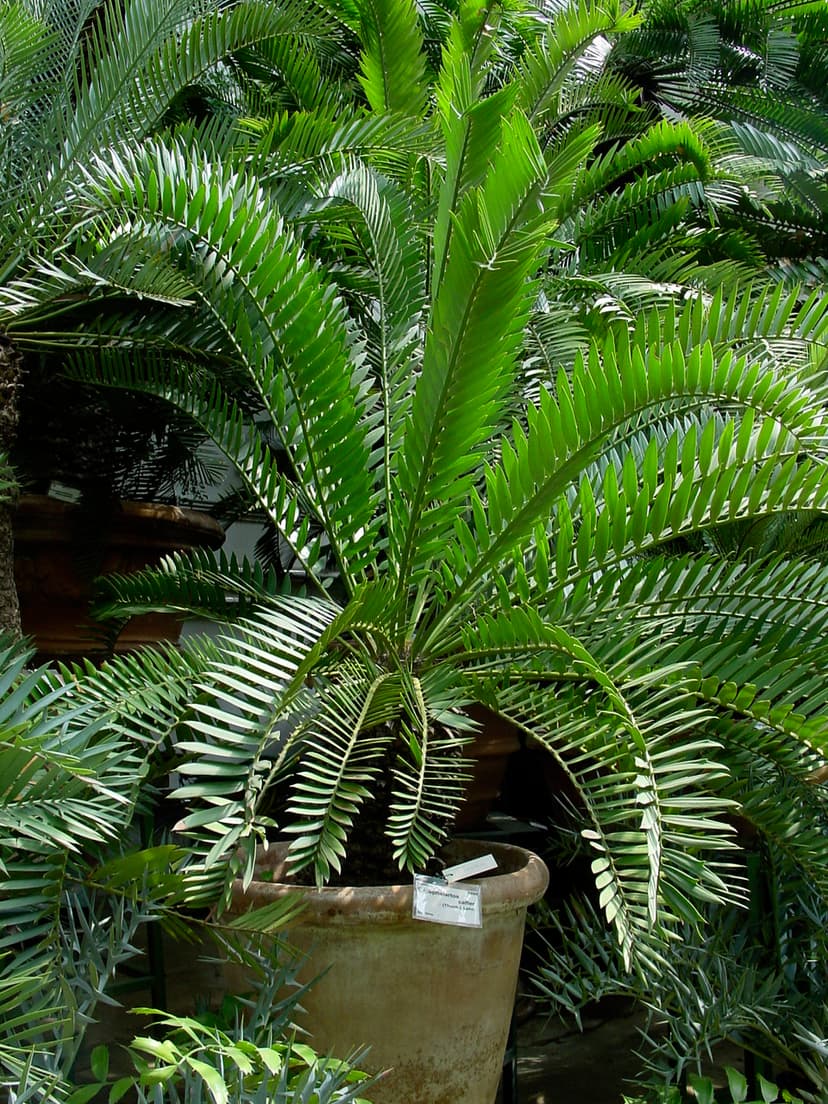
Encephalartos afer
Encephalartos afer, commonly known as the Eastern Cape dwarf cycad, is a species of cycad native to South Africa's Eastern Cape Province. This plant is characterized by its typically underground stem, from which emerge long, pinnate, dark green leaves that often have a distinctive ruffled, feathery appearance due to irregularly twisted leaflets. Both male and female plants produce reproductive cones, with females bearing scarlet-colored seeds.

Encephalartos ghellinckii
Encephalartos ghellinckii, commonly known as the Drakensberg cycad, is an evergreen species endemic to South Africa, primarily found in the Natal Drakensberg region. It thrives in diverse habitats from foothills to high elevations, including stream banks, steep grassy slopes, and sandstone outcrops, demonstrating remarkable resistance to veldfires, snow, and frost. Distinctive features include its olive to yellow-green fronds, narrow leaflets with revolute margins, and lemon-colored, woolly cones.