
Macrozamia fraseri
Sandy soils of the Swan Coastal Plain and Geraldton Sandplains, low heath.·Low-trunked cycad or upright tree
Macrozamia fraseri is a cycad species native to the southwest of Western Australia, primarily found on the sandy soils of the Swan Coastal Plain and Geraldton Sandplains. Known to the Noongar people as djiridji, this slow-growing, evergreen plant is characterized by its low-trunked or upright tree form, dull, keeled leaves, and thick trunks that can exceed a meter in height and show signs of past bushfires. It is a dioecious species, meaning male and female reproductive structures are found on separate plants.
Key Facts
- ›Endemic to the southwest of Western Australia.
- ›Found on the sandy soils of the Swan Coastal Plain and Geraldton Sandplains.
- ›Known to the Noongar people as djiridji.
- ›Possesses poisonous glycosides called cycasins.
- ›Exhibits a slow growth rate, is perennial, evergreen, and dioecious.
- ›Mature trunks can be over a meter tall and up to 105 cm in diameter.

Djiridji
Southwest Western Australia
- Trunk can be over a metre in height in old plants
- Trunk is thick for a cycad, up to 105 cm in diameter
- Surface can be burnt by bush fires of the past
Dull Leaves, Distinctly Keeled Leaves, Medium Or Small Leaflets
About Macrozamia fraseri
Macrozamia fraseri is a species of cycad belonging to the Zamiaceae family, notable for its endemic status in the southwest of Western Australia. This plant is primarily found thriving on the sandy soils characteristic of the Swan Coastal Plain and the Geraldton Sandplains, with its geographical range occasionally overlapping with that of Macrozamia riedlei.
Botanical Description
This species exhibits considerable variability in its form, presenting as either a low-trunked cycad or an upright tree. Its leaves are a distinct dull green and possess a pronounced keel, accompanied by leaflets that are typically medium to small in size. Macrozamia fraseri grows in low heath environments, often without the presence of jarrah (Eucalyptus marginata), on sandy substrates.
As is typical for cycads, Macrozamia fraseri is characterized by its slow growth rate. It is a perennial, evergreen plant and is dioecious, meaning that individual plants are either male or female. The trunks of mature specimens can extend to over a meter in height and are remarkably thick for a cycad, reaching up to 105 cm (41 inches) in diameter. The surface of these trunks often bears the marks of past bushfires.
Indigenous Recognition and Toxicity
The Noongar peoples, the Indigenous inhabitants of the region, know this plant as djiridji. It is important to note that Macrozamia fraseri contains poisonous glycosides, specifically compounds known as cycasins, which are present within the plant.
Source: Wikipedia ↗
Frequently Asked Questions
What is Macrozamia fraseri?
Macrozamia fraseri is a species of cycad belonging to the Zamiaceae family. It is native to the southwest of Western Australia and is known for its slow growth, evergreen nature, and dioecious reproductive system.
Where does Macrozamia fraseri grow?
This species is endemic to the southwest of Western Australia, predominantly found on the sandy soils of the Swan Coastal Plain and Geraldton Sandplains. Its distribution range sometimes overlaps with that of Macrozamia riedlei.
What are the common names for Macrozamia fraseri?
The Noongar peoples, Indigenous inhabitants of the region, know Macrozamia fraseri by the name djiridji. No other common names are widely documented.
What are the physical characteristics of Macrozamia fraseri?
Macrozamia fraseri can appear as a low-trunked cycad or an upright tree, showing significant variability in form. Its leaves are dull and distinctly keeled, with medium to small leaflets. The trunk of older plants can grow over a meter tall and be quite thick, up to 105 cm in diameter, often showing evidence of past bushfires.
Is Macrozamia fraseri poisonous?
Yes, Macrozamia fraseri contains poisonous glycosides known as cycasins. These compounds are present in the plant and can be harmful.
Related Cycad species

Encephalartos horridus
Encephalartos horridus, commonly known as the Eastern Cape blue cycad, is a distinctive, low-growing cycad native to the Eastern Cape Province of South Africa. It is recognized for its striking blue-gray, spiny leaves and typically develops a subterranean stem. This species thrives in arid shrublands and rocky ridges, exhibiting a slow growth rate and requiring specific conditions for successful cultivation.
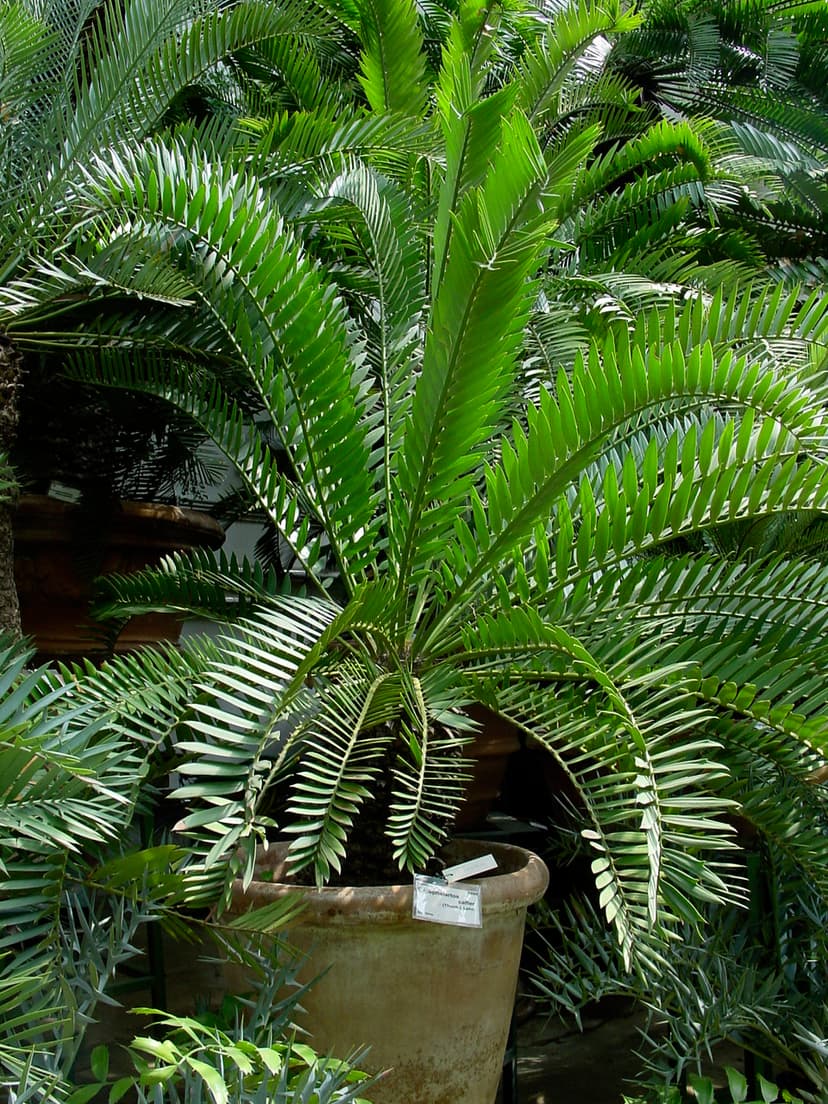
Encephalartos afer
Encephalartos afer, commonly known as the Eastern Cape dwarf cycad, is a species of cycad native to South Africa's Eastern Cape Province. This plant is characterized by its typically underground stem, from which emerge long, pinnate, dark green leaves that often have a distinctive ruffled, feathery appearance due to irregularly twisted leaflets. Both male and female plants produce reproductive cones, with females bearing scarlet-colored seeds.

Encephalartos ghellinckii
Encephalartos ghellinckii, commonly known as the Drakensberg cycad, is an evergreen species endemic to South Africa, primarily found in the Natal Drakensberg region. It thrives in diverse habitats from foothills to high elevations, including stream banks, steep grassy slopes, and sandstone outcrops, demonstrating remarkable resistance to veldfires, snow, and frost. Distinctive features include its olive to yellow-green fronds, narrow leaflets with revolute margins, and lemon-colored, woolly cones.