
Macrozamia riedlei
Jarrah forests, lateritic soils, areas near lakes or springs, and freshwater points at granitic outcrops.·Tree or trunkless low growing cycad·Insects are involved in the pollination of the female plant.
Macrozamia riedlei, commonly known as a zamia or zamia palm, is an endemic cycad species found in the forests of southwestern Australia. It typically grows as a trunkless or low-growing plant, reaching up to three meters in height, and is characterized by its glossy, palm-like fronds and large, red female cones containing edible seeds. The species plays a significant ecological role, benefiting from symbiotic nitrogen-fixing bacteria and serving as a food source for various animals, though its seeds contain toxins if not properly prepared.
Key Facts
- ›Endemic to southwestern Australia, often found in jarrah forests.
- ›Typically grows as a trunkless or low-growing cycad, reaching 0.5 to 3 meters in height.
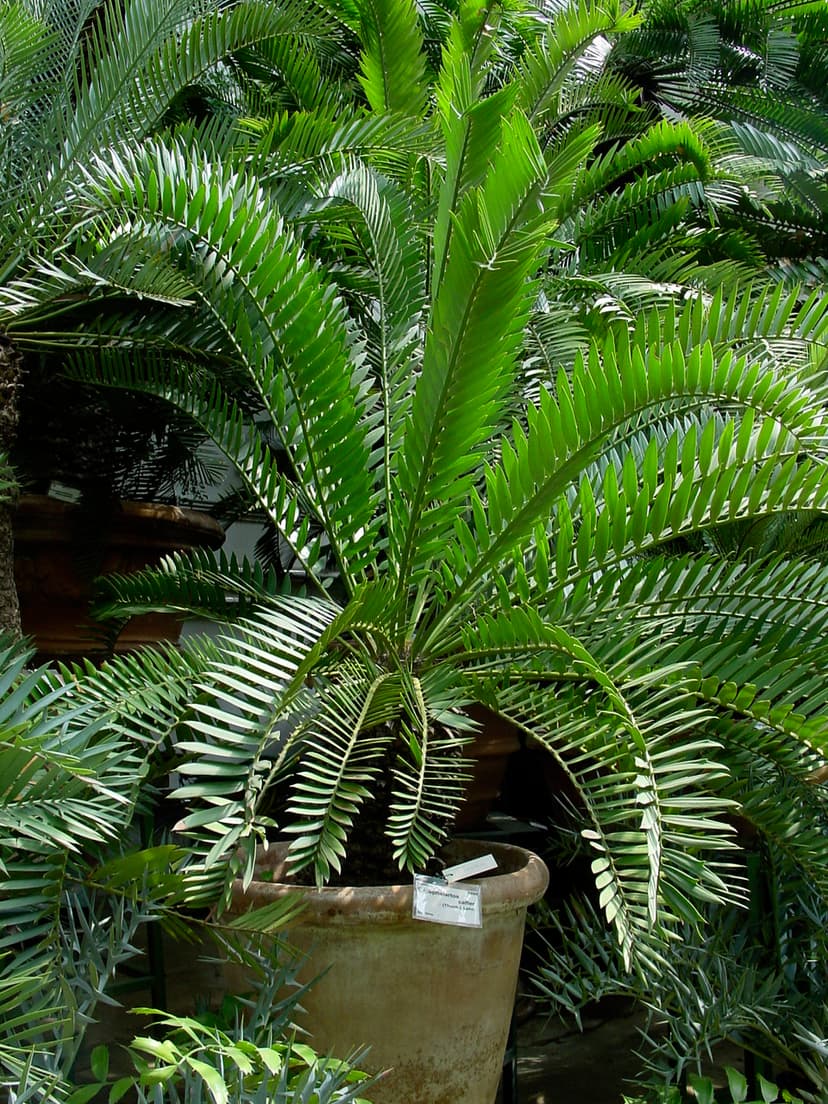
- ›Features glossy, MID- to dark-green leaves, each 1.2 to 2.2 meters long with numerous pinnae.
- ›Produces large, heavy female cones (up to 14 kg) that turn prominently red when ripe.
- ›Seeds are edible when properly prepared but contain toxic compounds if consumed raw.
- ›Benefits from a symbiotic relationship with nitrogen-fixing cyanobacteria in its root system.

Zamia, Zamia Palm, Baian, Djiriji, Koondagoor, Quinning
Southwestern Australia
- Usually trunkless
- Can attain an above-ground trunk up to two meters
- Stem provides starch used as 'bush flour' when processed
Glossy mid- to dark-green, Palm-like fronds, Each leaf reaches 1.2 to 2.2 meters long, Bearing 92–150 pinnae, Thickened mid-rib with evenly arranged pinnae
- Female cone measures 120–250 mm wide and 250–500 mm long
- Female cone weight recorded up to 14 kg
- Female cone becomes prominently red when ripe
- Male cone is smaller and remains green
- Spores contained in small box-like structures on the underside of the leaf until ripe
- Edible When Prepared Correctly
- Surrounded By Red Sarcotesta
- Contain Toxins If Unprepared
- Known As 'Nuts' Or Pauyin When Ripe and Unprepared
- Ornamental use
- Food source
- Starch from stem used as 'bush flour'
- Fronds substituted for palm fronds on Palm Sunday by the Catholic Church of Western Australia
- Poisoning of introduced mammals from ingesting leaves
- Habitat loss
- Poaching
About Macrozamia riedlei
Macrozamia riedlei, frequently identified by the common names zamia or zamia palm, is a distinctive species of cycad native to the southwestern region of Western Australia. It is an integral component of the local flora, often found thriving within the understory of jarrah forests and on lateritic soils. While typically presenting as a trunkless or low-growing plant, Macrozamia riedlei can develop an above-ground trunk reaching up to two meters in height, crowned by long, arching fronds that contribute to its overall stature.
Botanical Characteristics
The species is characterized by its glossy, mid- to dark-green leaves, which are palm-like in appearance and can extend between 1.2 to 2.2 meters in length. Each frond is supported by a thickened mid-rib, with numerous pinnae (leaflets) arranged symmetrically on either side. Macrozamia riedlei is dioecious, meaning it has separate male and female plants. The reproductive structures are notably large: the female cones can weigh up to 14 kilograms and display a striking red hue when ripe, while the male cones are smaller and remain green. The seeds, encased in a fleshy red sarcotesta, are a significant ecological feature, serving as a food source for various avian and mammalian species.
Ecology and Human Interaction
Macrozamia riedlei engages in a crucial symbiotic relationship with nitrogen-fixing cyanobacteria within its coralloid root system. These bacteria not only provide essential nitrogen but also produce toxins found throughout the plant, which can be harmful to some animals if consumed without proper preparation. Historically, Indigenous Australians developed sophisticated methods, known as mordak, to detoxify and utilize the seeds as a staple food. Conversely, early European explorers and settlers often suffered severe poisoning from ingesting unprepared seeds, leading to significant illness. The plant's toxins have also caused 'wobbles' or paralysis in cattle that have grazed on its leaves. Beyond its food potential, the starch from the plant's stem has been used as a 'bush flour,' and its fronds have been adopted by the Catholic Church in Western Australia for Palm Sunday celebrations.
Distribution and Cultivation
The natural range of Macrozamia riedlei is confined to southern Western Australia, extending from the coast eastward to Dwellingup and Albany, and also appearing on the Esperance Plains and Swan Coastal Plain. The species exhibits adaptations that allow it to recover and regrow rapidly after fires, with its root system playing a vital role in supplying nutrients for this regrowth. In cultivation, Macrozamia riedlei is valued as an ornamental plant for its attractive form and foliage. It prefers well-drained soil and is sensitive to fungal infections. While it can be slow-growing in its native habitat, it is also suitable for container planting and can tolerate low light conditions, making it a viable indoor specimen plant.
Source: Wikipedia ↗
Frequently Asked Questions
What are the common names for Macrozamia riedlei?
Macrozamia riedlei is commonly referred to as a zamia or zamia palm. Indigenous Australian names for the plant include baian, djiriji, koondagoor, and quinning.
Where is Macrozamia riedlei found naturally?
This species is endemic to the southwestern part of Western Australia. Its distribution extends from the coast eastward to areas like Dwellingup and Albany, and it is also found on the Esperance Plains and Swan Coastal Plain.
What are the distinctive features of Macrozamia riedlei's leaves and cones?
Macrozamia riedlei has palm-like leaves, each frond measuring 1.2 to 2.2 meters and bearing 92–150 pinnae. The female cones are remarkably large, measuring 250–500 mm in length and weighing up to 14 kg, turning a striking red color when mature. The male cones are smaller and remain green.
Are the seeds of Macrozamia riedlei safe to eat?
The seeds of Macrozamia riedlei contain toxins, such as macrozamin and cycasin, which can cause severe poisoning if consumed unprepared. Indigenous Australians developed methods to process the seeds, making them an important food source. European explorers often suffered poisoning due to improper preparation.
What role do bacteria play in the life of Macrozamia riedlei?
Macrozamia riedlei has a symbiotic relationship with nitrogen-fixing cyanobacteria, primarily of the genera Nostoc and Calothrix, which reside in its coralloid roots. These bacteria fix atmospheric nitrogen, providing essential nutrients to the plant and also producing toxins found throughout the plant.
How does Macrozamia riedlei adapt to its environment, such as fire?
Following fires, the weight ratio of coralloid roots to the plant's main stem increases, and nitrogen concentration in the roots is higher. This suggests that the nitrogen fixation by symbiotic bacteria helps meet the plant's nutritional needs for rapid leaf regrowth after fire events.
Related Cycad species

Encephalartos horridus
Encephalartos horridus, commonly known as the Eastern Cape blue cycad, is a distinctive, low-growing cycad native to the Eastern Cape Province of South Africa. It is recognized for its striking blue-gray, spiny leaves and typically develops a subterranean stem. This species thrives in arid shrublands and rocky ridges, exhibiting a slow growth rate and requiring specific conditions for successful cultivation.
Encephalartos afer
Encephalartos afer, commonly known as the Eastern Cape dwarf cycad, is a species of cycad native to South Africa's Eastern Cape Province. This plant is characterized by its typically underground stem, from which emerge long, pinnate, dark green leaves that often have a distinctive ruffled, feathery appearance due to irregularly twisted leaflets. Both male and female plants produce reproductive cones, with females bearing scarlet-colored seeds.

Encephalartos ghellinckii
Encephalartos ghellinckii, commonly known as the Drakensberg cycad, is an evergreen species endemic to South Africa, primarily found in the Natal Drakensberg region. It thrives in diverse habitats from foothills to high elevations, including stream banks, steep grassy slopes, and sandstone outcrops, demonstrating remarkable resistance to veldfires, snow, and frost. Distinctive features include its olive to yellow-green fronds, narrow leaflets with revolute margins, and lemon-colored, woolly cones.