
Anzu
Omnivore/Herbivore·Late Cretaceous·North America (North Dakota, South Dakota, Montana)·Bipedal
Anzu is a genus of caenagnathid dinosaur that lived in North America during the Late Cretaceous period. Known for its distinctive skull crest, toothless beak, and bird-like skeleton, Anzu was a remarkable discovery, providing the first well-preserved example of a North American oviraptorosaur.
Key Facts
- ›Lived during the Late Cretaceous period in what is now North Dakota, South Dakota, and Montana.
- ›Characterized by a toothless beak, a prominent skull crest, and bird-like skeletal features.
- ›Estimated to be among the largest North American oviraptorosaurs, reaching 3.5-3.75 meters in length and weighing 200-300 kg.
- ›Likely an omnivore or herbivore, capable of eating vegetation, small animals, and possibly eggs.
- ›The purpose of its large, thin-boned crest is speculated to have been for display, possibly for attracting mates.
- ›Fossils were found in mudstone indicating a floodplain habitat, suggesting a lifestyle different from arid-dwelling Asian oviraptorosaurs.
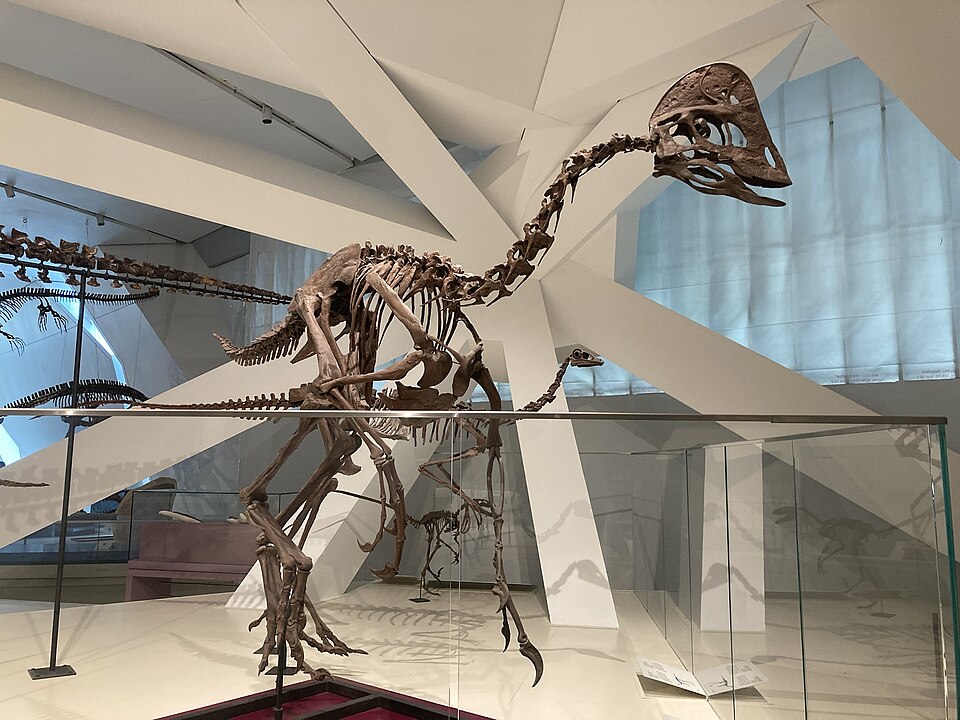
- Toothless beak
- Prominent, high crescent-like crest on the skull
- Long arms with large, curved claws
- Long, powerful legs with slender toes
- Relatively short tail
- Estimated length: 3.5–3.75 meters
- Estimated height at hips: up to 1.5 meters
- Estimated body mass: 200–300 kilograms
Caenagnathus
North America
About Anzu
Anzu is a genus of caenagnathid dinosaur that roamed North America during the Late Cretaceous period, approximately 67.2 to 66.0 million years ago. Its fossils have been unearthed in what are now North Dakota, South Dakota, and Montana, specifically within the Hell Creek Formation. The species Anzu wyliei, named in 2014, is known from numerous skeletons that have preserved both cranial and postcranial elements, making it the first well-preserved example of a North American oviraptorosaur.
Physical Characteristics and Description
Anzu wyliei was characterized by a distinctive set of features, including a toothless beak, a prominent, high crest on its skull formed by the fusion of upper jaw bones, long arms ending in large, curved claws, and long, powerful legs with slender toes. It possessed a relatively short tail and a skeleton that bore a striking resemblance to that of modern birds, though it was not an avian dinosaur. Estimates place its length at about 3.5 to 3.75 meters (11.5 to 12.3 feet), with a height of up to 1.5 meters (4.9 feet) at the hips, and a body mass of 200 to 300 kilograms (440 to 660 pounds). These dimensions made it one of the largest oviraptorosaurs found in North America.
Paleobiology and Habitat
The diet of Anzu is believed to have been omnivorous or herbivorous, with its beak not being as heavily constructed as those of its Asian oviraptorosaur relatives. This suggests a more generalized diet, potentially including vegetation, small animals, and eggs. Its fossils were discovered in mudstone, indicating a habitat within ancient floodplains, a lifestyle that differed from the arid or semi-arid environments inhabited by its Asian counterparts. The purpose of Anzu's large, thin-boned crest remains a subject of speculation, but it is theorized to have been used for display, possibly to attract mates, similar to the crests seen in modern cassowaries. Evidence of healed injuries, such as a broken rib and an arthritic toe, has also been found in fossil specimens, suggesting potential interactions with predators or intraspecific conflict.
Classification and Significance
Anzu belongs to the Oviraptorosauria, a group of theropod dinosaurs, and is classified within the family Caenagnathidae. Cladistic analyses suggest it may have been a sister species to Caenagnathus. The discovery of Anzu was of significant scientific value, as it finally provided concrete fossil evidence to illustrate the appearance and biology of North American oviraptorosaurs, whose presence on the continent had previously only been known from fragmentary remains. This finding helped clarify evolutionary relationships within the group, indicating closer ties among North American oviraptorosaurs than to their Asian counterparts. Despite its bird-like features, Anzu's lineage became extinct during the Cretaceous–Paleogene extinction event 66 million years ago, alongside all other known non-avian dinosaurs.
Source: Wikipedia ↗
Frequently Asked Questions
What is Anzu?
Anzu is a genus of caenagnathid dinosaur that lived in North America during the Late Cretaceous period. It is notable for being the first well-preserved North American oviraptorosaur, providing significant insights into the group's appearance and biology.
When did Anzu live?
Anzu lived during the Late Cretaceous period, specifically the upper Maastrichtian stage, approximately 67.2 to 66.0 million years ago.
What did Anzu look like?
Anzu possessed a toothless beak, a large, thin-boned crest on its skull, long arms with large claws, and powerful legs with slender toes. It had a bird-like skeleton and was relatively large for a North American oviraptorosaur.
What did Anzu eat?
Anzu was likely an omnivore or herbivore. Its jaw morphology suggests it could consume a variety of food items, including vegetation, small animals, and possibly eggs.
Where were Anzu fossils found?
Fossils of Anzu have been discovered in North Dakota, South Dakota, and Montana, primarily within the Hell Creek Formation.
What is the meaning of the name Anzu?
The genus name 'Anzu' is derived from Anzû, a bird-like daemon in ancient Mesopotamian religion. The specific name 'wyliei' honors Wylie J. Tuttle, the grandson of a museum donor.
What was the purpose of Anzu's crest?
The exact purpose of Anzu's large, cranial crest is unknown, but it is speculated to have been used for display, possibly to attract mates, similar to the crests of modern cassowaries.
Related Dinosaur species

Asilisaurus
Asilisaurus is an extinct genus of silesaurid archosaur from the Middle Triassic period, known from fossils found in Tanzania. It is considered one of the oldest known members of the Avemetatarsalia, the group of animals that includes dinosaurs and pterosaurs. Its discovery has provided valuable insights into the early evolution of dinosaurs and the diversification of archosaurs.

Abelisaurus
Abelisaurus was a genus of predatory theropod dinosaur that lived in South America during the Late Cretaceous Period. Known primarily from a partial skull, it is estimated to have been a bipedal carnivore reaching around 7.4 meters in length.

Acheroraptor
Acheroraptor is an extinct genus of dromaeosaurid theropod dinosaur that lived in North America during the Late Cretaceous period. It is known from fossil remains discovered in the Hell Creek Formation of Montana, United States. Acheroraptor is notable for being one of the geologically youngest dromaeosaurids, existing just before the Cretaceous-Paleogene extinction event.