
Australovenator
Australovenator, meaning "southern hunter," was a megaraptoran theropod dinosaur that lived in Australia during the Late Cretaceous period. It is the most complete predatory dinosaur discovered in Australia, known from partial cranial and postcranial remains. Its flexible arms and hands were adapted for prey capture, and it is thought to have been a fast-running predator.
Key Facts
- ›Australovenator was a megaraptoran theropod dinosaur from Australia.
- ›It lived during the Late Cretaceous period, approximately 95 million years ago.
- ›It is the most complete predatory dinosaur discovered in Australia.
- ›Estimated to be around 6 meters (20 ft) long and weighing between 310-500 kg.
- ›Possessed flexible arms and hands adapted for grasping prey.
- ›Likely capable of running at speeds approaching 30 mph (48 km/h).

- Estimated length of around 6 meters.
- Estimated body mass between 310-500 kg.
- Flexible arms with a wide range of motion for grasping prey.
- Fingers capable of extension beyond those of most other theropods.
- Gracile skull morphology.
- Potentially splayed phalanx ii-3 in the foot, possibly from kicking motions.
Fukuiraptor, Rapator
Australia
About Australovenator
Australovenator, a name meaning "southern hunter," was a genus of megaraptoran theropod dinosaur that roamed the Australian continent during the Late Cretaceous period, approximately 95 million years ago. It is particularly significant as the most complete predatory dinosaur ever discovered in Australia, with its remains providing valuable insights into the theropod fauna of the region. Some fossil evidence suggests that certain specimens from earlier geological periods, the Albian-aged Eumeralla and Wonthaggi Formations, might also belong to Australovenator.
Discovery and Naming
The holotype specimen of Australovenator, nicknamed "Banjo" after Banjo Paterson, was unearthed alongside the sauropod Diamantinasaurus matildae at the "Matilda site." The initial description of these partial cranial and postcranial remains was published in 2009 by paleontologist Scott Hocknull and his colleagues. The type species, A. wintonensis, references the nearby town of Winton. Excavation and analysis of the holotype have been ongoing, with new elements of the skeleton being described in subsequent years, contributing to a more comprehensive understanding of this dinosaur.
Physical Characteristics and Adaptations
Australovenator is estimated to have been around 6 meters (20 feet) in length, with a body mass ranging from 310 to 500 kilograms (680 to 1,100 lb). Its lightweight build led to it being dubbed the "cheetah of its time," with estimates suggesting it could run at speeds approaching 30 mph (48 km/h). Like other megaraptorans, it was a bipedal carnivore. Research has highlighted the remarkable flexibility of its arms and hands, which featured an extensive range of motion and fingers capable of significant extension. This adaptation is believed to have been crucial for prey capture, allowing Australovenator to grasp and disembowel its food effectively, complementing its relatively weaker jaws. The gracile morphology of its skull further supports this specialization for predatory arm use.
Palaeobiology and Palaeoecology
Studies focusing on Australovenator's appendages have revealed unique biomechanical features. Its forearms exhibited an elbow range of motion comparable to maniraptoriforms, with the radius capable of sliding independently of the ulna, a trait more akin to birds than most non-avian dinosaurs. The exceptional flexibility of its fingers, surpassed by few other theropods, played a vital role in its hunting strategy. Investigations into its feet have also provided insights into soft tissue reconstruction and its influence on limb flexibility, crucial for accurate paleontological analysis. Furthermore, research on artificial footprints created from reconstructed Australovenator feet has helped clarify the origin of controversial trackways, suggesting they were likely made by a theropod dinosaur rather than an ornithopod.
Australovenator fossils were recovered from deposits interpreted as an oxbow lake or billabong, indicating its presence in a diverse ecosystem. The Winton Formation fauna included various other dinosaurs such as sauropods and ankylosaurians, along with lungfish, turtles, crocodilians, and pterosaurs. Plant life consisted of ferns, ginkgoes, gymnosperms, and angiosperms, painting a picture of a rich prehistoric environment.
Source: Wikipedia ↗
Frequently Asked Questions
What does the name Australovenator mean?
The name Australovenator means "southern hunter." This name reflects its discovery in Australia and its predatory nature.
When did Australovenator live?
Australovenator lived during the Late Cretaceous period, specifically in the Cenomanian age, approximately 95 million years ago. Some specimens may also belong to the earlier Albian age.
What is Australovenator known for?
Australovenator is notable for being the most complete predatory dinosaur discovered in Australia. Its well-preserved hand and foot remains have been the subject of various research studies.
How big was Australovenator?
Estimates suggest Australovenator was around 6 meters (20 feet) long. Its body mass is estimated to have been between 310 and 500 kilograms (680 to 1,100 lb).
What did Australovenator eat?
Australovenator was a carnivore. Its physical adaptations, particularly its flexible arms and hands, suggest it was specialized for prey capture.
Where were Australovenator fossils found?
The primary discovery location for Australovenator fossils is the Winton Formation in Australia. Some specimens may also come from the Eumeralla and Wonthaggi Formations.
Related Dinosaur species

Diamantinasaurus
Diamantinasaurus is a genus of titanosaurian sauropod dinosaur discovered in Australia, living approximately 94 million years ago during the early Late Cretaceous period. Named "Diamantina lizard" after the nearby river and the Greek word for lizard, its species name honors the Australian song "Waltzing Matilda". Fossil discoveries have provided significant insight into its anatomy, including its forelimbs, hindlimbs, and skull.
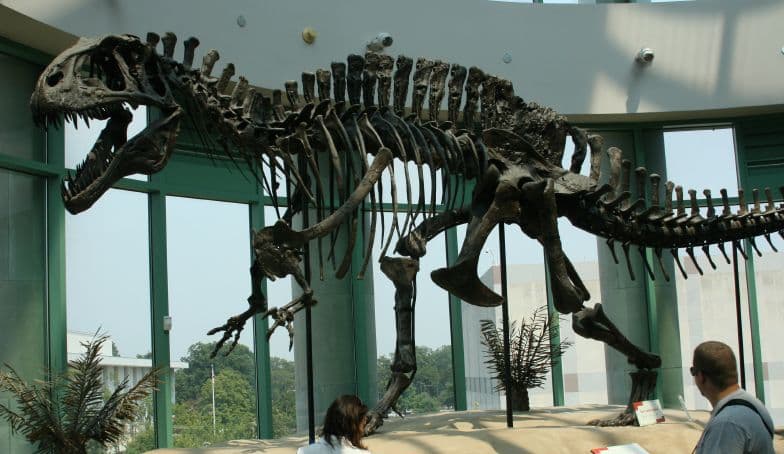
Acrocanthosaurus
Acrocanthosaurus is a genus of large theropod dinosaurs that roamed North America during the Early and Late Cretaceous periods. Known for its distinctive high neural spines along its back, it was one of the largest predators in its ecosystem, likely preying on large herbivores.

Afromimus
Afromimus tenerensis is a genus of theropod dinosaur from the Early Cretaceous period, discovered in Niger. Initially classified as an ornithomimosaur, later analyses suggest it belongs to the Abelisauroidea superfamily, possibly within the Noasauridae family. Its fossils indicate an adult size of approximately 4.14 meters in length.