
Brontosaurus
Brontosaurus was a genus of large, herbivorous sauropod dinosaurs that lived during the Late Jurassic period in what is now the United States. Known for its long neck, quadrupedal stance, and whip-like tail, it was a prominent figure in popular culture as the archetypal "long-necked" dinosaur. While historically considered a synonym of Apatosaurus, recent studies have re-established Brontosaurus as a distinct genus.
Key Facts
- ›Lived during the Late Jurassic period, approximately 156 to 146 million years ago.
- ›Fossils have been discovered in the Morrison Formation of Utah and Wyoming, USA.
- ›Characterized by a long neck, sturdy quadrupedal build, and a whip-like tail.
- ›Estimated to reach lengths of up to 21-23 meters (69-75 feet) and weigh 15-20 tons.
- ›Belongs to the family Diplodocidae and the subfamily Apatosaurinae.
- ›Its scientific name, Brontosaurus, translates to 'thunder lizard'.

- Large size, with some species reaching up to 21-23 meters in length.
- Long, muscular neck.
- Quadrupedal stance with forelimbs shorter than hindlimbs.
- Long tail that terminated in a whip-like structure.
- Robust cervical vertebrae, sturdier than those of its relatives.
- Single large claw on each forelimb.
Apatosaurus, Diplodocus, Barosaurus
United States
About Brontosaurus
Brontosaurus is a genus of large, herbivorous sauropod dinosaurs that roamed North America during the Late Jurassic period, approximately 156 to 146 million years ago. The name Brontosaurus, meaning "thunder lizard" from Greek, reflects its imposing size and the impression its movement might have made. For many years, scientists debated whether Brontosaurus was distinct from its close relative Apatosaurus, with many considering it a junior synonym. However, a significant study in 2015 re-established Brontosaurus as a valid genus based on detailed anatomical analysis.
Anatomy and Lifestyle
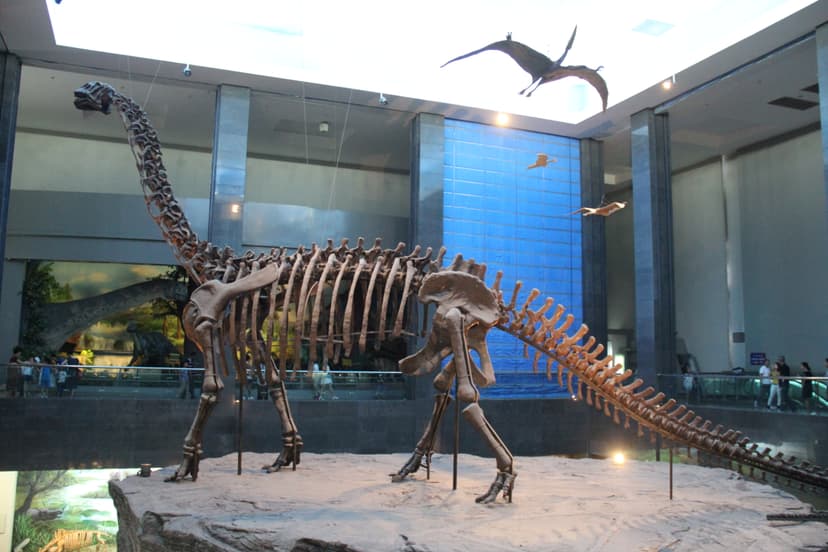
Fossil evidence reveals Brontosaurus as a quadrupedal animal characterized by a long, graceful neck, a massive body, and a lengthy tail that likely ended in a whip-like extremity. Its forelimbs were shorter and stouter than its elongated hindlimbs. The cervical vertebrae of Brontosaurus were notably robust, differing from those of more lightly built relatives like Diplodocus and Barosaurus. While the exact skull has not been definitively found and associated, it is presumed to have been similar to that of Apatosaurus, with small size relative to the body and spatulate, chisel-like teeth adapted for stripping vegetation. The largest species, B. excelsus, is estimated to have reached lengths of up to 21–23 meters (69–75 feet) and weighed between 15 to 20 metric tons (17 to 22 short tons).
Discovery and Classification
The genus Brontosaurus was first described by American paleontologist Othniel Charles Marsh in 1879, based on a partial skeleton recovered from the Morrison Formation at Como Bluff, Wyoming. The type species, B. excelsus, was among the most complete sauropod skeletons known at the time. The Morrison Formation, a rich source of dinosaur fossils, indicates that Brontosaurus coexisted with a diverse array of other dinosaurs, including other sauropods like Diplodocus and Brachiosaurus, as well as ornithischians such as Stegosaurus and carnivorous theropods like Allosaurus. Brontosaurus belongs to the family Diplodocidae and the subfamily Apatosaurinae, a group known for its sturdy build and thick necks.
Cultural Impact
Brontosaurus has achieved iconic status in popular culture, often serving as the archetypal image of a "long-necked" dinosaur in media, illustrations, and toys. Its widespread recognition predates the taxonomic debate over its genus status, cementing its place in the public imagination as a distinct and magnificent prehistoric creature.
Source: Wikipedia ↗
Frequently Asked Questions
What does the name Brontosaurus mean?
The name Brontosaurus is derived from ancient Greek words. 'Brontē' means 'thunder' and 'sauros' means 'lizard', so Brontosaurus literally translates to 'thunder lizard'.
When did Brontosaurus live?
Brontosaurus lived during the Late Jurassic period, specifically between 156 and 146 million years ago. This places it among dinosaurs that roamed the Earth during the Kimmeridgian and Tithonian ages.
Where were Brontosaurus fossils found?
The primary discovery location for Brontosaurus fossils is the Morrison Formation in the United States. Specifically, significant remains have been unearthed in Como Bluff, Wyoming, and other parts of Utah and Wyoming.
What did Brontosaurus eat?
Brontosaurus was a herbivore, meaning it subsisted on plants. Its spatulate (chisel-like) teeth were adapted for herbivory, and it likely consumed vegetation from its environment.
How large was Brontosaurus?
Brontosaurus was a very large dinosaur. The largest species, B. excelsus, could reach lengths of 21 to 23 meters (69 to 75 feet) and weigh between 15 to 20 metric tons.
Is Brontosaurus a valid dinosaur genus?
For many years, Brontosaurus was considered a synonym of Apatosaurus. However, a 2015 study re-evaluated the evidence and concluded that Brontosaurus is a distinct and valid genus, though some paleontologists still debate this classification.
Related Dinosaur species

Alcovasaurus
Alcovasaurus is an extinct genus of herbivorous stegosaurian dinosaur that lived during the Late Jurassic period. Originally described as Stegosaurus longispinus, it was later reclassified into its own genus due to unique characteristics, particularly its exceptionally long tail spines. Its exact taxonomic placement has been debated, with some researchers considering it a distinct genus and others suggesting it might be a species of Miragaia.

Amphicoelias
Amphicoelias was a genus of herbivorous sauropod dinosaur that roamed the Earth approximately 150 million years ago during the Late Jurassic period. Known from fossils found in Colorado, United States, it was moderately sized, with estimated lengths of around 18 meters and a body mass of 15 metric tons. Its anatomy, particularly its vertebrae and limb bones, shares similarities with its close relative, Diplodocus.
Angustungui
"Angustungui" is an informal genus of stegosaur that lived during the Late Jurassic period in what is now China. The name and its intended type species, "A. qiketaiensis," were announced in a biorxiv pre-print article in October 2024. The fossils, discovered in 2016, include axial, pectoral girdle, pelvic girdle, limb, and armor elements.