
Ceratonykus
Ceratonykus is a genus of alvarezsaurid dinosaur from the Late Cretaceous period of Mongolia. Known from fragmentary remains, it is characterized by its small size, estimated to be around 75 centimeters in length and weighing less than a kilogram. Its scientific name, "horned claw," refers to its presumed sharp claws, and "big-eyed" points to its large orbits.
Key Facts
- ›Ceratonykus lived during the Late Cretaceous period in what is now Mongolia.
- ›It was a small dinosaur, with estimated lengths around 75 cm and weights of 760 grams.
- ›The genus is known from a fragmentary skeleton, including an incomplete skull.
- ›Its scientific name means "horned claw," referencing its presumed sharp claws.
- ›The classification of alvarezsaurs, including Ceratonykus, has been debated, with some questioning their placement within Theropoda.
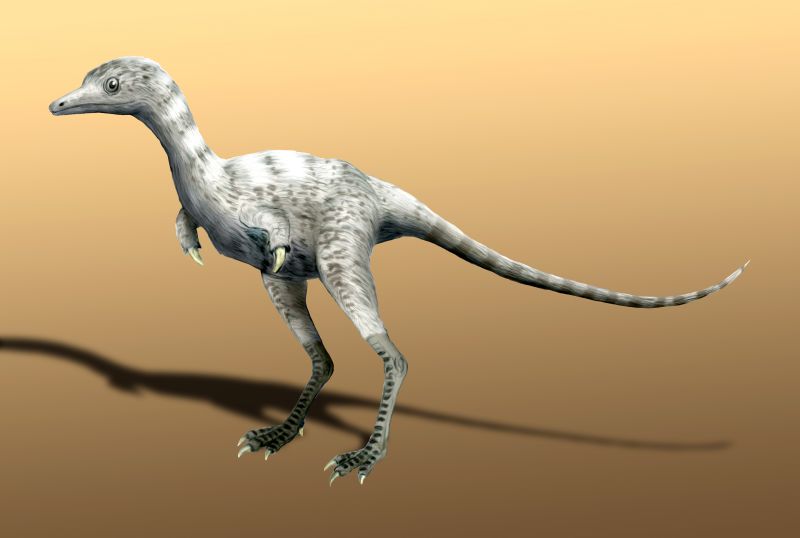
Estimated Length of 75 Centimeters, Estimated Weight of 760 Grams, Long, Preorbital Skull Region, Large Orbits, Deep Occipital Region, Specialized Forelimb and Hindlimb Elements
Mononykus, Parvicursor, Linhenykus, Shuvuuia, Xixianykus, Albinykus
Asia
About Ceratonykus
Ceratonykus is a genus of alvarezsaurid dinosaur that inhabited the Earth during the Late Cretaceous period. The only known species, Ceratonykus oculatus, is named for its "horned claw" and "big-eyed" features, reflecting its presumed sharp claws and large orbits. Fossils of this small dinosaur were discovered in what is now the Barun Goyot Formation in Mongolia.
Discovery and Naming
The partial skeleton of Ceratonykus was unearthed in 2003 at the Khermiin Tsav locality in Mongolia by Otkhoon Zhargal. The specimen, consisting of an incomplete skull, vertebrae, and limb bones, was formally described in 2009 by Vladimir Alifanov and Rinchen Barsbold. The discoverers initially proposed a controversial reclassification of alvarezsaurs, suggesting they might be ornithischians rather than theropods, a view that has not gained widespread acceptance.
Description and Paleobiology
Ceratonykus was a diminutive dinosaur, with estimates placing its length at around 75 centimeters (2.46 feet) and its weight at approximately 760 grams (1.68 pounds). Its skull featured a narrow, extended rostrum, deep occipital region, and notably large orbits, suggesting keen eyesight. The braincase reveals specialized structures, including large optic lobes displaced ventrolaterally and a complex cerebellum, which have led to hypotheses about arboreal ancestry and sophisticated locomotor abilities, such as jumping. The forelimbs and hindlimbs also display adaptations characteristic of alvarezsaurs.
Paleoenvironment
Fossils of Ceratonykus were found within the Barun Goyot Formation, dating to the Maastrichtian stage of the Late Cretaceous. This formation indicates a paleoenvironment that was semi-arid, receiving significant rainfall and characterized by alternating dune deposits and interdune lakes. The fauna of this formation was diverse, including other dinosaurs like ankylosaurids, ceratopsians, and dromaeosaurids, as well as early birds.
Source: Wikipedia ↗
Frequently Asked Questions
What does the name Ceratonykus mean?
The name Ceratonykus is derived from Greek words "ceratinus" meaning "horned" and "onyx" meaning "claw." The specific name, oculatus, is Latin for "sharp-sighted" or "big-eyed."
When and where did Ceratonykus live?
Ceratonykus lived during the Late Cretaceous period, specifically the Maastrichtian stage, in what is now the Barun Goyot Formation of Mongolia.
What was the estimated size of Ceratonykus?
Estimates for Ceratonykus vary slightly, but it was a very small dinosaur, with lengths around 75 centimeters (2.46 feet) and weights of approximately 760 grams (1.68 pounds).
What kind of dinosaur was Ceratonykus?
Ceratonykus is classified as an alvarezsaurid dinosaur. This group is known for their small size and distinctive, often robust, forelimbs.
What is known about the physical characteristics of Ceratonykus?
Ceratonykus had a long, narrow skull region, large orbits, and a deep occipital region. Its postcranial skeleton shows features typical of alvarezsaurs, including specialized forelimb elements and hindlimbs adapted for locomotion.
What is the fossil record for Ceratonykus like?
The fossil record for Ceratonykus is considered fragmentary, consisting of an incomplete skeleton of an adult individual, including parts of the skull and postcranial elements.
Related Dinosaur species

Aepyornithomimus
Aepyornithomimus is a genus of ornithomimid theropod dinosaur that lived during the Late Cretaceous period, approximately 75 million years ago. Its fossils were discovered in the Djadochta Formation of Mongolia, an area believed to have been a desert at the time. The genus name "Aepyornithomimus" means "Aepyornis mimic," referencing its foot structure, and the species name "tugrikinensis" refers to its discovery location.

Amtocephale
Amtocephale is a genus of pachycephalosaurid dinosaur discovered in the southern Gobi Desert of Mongolia. Known from a nearly complete frontoparietal dome, it represents a subadult individual. Amtocephale is considered a potentially very old representative of its family, dating back to the early Late Cretaceous period.

Achillobator
Achillobator was a large, heavily-built dromaeosaurid theropod dinosaur that inhabited Mongolia during the Late Cretaceous period. It is distinguished by its robust skeleton, deep maxilla, and primitive pelvis, contrasting with the generally lighter build of other dromaeosaurids. This predator likely hunted large prey using its enlarged sickle claw.