
Chungkingosaurus
Herbivore·Late Jurassic·Chongqing, China·Quadrupedal
Chungkingosaurus was a genus of stegosaurian dinosaur that lived during the Late Jurassic period in what is now China. It is known for its relatively small size compared to other stegosaurs and its unique tail spike arrangement. Chungkingosaurus was a herbivore and likely coexisted with other large plant-eating dinosaurs and was potentially preyed upon by theropods.
Key Facts
- ›Chungkingosaurus lived during the Late Jurassic epoch.
- ›Fossils were discovered near Chongqing, China.
- ›It was a herbivore, feeding on plants.
- ›The dinosaur had two rows of plates and spikes on its back.
- ›Its tail featured a unique 'pin-cushion array' of spikes.
- ›Chungkingosaurus was relatively small for a stegosaur.
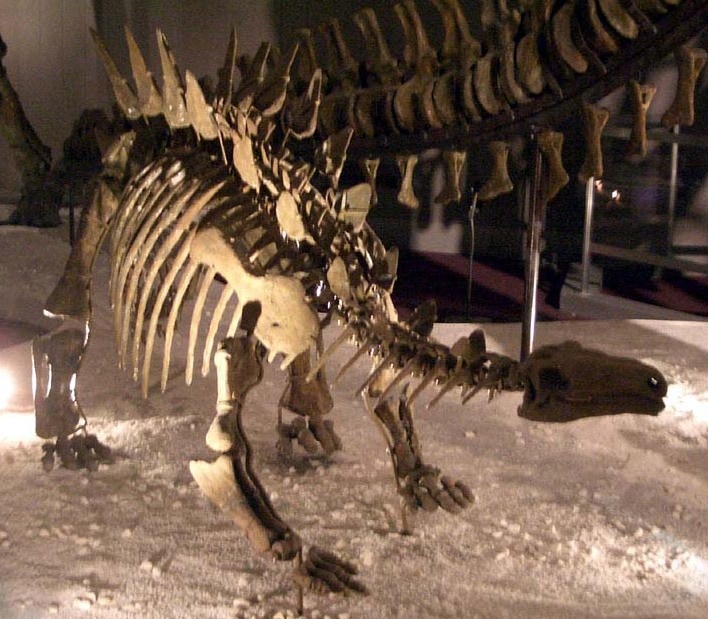
- Smallest stegosaurs, with adults less than four meters in length.
- Two rows of plates and spikes on its back, arranged in pairs.
- Deep snout and front lower jaws, resulting in a relatively high and narrow skull.
- Non-overlapping teeth with less pronounced denticles.
- Tail weapon with two pairs of obliquely vertical, stout spikes, and an additional pair of long, thin, horizontally oriented spikes at the very tail end.
Tuojiangosaurus, Chialingosaurus
China
About Chungkingosaurus
Chungkingosaurus is a genus of stegosaurian dinosaur that roamed the Earth during the Late Jurassic epoch. Its fossils were unearthed near Chongqing, China, giving the dinosaur its name, which translates to "Chongqing Lizard." This herbivorous dinosaur is notable for its relatively small size compared to other members of the Stegosauria family.
Description and Anatomy
Chungkingosaurus is considered one of the smaller stegosaurs, with adult specimens estimated to be less than four meters in length, even when fully grown. Anatomically, it bore a resemblance to Tuojiangosaurus, another stegosaur found in the same geological formation. Distinctive features include a smaller overall size, a deeper snout, and a relatively high and narrow skull. Its teeth were non-overlapping and had less pronounced denticles. Like other stegosaurs, Chungkingosaurus likely possessed two rows of plates and spikes along its back, though the exact number is not precisely known. A notable feature is its unique tail weapon, known as a thagomizer, which featured two pairs of stout spikes and an additional pair of long, thin spikes oriented horizontally, creating what has been described as a "pin-cushion array."
Discovery and Classification
Fossils of Chungkingosaurus were first discovered and excavated from the Upper Shaximiao Formation near Chongqing starting in 1977. The type species, Chungkingosaurus jiangbeiensis, was formally described and named in 1983 by paleontologists Dong Zhiming, Zhou Shiwu, and Zhang Yihong. Initially, the genus was placed within the Stegosaurinae. Later classifications considered it a basal member of the Stegosauria, and in 2008, it was assigned to the Huayangosauridae family. While some debate has occurred regarding the validity of certain species and their classification, Chungkingosaurus is generally recognized as a distinct genus.
Paleobiology and Ecology
As a herbivore, Chungkingosaurus subsisted on plant matter. It is believed to have shared its habitat with a diverse array of other dinosaurs, including large plant-eaters such as Chialingosaurus, Tuojiangosaurus, Mamenchisaurus, and Omeisaurus. Its defensive adaptations, particularly the formidable tail spikes, suggest it was preyed upon by large theropod dinosaurs, with Yangchuanosaurus being a potential predator in the same ecosystem.
Source: Wikipedia ↗
Frequently Asked Questions
When did Chungkingosaurus live?
Chungkingosaurus lived during the Late Jurassic period. This geological period spans from approximately 163.5 to 145 million years ago.
Where were Chungkingosaurus fossils found?
Fossils of Chungkingosaurus were discovered near Chongqing, China. These fossils were found in the Upper Shaximiao Formation.
What did Chungkingosaurus eat?
Chungkingosaurus was a herbivore, meaning its diet consisted of plants. It likely grazed on vegetation available in its environment.
What are the defining physical characteristics of Chungkingosaurus?
Chungkingosaurus was one of the smaller stegosaurs, with adults measuring less than four meters in length. It possessed two rows of plates and spikes on its back and a distinctive tail weapon with multiple pairs of spikes, described as a 'pin-cushion array'.
What is the meaning of the name Chungkingosaurus?
The name Chungkingosaurus means 'Chongqing Lizard'. The generic name refers to the city of Chongqing, where its fossils were found, and the specific name, jiangbeiensis, refers to the Jiangbei district.
What other dinosaurs might Chungkingosaurus have lived with?
Chungkingosaurus is thought to have coexisted with other large plant-eaters and stegosaurids such as Chialingosaurus, Tuojiangosaurus, Mamenchisaurus, and Omeisaurus. It may have also been preyed upon by theropods like Yangchuanosaurus.
Related Dinosaur species

Alcovasaurus
Alcovasaurus is an extinct genus of herbivorous stegosaurian dinosaur that lived during the Late Jurassic period. Originally described as Stegosaurus longispinus, it was later reclassified into its own genus due to unique characteristics, particularly its exceptionally long tail spines. Its exact taxonomic placement has been debated, with some researchers considering it a distinct genus and others suggesting it might be a species of Miragaia.

Amphicoelias
Amphicoelias was a genus of herbivorous sauropod dinosaur that roamed the Earth approximately 150 million years ago during the Late Jurassic period. Known from fossils found in Colorado, United States, it was moderately sized, with estimated lengths of around 18 meters and a body mass of 15 metric tons. Its anatomy, particularly its vertebrae and limb bones, shares similarities with its close relative, Diplodocus.
Angustungui
"Angustungui" is an informal genus of stegosaur that lived during the Late Jurassic period in what is now China. The name and its intended type species, "A. qiketaiensis," were announced in a biorxiv pre-print article in October 2024. The fossils, discovered in 2016, include axial, pectoral girdle, pelvic girdle, limb, and armor elements.