
Convolosaurus
Herbivore·Cretaceous·Comanche County, Texas, USA·Bipedal
Convolosaurus is a genus of basal ornithopod dinosaur that lived during the Aptian stage of the Early Cretaceous period. Its name, meaning "flocking lizard," refers to the significant discoveries of juvenile fossils found together. The most complete fossils were unearthed in Comanche County, Texas, providing a substantial understanding of its anatomy.
Key Facts
- ›Fossils of Convolosaurus were discovered in the Twin Mountains Formation in Comanche County, Texas.
- ›The genus name "Convolosaurus" translates to "flocking lizard" due to the discovery of many juvenile fossils concentrated together.
- ›The type species, Convolosaurus marri, was named in 2019 by Andrzejewski, Winkler, and Jacobs.
- ›The holotype specimen is a partial skeleton with a skull, representing a subadult individual.
- ›Almost the entire skeleton of Convolosaurus is now known from numerous specimens, ranging from juveniles to subadults.
- ›Convolosaurus is considered a basal ornithopod, positioned evolutionarily between Hypsilophodon and Thescelosaurus.
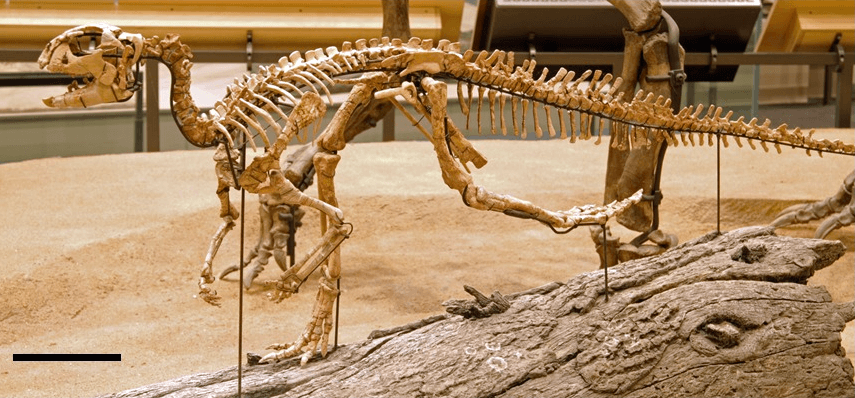
- Estimated length of 2.5-3 meters.
- Premaxilla bears four teeth with a vertical trough on the outside.
- Upper rim of the eye socket covered by two supraorbitals.
- Roots of maxillary teeth are curved.
- Neck vertebrae are opisthocoelous.
- Sacral vertebrae neural spines are twice the height of the vertebral body.
- Ischium has an expanded rear end forming a "foot".
- Shallow groove between the condyles of the thighbone.
- Prepubic process of the pubic bone is transversely flattened.
Hypsilophodon, Thescelosaurus
North America
About Convolosaurus
Convolosaurus is a genus of basal ornithopod dinosaur that roamed the Earth during the Aptian stage of the Early Cretaceous period. Its scientific name, derived from the Latin "convolare" meaning "to flock," reflects the significant discovery of numerous juvenile fossils found concentrated together at its primary excavation site.
Discovery and Naming
The most notable fossils of Convolosaurus were discovered in 1985 at a rich fossil site near Proctor Lake in Comanche County, Texas. This site, located within the Twin Mountains Formation, yielded a remarkable abundance of specimens. The genus and type species, Convolosaurus marri, were formally described and named in 2019 by paleontologists Kate A. Andrzejewski, Dale A. Winkler, and Louis Leo Jacobs. The specific epithet "marri" honors Dr. Ray H. Marr for his contributions to vertebrate paleontology at Southern Methodist University.
Anatomy and Characteristics
The holotype specimen of Convolosaurus marri is a partial skeleton including a skull, representing a subadult individual. This specimen, along with hundreds of other referred fossils from at least twenty-nine individuals, has allowed for a nearly complete reconstruction of the dinosaur's skeleton. The holotype individual was estimated to be between 2.5 and 3 meters (8.2 to 9.8 feet) in length, though the adult size remains unknown. Distinctive features include four teeth on the premaxilla, each possessing a vertical trough on the outer side, and the presence of two supraorbitals that fully covered the upper rim of the eye socket. Other derived traits include curved maxillary tooth roots and an expanded "foot" at the rear end of the ischium.
Phylogeny and Classification
Initially, Convolosaurus was thought to belong to the Hypsilophodontidae, a group now considered invalid. However, phylogenetic analyses in 2019 placed Convolosaurus in a basal position within the Ornithopoda, situated evolutionarily between Hypsilophodon and Thescelosaurus. This placement was supported by shared traits, such as the two supraorbitals, which indicated a reversal of previous assumptions about the evolutionary relationships between these genera.
Source: Wikipedia ↗
Frequently Asked Questions
What does the name Convolosaurus mean?
The name Convolosaurus means "flocking lizard." This name was chosen because a large number of juvenile fossils were found concentrated in one area, suggesting they may have lived or died together in groups.
When and where did Convolosaurus live?
Convolosaurus lived during the Aptian stage of the Early Cretaceous period. Its fossils have been found in Comanche County, Texas, specifically in the Twin Mountains Formation.
How large was Convolosaurus?
The holotype individual, which was a subadult, had an estimated length of between 2.5 and 3 meters (8.2 to 9.8 feet). The adult size is not precisely known, as the specimen was not fully grown.
What are some distinctive physical features of Convolosaurus?
One unique feature is that the premaxilla has four teeth, each with a vertical trough on the outside. Additionally, Convolosaurus possessed two supraorbitals that covered the entire upper rim of the eye socket, a trait shared with Thescelosaurus.
What is the evolutionary classification of Convolosaurus?
Convolosaurus is classified as a basal ornithopod. Its evolutionary position is considered to be between the genera Hypsilophodon and Thescelosaurus.
How complete is the fossil record for Convolosaurus?
The fossil record for Convolosaurus is exceptionally good. Nearly the entire skeleton is known, with hundreds of specimens representing at least twenty-nine individuals of various ages, from juveniles to subadults.
Related Dinosaur species

Albertadromeus
Albertadromeus is an extinct genus of herbivorous dinosaur from the Late Cretaceous period, known from Alberta, Canada. It was a small, bipedal runner, likely specialized in eating ferns and low vegetation. The genus contains a single species, Albertadromeus syntarsus.

Alxasaurus
Alxasaurus is a genus of therizinosauroid theropod dinosaur that lived during the Early Cretaceous period. Known from five specimens discovered in Inner Mongolia, it possessed features characteristic of later therizinosaurs, such as a short tail and long hand claws, and is believed to have been a bipedal herbivore. Its discovery helped solidify the understanding of therizinosaurs as derived theropods rather than basal sauropodomorphs.

Changchunsaurus
Changchunsaurus is a small, herbivorous dinosaur that lived during the Early to Late Cretaceous period in what is now China. It is known for its unique combination of primitive and derived ornithopod features, including its small size and a distinctive "nubble structure" on its cheekbone. The genus holds the distinction of being the first named dinosaur from the Jilin region of China.