
Daliansaurus
Daliansaurus is a small, feathered troodontid dinosaur that lived in China during the Early Cretaceous period. It is distinguished by its enlarged claw on the fourth toe, in addition to the typical sickle claw on the second toe found in many paravians. This dinosaur was part of the Sinovenatorinae subfamily, living alongside its closest relatives in a volcanically influenced, cold-climate region.
Key Facts
- ›Daliansaurus was a small troodontid dinosaur, measuring about 1 meter (3 ft 3 in) in length.
- ›It is known from a single, nearly complete skeleton preserved in three dimensions.
- ›A unique feature of Daliansaurus is an enlarged claw on its fourth toe, in addition to the typical sickle claw on the second toe.
- ›The dinosaur possessed long metatarsal bones, suggesting good running capabilities.
- ›Daliansaurus lived in the Lujiatun Beds of the Yixian Formation in China during the Early Cretaceous.
- ›It is classified within the Sinovenatorinae subfamily, alongside Sinovenator, Sinusonasus, and Mei.

- Small, lightly-built theropod dinosaur.
- Approximately 1 meter in length.
- Enlarged claw on the fourth toe of the foot.
- Long metatarsal bones.
- Bird-like uncinate processes on ribs.
- Proportionally larger skull than Mei.
- Smaller nostril than Mei.
- Flattened projection of the premaxilla above the nostril.
- Straight projection below the nostril.
- Straight bottom edge of the lower jaw.
- Fewer tooth positions in the lower jaw compared to Sinovenator.
- Relatively long humerus.
- First metacarpal bone strongly curved.
- Second metacarpal shorter than the third.
- Proportionally larger ilium compared to femur.
- Tibia about 1.4 times the length of the femur.
- Second metatarsal shorter than the fourth.
- Possesses a beak-like snout.
Sinovenator, Sinusonasus, Mei, Sinornithoides, Velociraptor, Linheraptor, Heyuannia, Tochisaurus, Stenonychosaurus
Asia
About Daliansaurus
Daliansaurus is a genus of small troodontid theropod dinosaur that roamed the Earth during the Early Cretaceous period. Its name, meaning "Dalian reptile," honors the city of Dalian, China, where its fossils are preserved. The type species, Daliansaurus liaoningensis, was formally described in 2017 based on a remarkably complete fossil skeleton.
Physical Characteristics and Adaptations
This lightly-built dinosaur measured approximately one meter (3 ft 3 in) in length. Daliansaurus possessed several distinctive features, most notably an enlarged claw on the fourth toe of its foot, in addition to the well-known "sickle claw" found on the second toe of many paravian dinosaurs. It also featured long metatarsal bones, which suggest it was a capable runner. Unprecedented among troodontids, Daliansaurus appears to have had bird-like uncinate processes on its ribs, which would have provided reinforcement to the rib cage and potentially aided in breathing efficiency.
Discovery and Classification
The nearly complete skeleton of Daliansaurus was unearthed in the Lujiatun Beds of the Yixian Formation in Liaoning, China. This region is known for its volcanically influenced environment and cold climate during the Early Cretaceous. Daliansaurus belongs to the family Troodontidae and is part of the Sinovenatorinae subfamily, indicating a close evolutionary relationship with other troodontids such as Sinovenator, Sinusonasus, and Mei, which inhabited the same locale.
Paleoecology
Daliansaurus lived in a diverse ecosystem alongside numerous other species, including various dinosaurs, mammals, frogs, and lizards. The presence of tuffaceous sandstone and conglomerate debris flow deposits in the fossil beds suggests that animals in this area were often killed suddenly and catastrophically by lahars from nearby volcanoes. The climate during this period was notably cold, with mean annual air temperatures around 10°C (50°F).
Source: Wikipedia ↗
Frequently Asked Questions
What does the name Daliansaurus mean?
The name Daliansaurus means 'Dalian reptile'. It was named after the city of Dalian, where the fossil specimen is housed in the Dalian Natural History Museum.
What is unique about Daliansaurus's feet?
Daliansaurus is distinguished by having an enlarged claw on its fourth toe, which was the same length and more robust than the typical sickle claw found on the second toe of many paravian dinosaurs.
How large was Daliansaurus?
Daliansaurus was a small dinosaur, estimated to be approximately 1 meter (3 ft 3 in) in length. It was lightly built, similar in size to its close relatives Sinovenator and Sinusonasus.
When and where did Daliansaurus live?
Daliansaurus lived during the Early Cretaceous period, approximately 126 million years ago. Its fossils were discovered in the Lujiatun Beds of the Yixian Formation in Liaoning, China, a region known for volcanic activity and a cold climate.
What group of dinosaurs does Daliansaurus belong to?
Daliansaurus is classified as a troodontid theropod dinosaur. It is further placed within the Sinovenatorinae subfamily, along with other troodontids found in the same geological formation.
What can the fossil histology tell us about Daliansaurus?
Histological analysis of Daliansaurus's bones suggests the individual was at least four years old and in its late subadult stage of life. The bone growth patterns indicate a rapid growth rate that slowed down, similar to some modern animals in cold climates, and may indicate it had reached near skeletal maturity.
Related Dinosaur species

Anchiornis
Anchiornis is a genus of small, feathered, four-winged paravian dinosaurs discovered in China and dating back to the Late Jurassic period, approximately 160 million years ago. Its name, meaning "near bird," reflects its significance in understanding the early evolution of birds, with exceptionally preserved fossils providing detailed insights into its life appearance, including its coloration and plumage.
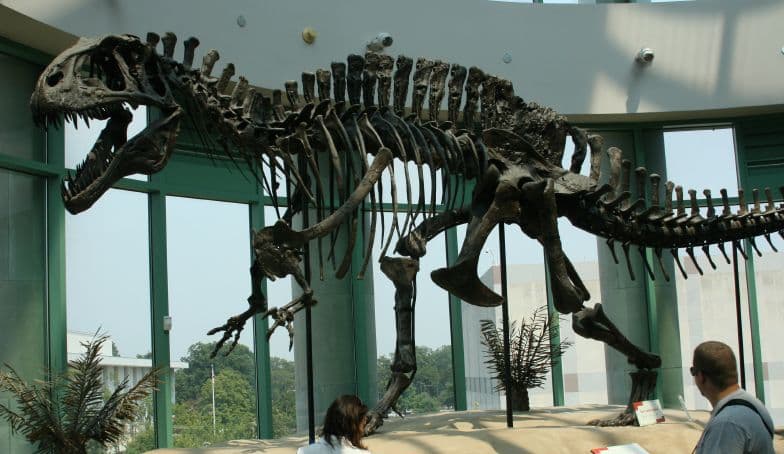
Acrocanthosaurus
Acrocanthosaurus is a genus of large theropod dinosaurs that roamed North America during the Early and Late Cretaceous periods. Known for its distinctive high neural spines along its back, it was one of the largest predators in its ecosystem, likely preying on large herbivores.

Afromimus
Afromimus tenerensis is a genus of theropod dinosaur from the Early Cretaceous period, discovered in Niger. Initially classified as an ornithomimosaur, later analyses suggest it belongs to the Abelisauroidea superfamily, possibly within the Noasauridae family. Its fossils indicate an adult size of approximately 4.14 meters in length.