
Deuterosaurus
Omnivore (debated)·Permian·Siberia·Quadrupedal (inferred)
Deuterosaurus was a large, extinct genus of dinocephalian therapsids that lived during the Permian period. Known for its robust skull with prominent canine teeth and a thickened cranial region, its diet remains a subject of debate, with possibilities ranging from herbivore to carnivore or omnivore. Deuterosaurus likely moved with splayed legs and a swinging tail, and may have engaged in head-butting behavior.
Key Facts
- ›Deuterosaurus was a therapsid, an extinct group of animals considered ancestors of mammals.
- ›It possessed a large skull with long, dagger-like canine teeth and a thickened area above the eyes.
- ›Its exact diet is uncertain, with evidence suggesting it could have been herbivorous, carnivorous, or omnivorous.
- ›Fossil remains have been found in Siberia, which was a temperate lowland environment during the Permian.
- ›The animal was roughly the size of a modern grizzly bear, with short, massive legs.
- ›Deuterosaurus may have engaged in head-butting, possibly for mating or territorial disputes.

Large Animal, Size of A Modern Grizzly Bear, Skull Over 10 Inches High, Long Snout, Conical Teeth, Long, Dagger-Like Canine Teeth, Broad Cheek Region, Eyes Partly Slanted Forward, Well-Formed Opening For A Pineal Eye, Short But Massive Legs, Thickened Skull Above the Eyes
Deuterosaurus Biarmicus, Deuterosaurus Seeleyi, Deuterosaurus Jubilaei, Deuterosaurus Gigas
Siberia
About Deuterosaurus
Deuterosaurus is an extinct genus of dinocephalian therapsids, a group of animals that are considered to be among the ancestors of mammals. The genus lived during the Permian period and is known from fossil discoveries in Siberia.
Anatomy and Biology
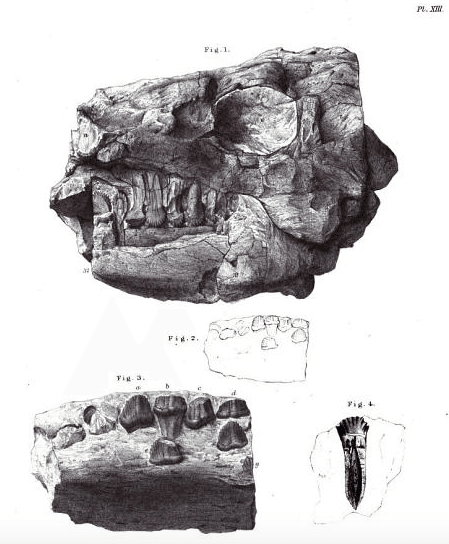
The skulls of Deuterosaurus are well-documented from several finds. They were large, exceeding 10 inches (25 cm) in height, and featured a long snout, conical teeth, and notable long, dagger-like canine teeth, characteristic of anteosaurs. The skull was relatively short for an anteosaur, with a broad cheek region suggesting a powerful bite. Its eyes were positioned to allow for at least partial stereoscopic vision, and a small but well-formed opening for a pineal eye was present atop the braincase.
Deuterosaurus was a substantial animal, estimated to be the size of a modern grizzly bear. Based on related therapsids, its short but massive legs were likely held in a splayed posture, similar to that of modern crocodiles. Its locomotion would have involved a sideways swinging of the tail, much like in modern reptiles. A remarkable thickening of the skull above the eyes suggests that Deuterosaurus may have engaged in head-butting, possibly for mating rituals or to assert dominance in territorial disputes.
Diet and Habitat
The precise diet of Deuterosaurus remains a subject of some debate among paleontologists. While the presence of large canines might indicate a predatory capability, its short legs and massive body could have made it less suited for long-distance pursuit, perhaps favoring a herbivorous diet. Conversely, the potential for stereoscopic vision could align with an ambush predator strategy. The blunt, cone-like post-canine teeth offer interpretations supporting either a plant-based or meat-based diet. Consequently, it is also considered possible that Deuterosaurus was omnivorous, similar to modern bears. During the Permian period, the Siberian region where Deuterosaurus fossils are found was characterized by temperate lowlands.
Source: Wikipedia ↗
Frequently Asked Questions
What kind of animal was Deuterosaurus?
Deuterosaurus was an extinct genus of dinocephalian therapsids. Therapsids are an extinct group of animals that are considered to be the ancestors of mammals.
What did Deuterosaurus look like?
Deuterosaurus had a large skull, over 10 inches high, with a long snout and conical teeth, including long, dagger-like canine teeth. Its legs were short and massive, held splayed, and its tail would have swung sideways when walking.
What did Deuterosaurus eat?
The diet of Deuterosaurus is debated. While large canines suggest it could kill prey, its short legs and massive body might have made it better suited for eating plants. It's also possible it was omnivorous, like a modern bear.
Where did Deuterosaurus live?
Fossils of Deuterosaurus have been found in what is now Siberia. During the Permian period, this region was dominated by temperate lowlands.
How did Deuterosaurus move?
Judging from related therapsids, Deuterosaurus had short but massive legs that were held splayed, similar to a modern crocodile. Its tail would have swung sideways when it walked.
Did Deuterosaurus have any unusual behaviors?
A remarkable thickening of the skull above the eyes suggests that Deuterosaurus may have engaged in head-butting. This behavior could have been related to mating or territorial disputes.
Related Dinosaur species
Anthodon
Anthodon was an extinct genus of parareptile that lived during the Permian period in what is now South Africa and Tanzania. Named for its distinctive flower-like teeth, which had numerous cusps, Anthodon was a relatively small herbivore, measuring about 1.2 to 1.5 meters in length.

Coelurosauravus
Coelurosauravus was a genus of extinct gliding reptile that lived during the Late Permian period in Madagascar. Members of this genus are distinguished by unique, long, rod-like ossifications projecting from their bodies, which are believed to have formed folding wings for gliding flight, similar to modern Draco lizards. Its scientific name, "hollow-tailed lizard grandfather," reflects its unique anatomical features and its place in evolutionary history.