
Dilophosaurus
Carnivore·Early Jurassic·Northern Arizona, North America·Bipedal
Dilophosaurus is a genus of theropod dinosaurs that lived in North America during the Early Jurassic period, approximately 186 million years ago. Named for the distinctive pair of crests on its skull, it was one of the earliest large predatory dinosaurs and the largest known land animal in North America at the time. Despite its significant presence in popular culture, the real Dilophosaurus differed considerably from fictional depictions.
Key Facts
- ›Lived during the Early Jurassic, about 186 million years ago.
- ›Named Dilophosaurus, meaning "two-crested lizard," for the prominent skull crests.
- ›Estimated to be around 7 meters (23 ft) long and weigh approximately 400 kg (880 lb).
- ›One of the earliest large predatory dinosaurs and the largest known land animal in North America during its time.
- ›Possessed a slender, lightly built body with a proportionally large but delicate skull.
- ›Known from fossils discovered in northern Arizona, USA.

- Estimated length of up to 7 meters.
- Estimated weight of up to 400 kg.
- Slender and lightly built body.
- Proportionally large, delicate skull.
- Narrow snout with a gap or kink below the nostril.
- Pair of longitudinal, arched crests on the skull, possibly enlarged by keratin.
- Long neck with hollow, light vertebrae.
- Powerful arms with four fingers; the first had a large claw, the next two were longer and slender with smaller claws, the fourth was vestigial.
- Massive thigh bone and stout feet with large claws.
- Long, curved, thin, and laterally compressed teeth with serrations.
Megalosaurus, Dracovenator, Sinosaurus
North America
About Dilophosaurus
Dilophosaurus is a genus of theropod dinosaurs that roamed what is now North America during the Early Jurassic period, approximately 186 million years ago. It holds the distinction of being one of the earliest large predatory dinosaurs and was the largest known land animal in North America during its time. The genus name, meaning "two-crested lizard," refers to the distinctive pair of crests adorning its skull, a feature that has captured scientific and public imagination.
Discovery and Naming
The first fossils of Dilophosaurus were discovered in northern Arizona in 1940. Two of the most complete skeletons were collected in 1942. Initially, the most complete specimen was classified as a new species of Megalosaurus, named M. wetherilli by Samuel P. Welles in 1954. A significant discovery in 1964 by Welles revealed a larger skeleton of the same species, which possessed prominent crests on its skull. This led Welles to establish the new genus Dilophosaurus in 1970, formally naming the species Dilophosaurus wetherilli.
Physical Characteristics
Dilophosaurus was characterized by its slender and lightly built physique, with an estimated length of about 7 meters (23 ft) and a weight of around 400 kg (880 lb). Its skull was proportionally large but delicate, featuring a narrow snout and a unique gap or kink below the nostril. The most striking feature was the pair of longitudinal, arched crests on its skull, which were likely enlarged by keratin. The neck was long, and its vertebrae were hollow and light. Its arms were powerful, ending in hands with four fingers, the first bearing a large claw. The rest of its anatomy included stout feet with large claws.
Paleobiology and Behavior
As a theropod, Dilophosaurus was active and bipedal. Its diet likely consisted of large animals, though it may also have consumed smaller prey and fish. The precise function of its cranial crests remains a subject of speculation; they were too fragile for combat and are thought to have been used for visual display, possibly for species recognition or sexual selection. Fossil evidence suggests Dilophosaurus may have experienced rapid growth early in life. Some resting trace fossils have been interpreted as potentially showing impressions of feathers, though this remains debated.
Scientific Context and Popular Culture
Dilophosaurus is considered a significant find for understanding Early Jurassic theropod diversity. While it has been placed in the family Dilophosauridae, the exact phylogenetic relationships are still debated. The dinosaur gained widespread fame through its depiction in Michael Crichton's novel Jurassic Park and its subsequent film adaptation. However, these fictional portrayals, which included abilities like venom spitting and a neck frill, differ significantly from the scientific understanding of the actual animal, which was depicted as much smaller and lacking these sensationalized traits.
Source: Wikipedia ↗
Frequently Asked Questions
What does the name Dilophosaurus mean?
The genus name Dilophosaurus means "two-crested lizard." It is derived from the Greek words 'di' (two), 'lophos' (crest), and 'sauros' (lizard).
When and where did Dilophosaurus live?
Dilophosaurus lived in what is now North America during the Early Jurassic period, approximately 186 million years ago. Its fossils have been found in the Kayenta Formation in northern Arizona.
What did Dilophosaurus look like?
Dilophosaurus was a slender, lightly built theropod with a large, delicate skull. Its most distinctive feature was a pair of longitudinal, arched crests on its skull, likely covered in keratin. It had a narrow snout, a long neck, and powerful arms with four-fingered hands.
How large was Dilophosaurus?
The largest known specimens of Dilophosaurus measured about 7 meters (23 ft) in length and weighed around 400 kg (880 lb). The holotype specimen was smaller, measuring approximately 6 meters (19 ft 9 in) long and weighing about 283 kg (624 lb).
What did Dilophosaurus eat?
Dilophosaurus was a predator and likely hunted large animals, though it may also have fed on smaller animals and fish. Its slender build and potentially limited forelimb range suggest its mouth may have made the first contact with prey.
What was the function of Dilophosaurus's crests?
The exact function of Dilophosaurus's crests is unknown. They were too weak for combat and may have been used for visual display, such as species recognition or sexual selection.
How does the real Dilophosaurus compare to its depiction in Jurassic Park?
The real Dilophosaurus was significantly larger than depicted in the novel and movie Jurassic Park. Furthermore, the fictional abilities to spit venom and expand a neck frill are not supported by scientific evidence.
Related Dinosaur species

Cryolophosaurus
Cryolophosaurus is a genus of large theropod dinosaur from the Early Jurassic period of Antarctica. It was one of the largest theropods of its time, with estimated lengths between 6-7 meters and weights of 350-465 kilograms. A distinctive feature of Cryolophosaurus is its "pompadour" crest, a bony structure running across its head, believed to have been used for species recognition.
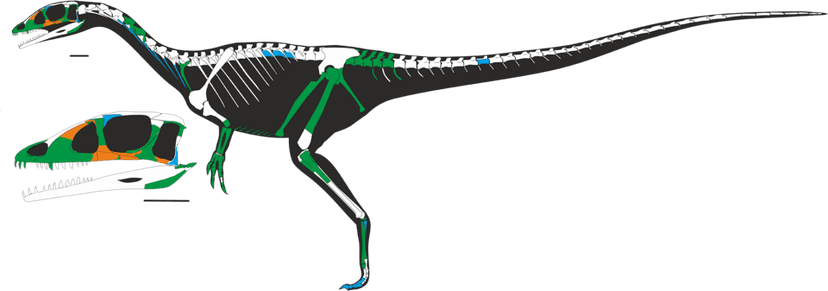
Dracoraptor
Dracoraptor is a genus of early theropod dinosaur that lived during the Hettangian stage of the Early Jurassic Period, approximately 201 million years ago. Its fossils were discovered in Wales, making it one of the oldest known Jurassic dinosaurs and the first from the Jurassic of Wales. The name "Dracoraptor" means "dragon thief," referencing the Welsh dragon and its predatory nature.

Berberosaurus
Berberosaurus is a genus of neotheropod dinosaur that lived during the Early Jurassic period in what is now Morocco. It is considered one of the oldest formally identified theropods from North Africa and may represent the earliest known ceratosaur. Berberosaurus is known from partial postcranial remains and is characterized by unique anatomical features in its vertebrae and hindlimb bones.