
Acanthixalus sonjae
Acanthixalus sonjae, also known as the Ivory Coast wart frog, is a frog species found in the forests of southwestern Ivory Coast and Ghana. It is distinctive for its use of large, water-filled tree holes for breeding and its ability to change color rapidly from green to black.
Key Facts
- ›Found in southwestern Ivory Coast and Ghana, with possible presence in Liberia.
- ›Breeds exclusively in large, water-filled tree holes.
- ›Males can change color from green to almost black within minutes.
- ›Juveniles are typically bright yellow to orange.
- ›Threatened by deforestation due to agricultural development and timber extraction.

Ivory Coast Wart Frog, African Wart Frog
Lowland Wet Evergreen Forest, Moist Semi-Deciduous Forest
Ivory Coast, Ghana
- Flattened Body
- Long, Pointed Snout
- Protruding Eyes With Rhomboid Pupils
- Webbed Hands and Feet With Enlarged Disc Tips
- Clear Yellow-Green Ground Color With Black Spots, Lines, and Cross Bands
- Ability of Females To Change Color Rapidly
About Acanthixalus sonjae
Acanthixalus sonjae, commonly known as the Ivory Coast wart frog or the African wart frog, is a species of frog native to the forests of southwestern Ivory Coast and Ghana, with potential presence in adjacent Liberia. This species is part of the Hyperoliidae family and is distinguished by its unique breeding habits and remarkable color-changing abilities.
Description and Characteristics
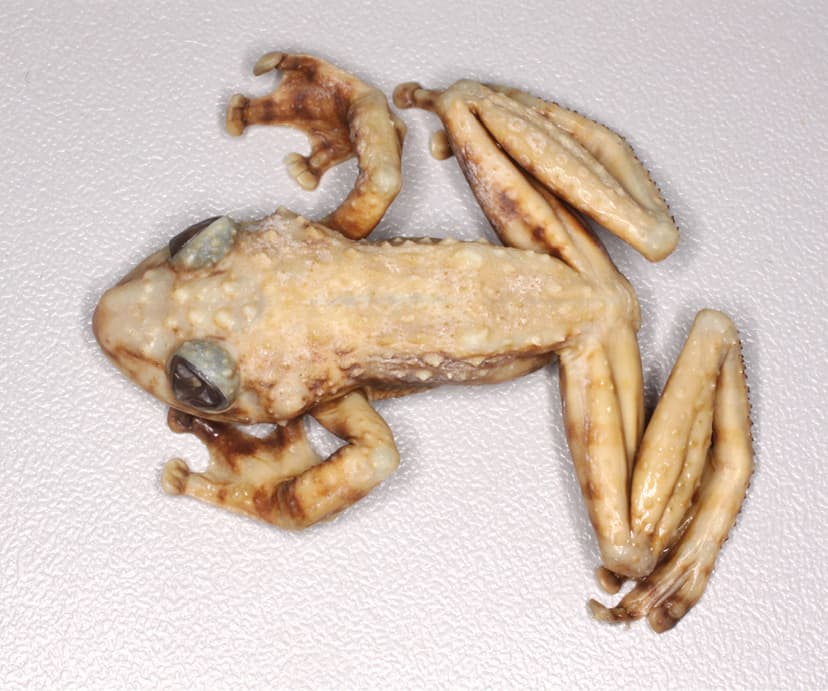
The body of Acanthixalus sonjae is notably flattened, and it possesses a long, pointed snout. Its eyes are protruding and feature rhomboid pupils. Both the hands and feet are webbed, with the finger and toe tips enlarged into discs, likely aiding in climbing or grasping. The typical coloration is a clear yellow-green on the back and extremities, interspersed with numerous black spots and lines. Three larger black cross bands further break up the pattern. A distinctive trait is observed in females, which can rapidly transition their color from green to almost black within minutes. Juveniles are generally more brightly colored, often exhibiting shades of yellow to orange.
Habitat and Breeding
The natural habitat for Acanthixalus sonjae is primary and secondary lowland wet evergreen forests and moist semi-deciduous forests. A crucial ecological requirement for this species is the use of very large tree holes for breeding. These cavities are typically about 40 cm in diameter and hold a substantial volume of water. Egg clutches are attached to the walls or ceiling of these water-filled tree holes. The eggs hatch into larvae after approximately 11 to 14 days, and the larval stage is relatively prolonged, lasting for at least three months. Males of this species are described as appearing mute.
Conservation Concerns
Acanthixalus sonjae is considered an uncommon species and faces threats primarily from habitat loss. Deforestation, driven by agricultural development, timber extraction, and human settlement, is significantly impacting its forest environment. Despite these threats, the species does occur within several protected areas, including Taï National Park and the Ankasa Conservation Area, which offer some refuge.
Source: Wikipedia ↗
Frequently Asked Questions
What are the common names for Acanthixalus sonjae?
Acanthixalus sonjae is commonly referred to as the Ivory Coast wart frog or the African wart frog.
Where is Acanthixalus sonjae found?
This species is found in the southwestern regions of Ivory Coast, including Taï National Park, and in southwestern Ghana. It may also be present in adjacent areas of Liberia.
What makes Acanthixalus sonjae's breeding behavior unique?
Acanthixalus sonjae utilizes large tree holes, approximately 40 cm in diameter and holding significant water volume, for breeding. Egg clutches are attached to the walls or ceiling of these cavities.
What is the typical size of Acanthixalus sonjae?
Males of the species measure between 33–38 mm in snout-to-vent length, while females are slightly larger, ranging from 36–39 mm.
What are the conservation concerns for Acanthixalus sonjae?
The species is considered uncommon and is threatened by habitat loss due to deforestation. Agricultural development, timber extraction, and human settlement are the primary drivers of this threat.
Can Acanthixalus sonjae change color?
Yes, females of Acanthixalus sonjae have the remarkable ability to change their color from green to almost black within a few minutes. Juveniles are noted for their brighter yellow to orange coloration.
Related Frogs
Acanthixalus
Acanthixalus, commonly known as African wart frogs, is a genus of frogs belonging to the family Hyperoliidae. These frogs are found in the rainforests of Western and Central Africa, spanning from Ivory Coast to Congo. They are distinctive for their habit of living in water-filled tree cavities and their apparent lack of vocalizations, possibly using olfactory cues for mating.
Acanthixalus spinosus
Acanthixalus spinosus, commonly known as the African wart frog, is a species of frog native to Africa, found from southeastern Nigeria to Gabon and the Democratic Republic of the Congo. It is distinctive for its warty, black or brownish-to-olive dorsum with an hourglass pattern, and the males' unique possession of strong tarsal spines and larger digital discs. This species primarily inhabits lowland rainforests, dwelling in water-filled tree holes and exhibiting predominantly aquatic behavior.