
Afrixalus dorsalis
The brown banana frog (Afrixalus dorsalis), also known as the striped spiny reed frog, is a frog species found across several West and Central African countries. It is distinguished by its light to dark brown coloration with distinctive silverish-white patterns, which can vary in form and placement.
Key Facts
- ›Found in Angola, Cameroon, Republic of the Congo, Democratic Republic of the Congo, Ivory Coast, Equatorial Guinea, Gabon, Ghana, Guinea, Liberia, Nigeria, Sierra Leone, and possibly Togo.
- ›Inhabits subtropical or tropical moist lowland forests, shrubland, seasonally wet or flooded lowland grassland, freshwater marshes, and degraded former forests.
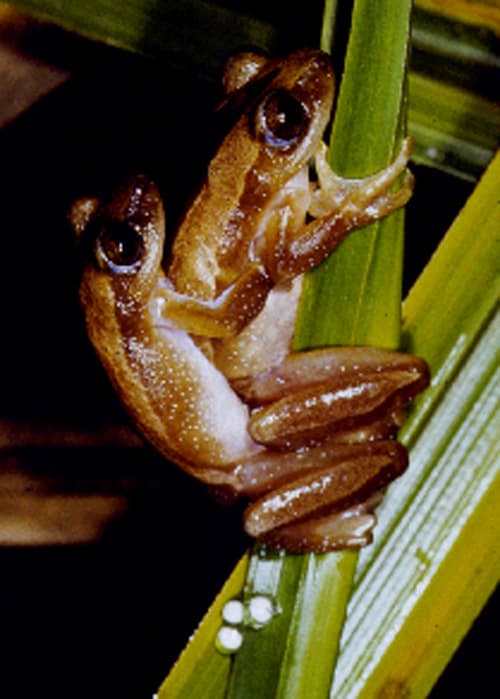
- ›Features a light to dark brown body with silverish-white patterns, often including a snout triangle, a stripe to the groin, and spots on the lumbar region and tibia.
- ›May benefit from deforestation as it thrives in grasslands and degraded former forests.
- ›A high prevalence of the chytrid fungus has been noted in specimens from Nigeria.
- ›Its lifespan is currently unknown.

Brown Banana Frog, Striped Spiny Reed Frog
Forest, Shrubland, Grassland, Wetlands, Degraded Former Forest, Agricultural Land
Angola, Cameroon, Republic of the Congo, Democratic Republic of the Congo, Ivory Coast, Equatorial Guinea, Gabon, Ghana, Guinea, Liberia, Nigeria, Sierra Leone, Togo
- Light To Dark Brown Coloration
- Silverish-White Patterned Markings On the Body
- Potential Patterns Include Snout Triangle, Stripe To Groin, Lumbar Spot, and Tibia Spots
About Afrixalus dorsalis
What is known
Afrixalus dorsalis, commonly referred to as the brown banana frog or the striped spiny reed frog, is an amphibian belonging to the family Hyperoliidae. This species is distributed across a significant portion of West and Central Africa, with documented occurrences in Angola, Cameroon, the Republic of the Congo, the Democratic Republic of the Congo, Ivory Coast, Equatorial Guinea, Gabon, Ghana, Guinea, Liberia, Nigeria, and Sierra Leone, and it may also be present in Togo.
Physical Characteristics
The defining characteristic of Afrixalus dorsalis is its coloration and patterning. These frogs typically present with a light to dark brown base color, overlaid with a distinctive silverish-white pattern. The specific markings can vary among individuals but commonly include a triangular shape on the tip of the snout, a prominent stripe running towards the groin, a lighter spot located in the lumbar region of the back, and/or a pair of lighter spots on the tibia (shinbone).
Habitat and Distribution
The natural habitats favored by Afrixalus dorsalis are varied and include subtropical or tropical moist lowland forests and shrublands. They are also found in subtropical or tropical seasonally wet or flooded lowland grasslands, as well as freshwater marshes and intermittent freshwater marshes. Their adaptability is further demonstrated by their presence in rural gardens, heavily degraded former forests, around ponds, in seasonally flooded agricultural land, and within artificial watercourses such as canals and ditches.
Conservation Considerations
Like many anurans in its native regions, Afrixalus dorsalis faces pressures from habitat destruction and the expansion of human populations. However, this species exhibits a degree of resilience and may even benefit from the widespread deforestation that creates grasslands and degraded former forests, environments in which it thrives. Research has indicated a high prevalence of Batrachochytrium, the fungus responsible for the amphibian disease chytridiomycosis, in specimens collected from Nigeria's Okomu National Park, highlighting a potential health concern for amphibian populations in the area.
The lifespan of Afrixalus dorsalis is not currently known, and specific details regarding its diet, breeding behavior, and vocalizations are not documented in available records.
Source: Wikipedia ↗
Frequently Asked Questions
What does the brown banana frog look like?
The brown banana frog is typically light to dark brown with a silverish-white pattern. These patterns can manifest as a triangle on the snout, a prominent stripe extending to the groin, a light spot in the lumbar region, and/or two light spots on the tibia.
Where can the brown banana frog be found?
Its distribution includes Angola, Cameroon, Republic of the Congo, Democratic Republic of the Congo, Ivory Coast, Equatorial Guinea, Gabon, Ghana, Guinea, Liberia, Nigeria, Sierra Leone, and potentially Togo.
What kind of habitats does the brown banana frog prefer?
This species prefers subtropical or tropical moist lowland forests, shrubland, and seasonally wet or flooded lowland grasslands. It also inhabits freshwater marshes, rural gardens, degraded former forests, ponds, and seasonally flooded agricultural land, as well as canals and ditches.
What is the conservation status of the brown banana frog?
While specific conservation status is not detailed, anurans in its region face pressure from habitat destruction and human population expansion. However, Afrixalus dorsalis may benefit from deforestation as it thrives in grasslands and degraded forests.
Are there any known health issues affecting the brown banana frog?
A high prevalence of Batrachochytrium, the fungus responsible for chytridiomycosis, has been observed in specimens collected from Okomu National Park in Nigeria.
Related Frogs
Afrixalus
Afrixalus is a genus of frogs belonging to the family Hyperoliidae, found throughout Sub-Saharan Africa. They are commonly known as banana frogs, spiny reed frogs, cat's eye reed frogs, or leaf-folding frogs. A distinctive characteristic is their habit of laying eggs in vegetation above water, often folding leaves around them for protection.

Afrixalus fulvovittatus
The Banded Banana Frog (Afrixalus fulvovittatus) is a species of frog native to West Africa, specifically found in Ivory Coast, Ghana, Guinea, Liberia, and Sierra Leone. Its natural habitats include moist savannas and various wetland environments, often in areas that have been degraded from their original forest state. This species is currently threatened by habitat loss.

Afrixalus laevis
Afrixalus laevis is a species of frog belonging to the Hyperoliidae family, found across several countries in Central and East Africa. This species is distinguished by its translucent posterior dorsum, yellowish coloration with brown patterning, and its unusual breeding behavior which occurs near flowing water rather than in standing water.