
Afrixalus laevis
Afrixalus·Not specified, but noted as reasonably common in parts of its range and threatened by habitat destruction.
Afrixalus laevis is a species of frog belonging to the Hyperoliidae family, found across several countries in Central and East Africa. This species is distinguished by its translucent posterior dorsum, yellowish coloration with brown patterning, and its unusual breeding behavior which occurs near flowing water rather than in standing water.
Key Facts
- ›Found in southern Cameroon, northern Gabon, Equatorial Guinea, Democratic Republic of the Congo, and southwestern Uganda.
- ›Adult males measure 20–23 MM, while females are slightly larger at 23–25 MM snout-to-vent length.
- ›Distinctive features include a translucent posterior dorsum, yellowish coloration with brown patterns, and protruding eyes.
- ›Breeding occurs with eggs deposited on leaves near flowing water, unlike other Afrixalus species.
- ›Threatened by habitat destruction due to agricultural encroachment and human settlements.

Smooth Spiny Reed Frog, Liberian Banana Frog
Forest
- Translucent Posterior Dorsum
- Yellowish Coloration With Brown Pattern Anteriorly
- Transparent Limbs
- Brown Canthal Stripe Continuing Behind the Eye
- Unusual Breeding Site Near Flowing Water
About Afrixalus laevis
Afrixalus laevis is a species of frog belonging to the family Hyperoliidae. This amphibian is found across a range in Central and East Africa, including southern Cameroon, northern Gabon, Equatorial Guinea (specifically on Bioko Island), the Democratic Republic of the Congo, and southwestern Uganda, with its distribution potentially extending into neighboring countries.
Physical Description
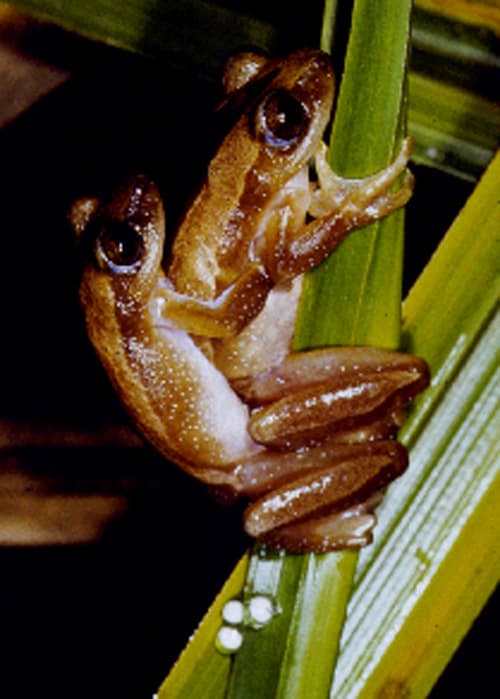
Adults of this species exhibit distinct physical characteristics. Males typically measure between 20 to 23 mm in snout-to-vent length, while females are slightly larger, ranging from 23 to 25 mm. The frog possesses a large head with prominent, protruding eyes. Its dorsal surface is translucent towards the posterior and yellowish with a variable brown pattern on the anterior half. The limbs are also transparent. A notable marking is a brown stripe that runs along the canthus (the ridge between the eye and the nostril) and extends behind the eye.
Habitat and Breeding
Afrixalus laevis primarily inhabits forest interiors. A defining characteristic of this species is its unusual breeding behavior, which deviates from that of many other Afrixalus frogs. Instead of breeding in standing water, the eggs are deposited on a leaf situated near flowing water, without the leaf being folded.
Conservation Status and Threats
While Afrixalus laevis is considered reasonably common in certain parts of its geographical range, it faces significant threats. The species does not thrive in modified habitats and is locally endangered by the destruction of its native forest environment. This habitat loss is driven by agricultural encroachment, the expansion of human settlements, and the collection of wood resources. Despite these threats, the species is known to occur within several protected areas.
Vocalization
The male Afrixalus laevis is known to produce a distinct advertisement call, which consists of single clacks.
Source: Wikipedia ↗
Frequently Asked Questions
What are the common names for Afrixalus laevis?
Afrixalus laevis is commonly known as the smooth spiny reed frog and the Liberian banana frog.
What is the size of Afrixalus laevis?
Adult males typically measure between 20–23 mm in snout-to-vent length, while adult females are slightly larger, ranging from 23–25 mm.
Where does Afrixalus laevis breed?
Unusually for its genus, Afrixalus laevis deposits its eggs on leaves near flowing water, rather than in standing water bodies.
What are the main threats to Afrixalus laevis?
The primary threats to this species are habitat destruction caused by agricultural expansion, growing human settlements, and the collection of wood.
What does Afrixalus laevis look like?
It has a large head with protruding eyes. The posterior part of its dorsum is translucent, and its coloration is yellowish with a brown pattern anteriorly. Its limbs are also transparent, and it has a brown stripe extending behind the eye.
Related Frogs
Afrixalus
Afrixalus is a genus of frogs belonging to the family Hyperoliidae, found throughout Sub-Saharan Africa. They are commonly known as banana frogs, spiny reed frogs, cat's eye reed frogs, or leaf-folding frogs. A distinctive characteristic is their habit of laying eggs in vegetation above water, often folding leaves around them for protection.

Afrixalus dorsalis
The brown banana frog (Afrixalus dorsalis), also known as the striped spiny reed frog, is a frog species found across several West and Central African countries. It is distinguished by its light to dark brown coloration with distinctive silverish-white patterns, which can vary in form and placement.

Afrixalus fulvovittatus
The Banded Banana Frog (Afrixalus fulvovittatus) is a species of frog native to West Africa, specifically found in Ivory Coast, Ghana, Guinea, Liberia, and Sierra Leone. Its natural habitats include moist savannas and various wetland environments, often in areas that have been degraded from their original forest state. This species is currently threatened by habitat loss.