
Alcalus rajae
Alcalus rajae, also known as the king dwarf mountain frog, is a species of frog endemic to the island of Borneo in Indonesia. This stocky amphibian is distinguished by its uniformly colored brown to blackish dorsal side, short limbs, and discs on its fingers and toes. It inhabits undisturbed and secondary forests near water sources within a specific altitudinal range.
Key Facts
- ›Endemic to Kalimantan, Borneo (Indonesia).
- ›Found in primary and secondary forests near streams and swamps.
- ›Adult females reach up to 40 MM in snout-to-vent length.
- ›Dorsal coloration is uniformly light to dark brown or blackish.
- ›Possesses fully webbed toes and discs on fingers and toes.
- ›Occurs at altitudes between 200–1,200 meters.
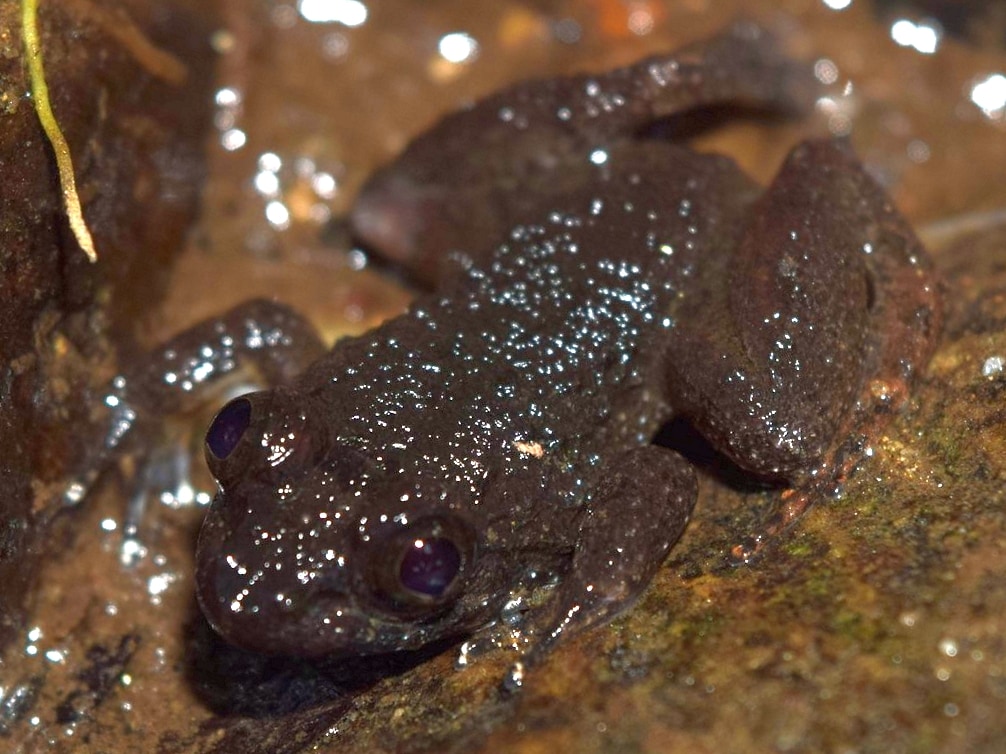
King Dwarf Mountain Frog
Forest, Wetlands, Streams
West Kalimantan, South Kalimantan
Stocky Build, Uniformly Brown To Blackish Dorsal Coloration, Short Limbs, Fully Webbed Toes, Flattened Discs On Fingers and Toes, Indistinct Darker Crossbars On Hind Limbs, Scattered White Spots On Body and Limbs, White Crossbar On Digits
About Alcalus rajae
Alcalus rajae: King Dwarf Mountain Frog
Alcalus rajae, also referred to as the king dwarf mountain frog, is a species of frog belonging to the family Ceratobatrachidae. It is native to the island of Borneo, specifically within the Indonesian province of Kalimantan. The species' specific name, 'rajae,' honors the majestic Bukit Raya mountain, its type locality and the highest peak in Kalimantan, referencing both the peak's name and the frog's relatively large size compared to its former congeners.
Description and Habitat
Adult females of Alcalus rajae typically reach a snout-to-vent length of up to 40 mm, presenting a stocky appearance. Key physical characteristics include a rounded snout, a head slightly wider than it is long, and short limbs. Externally, the tympanum is not visible, concealed by skin and muscle, although a noticeable supratympanic fold is present. Both fingers and toes are equipped with wide, truncated, flattened discs, and the toes are fully webbed. The skin texture is granular.
The dorsal coloration of Alcalus rajae is uniformly light to dark brown or blackish, devoid of any specific markings. The hind limbs exhibit three indistinct darker crossbars, and scattered white spots can be observed on the sides of the body and head, the lower flanks, as well as on the hands and limbs. A distinctive white crossbar is present on the middle of the flattened disc of each digit. The iris of the eye is dark brown, featuring indistinct reticulation.
This species is found in primary undisturbed and secondary forests, favoring locations near seepage areas adjacent to small, slow-moving streams and swamps. Its altitudinal distribution ranges from 200 to 1,200 meters (660 to 3,940 feet).
Conservation Status and Threats
Alcalus rajae is found within the protected confines of the Bukit Baka-Bukit Raya National Park and the Meratus Protected Forest, which still retain intact forest cover. However, outside these protected areas, the species faces significant threats from habitat loss. Deforestation driven by the expansion of oil palm plantations and forestry concessions is a major concern, particularly impacting populations outside of known sites. While the Gunung Penrissen Nature Reserve is a known locality, most of its original vegetation has been lost due to slash-and-burn activities and development for tourism and recreation.
Biology
Morphological features such as fully webbed toes and the absence of an externally visible tympanic annulus suggest that Alcalus rajae is an aquatic species. It is believed to be an egg-laying species, though further details regarding its breeding behavior and life cycle are not extensively documented.
Source: Wikipedia ↗
Frequently Asked Questions
What is the scientific name for the king dwarf mountain frog?
The scientific name for the king dwarf mountain frog is Alcalus rajae. It belongs to the family Ceratobatrachidae and the subfamily Alcalinae.
Where is Alcalus rajae found?
Alcalus rajae is endemic to Kalimantan, Borneo, in Indonesia. It has been recorded in national parks and protected forests in West and South Kalimantan provinces.
What does Alcalus rajae look like?
Adult females reach up to 40 mm in snout-to-vent length and have a stocky appearance. Their dorsal coloration is a uniform light to dark brown or blackish, and they have short limbs with fully webbed toes and flattened discs on their digits.
What is the habitat of Alcalus rajae?
This species inhabits primary undisturbed and secondary forests, typically near seepage areas close to small, slow-moving streams and swamps. They are found at altitudes ranging from 200 to 1,200 meters.
What are the conservation concerns for Alcalus rajae?
While the species is found in well-protected areas like Bukit Baka-Bukit Raya National Park, habitat loss is a significant threat outside these reserves. Deforestation due to oil palm plantations and forestry concessions poses a risk to its survival.
Related Frogs

Alcalus tasanae
Smith's wrinkled frog, scientifically known as Alcalus tasanae, is a frog species native to western and southern Thailand, with its range potentially extending into Myanmar. This species is distinguished by its habitat preference for primary rainforests adjacent to streams and is currently facing threats from habitat loss.
Alcalinae
Alcalus is a small genus of frogs belonging to the subfamily Alcalinae, found in Palawan, Borneo, and the Malay Peninsula. These frogs are distinguished by their intermediate body size compared to related genera, broad heads, and textured skin. They prefer semi-aquatic microhabitats and are named in honor of Filipino biologist Angel Alcala.

Alcalus baluensis
Alcalus baluensis is a small, stocky frog species native to the rainforests of northern and western Borneo. Previously classified in the family Dicroglossidae, it was transferred to Ceratobatrachidae in 2015. This species is characterized by its small size, visible tympanic ring, and preference for the forest floor and stream banks.