
Amietia wittei
Amietia wittei, also known as the Molo frog or De Witte's river frog, is a species of frog found in the montane grasslands of Kenya and Tanzania. This species is distinctive for its dark brown dorsal coloration, which lightens on the flanks and becomes yellowish on the belly, and for the black dorsolateral folds that extend to the groin.
Key Facts
- ›Found in Kenya and Tanzania, including Mount Elgon.
- ›Inhabits montane grasslands at elevations between 1,100–3,300 meters.
- ›Adult females are larger than males, reaching up to 87 MM in snout-urostyle length.
- ›Characterized by dark brown dorsal coloring and black dorsolateral folds.
- ›Associated with streams and can be found in areas of low-intensity agriculture.
- ›Suffers from habitat loss due to human settlements, wood collection, and logging.
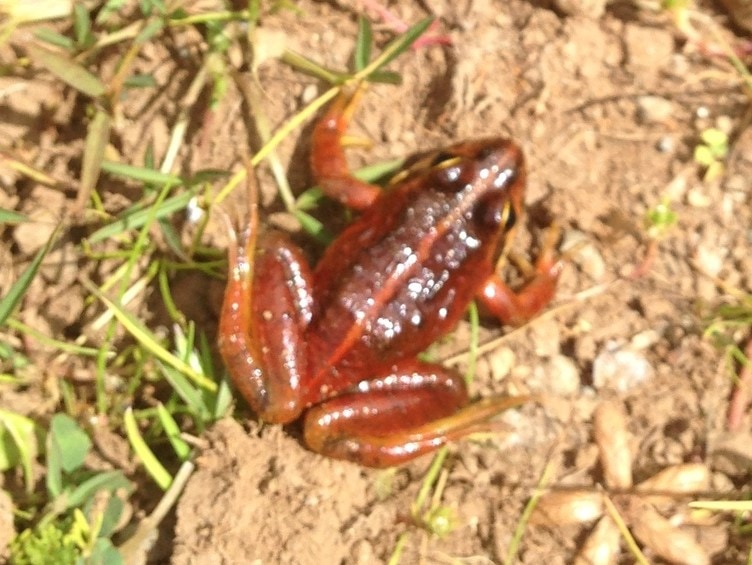
Molo Frog, De Witte's River Frog
Montane Grasslands, Streams, Areas of Low-Intensity Agriculture
Kenya, Tanzania, Uganda
- Dark Brown Dorsal Coloration
- Lighter Flanks
- Yellowish Belly
- Black Dorsolateral Folds
- Elongated Warts On the Back
- Pale Vertebral Stripe
- Pale Band Above the Upper Lip Extending To the Eye
About Amietia wittei
Amietia wittei: The Molo Frog
Amietia wittei, commonly known as the Molo frog or De Witte's river frog, is a species of frog belonging to the family Pyxicephalidae. This amphibian is native to Kenya and Tanzania, with its distribution extending to areas such as Mount Elgon on the Kenya-Uganda border. The species' type locality is Molo, Kenya, situated near the summit of the Mau Escarpment. The specific epithet 'wittei' serves to honor Gaston-François de Witte, a notable Belgian naturalist.
Description and Habitat
Amietia wittei is characterized by its distinct coloration and size. Adult males typically measure up to 55 mm, while females are larger, reaching up to 87 mm in snout-urostyle length. The frog's dorsal surface is dark brown, gradually lightening on its flanks and becoming yellowish on the ventral side. Prominent black dorsolateral folds run along its body, accompanied by numerous elongated warts on its back. Some individuals may also feature a pale, bright green vertebral stripe. The upper lip is uniformly dark or marbled, with a pale, coppery band above it that stretches between the tympanum and the eye. The lower lip is often marbled.
This species thrives in montane grasslands at considerable altitudes, typically between 1,100 and 3,300 meters above sea level. Amietia wittei is closely associated with streams and can also be found in environments modified by low-intensity agriculture. Its presence is noted within several national parks, including Aberdare and Mount Kenya National Parks in Kenya, Mount Elgon National Park, and Kilimanjaro National Park in Tanzania.
Conservation Concerns
Despite being locally common, Amietia wittei faces significant threats due to habitat loss and degradation. These pressures stem from the expansion of human settlements, increased demand for wood collection, and logging activities within its natural range. These factors contribute to a deterioration of the frog's essential habitats.
Source: Wikipedia ↗
Frequently Asked Questions
What is the scientific name for the Molo frog?
The scientific name for the Molo frog is Amietia wittei. It is also sometimes referred to as De Witte's river frog.
Where can Amietia wittei be found?
Amietia wittei is found in Kenya and Tanzania, inhabiting montane grasslands at significant elevations. Its range includes areas like Mount Elgon and national parks such as Aberdare and Mount Kenya.
What are the physical characteristics of Amietia wittei?
Adult males can reach up to 55 mm, while females can grow to 87 mm in snout-urostyle length. They have a dark brown dorsal color that lightens on the flanks and is yellowish on the belly, with black dorsolateral folds and elongated warts.
What is the habitat of the Molo frog?
The Molo frog inhabits montane grasslands at elevations between 1,100 and 3,300 meters above sea level. It is closely associated with streams and can also be found in areas with low-intensity agriculture.
What threats does Amietia wittei face?
Amietia wittei is experiencing habitat loss and deterioration. This is primarily due to expanding human settlements, wood collection, and logging in its natural environment.
Related Frogs

Amietia angolensis
Amietia angolensis, also known as the Angola river frog or common river frog, is a widespread frog species found across southern and eastern Africa. It inhabits a diverse range of environments, from forests and savannas to grasslands and various freshwater bodies. This species is not considered threatened by the IUCN.
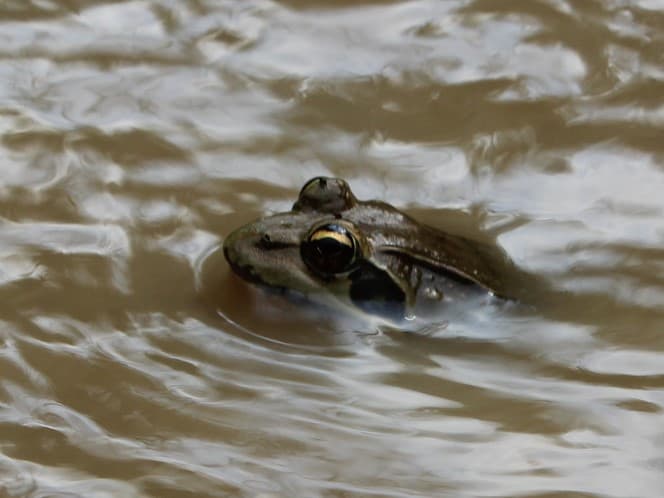
Amietia desaegeri
Amietia desaegeri is a frog species found west and south of the Rwenzori Mountains in the Democratic Republic of the Congo and northwestern Rwanda. Distinguished by its smooth skin with two dorso-lateral folds and a pale beige dorsum with brown infusions, it inhabits submontane and montane rainforests, often near streams. It is known for its ability to tolerate habitat disturbance and can be locally abundant.