
Amietophrynus superciliaris
The African giant toad, also known as the Cameroon toad, is a large amphibian species found across tropical Central and West Africa. It is characterized by its robust, ovoid body, short snout, and distinctive pointed eyelid projections. This species is primarily found in lowland forests and marshes, where its coloration provides excellent camouflage among leaf litter.
Key Facts
- ›Found in Cameroon, Central African Republic, Republic of the Congo, Democratic Republic of the Congo, Ivory Coast, Equatorial Guinea, Gabon, Ghana, Nigeria, and possibly Liberia and Sierra Leone.
- ›Inhabits subtropical or tropical moist lowland forests, freshwater marshes, and degraded former forest areas.
- ›Adult males of the largest subspecies can reach an average snout-to-vent length of 127 MM.
- ›Its diet likely consists of invertebrates, including ants, and in captivity, it has consumed snails, insects, other frogs, and tadpoles.
- ›Classified as 'least concern' by the IUCN due to its wide range and presumed large population, despite threats from habitat loss.
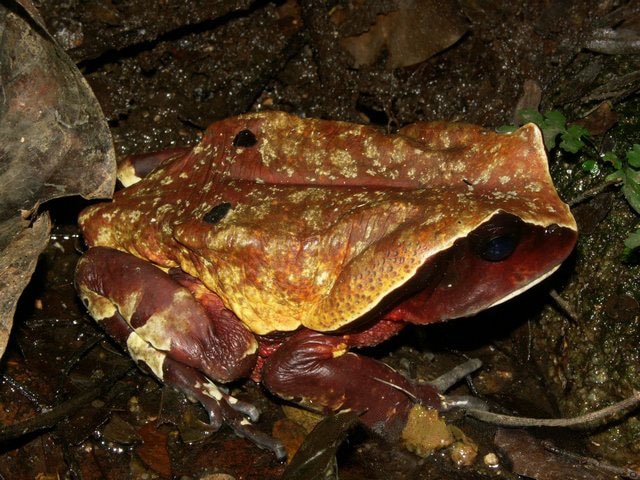
African Giant Toad, Congo Toad, Cameroon Toad
Lowland Forest, Freshwater Marsh, Degraded Forest, Plantation
Cameroon, Central African Republic, Republic of the Congo, Democratic Republic of the Congo, Ivory Coast, Equatorial Guinea, Gabon, Ghana, Nigeria, Liberia, Sierra Leone
- Pointed Projection On the Upper Eyelid
- V-Shaped Black Mark Between the Eyes
- Bright Red Coloration On the Back of the Thigh and Sometimes Flanks
- Robust, Ovoid Body Shape
- Leaf-Like Camouflage
About Amietophrynus superciliaris
African Giant Toad (Sclerophrys superciliaris)
The African giant toad, also referred to as the Congo toad or Cameroon toad, is a significant amphibian species belonging to the Bufonidae family. It is native to the tropical regions of Central and West Africa, with its distribution spanning countries like Cameroon, Nigeria, Ghana, and the Democratic Republic of the Congo, and possible presence in Liberia and Sierra Leone. This species thrives in subtropical or tropical moist lowland forests, freshwater marshes, and even heavily degraded former forest areas, often found in dense undergrowth and plantations.
Description and Identification
A visually distinctive amphibian, the African giant toad possesses a robust, broad ovoid body and a short snout. Its head features nearly-vertical sides and an unridged crown, with closely set eyes. A notable characteristic is the pointed projection extending from the upper eyelid. While the tympanum is indistinct, the parotid glands are large. The first finger of the hand is longer than the second, and males develop nuptial pads on their first two fingers. The hind limb toes are short and partially webbed. The skin on its back can be either smooth or bear small warts. Its coloration provides excellent camouflage, mimicking a dead leaf. The upper surfaces are typically pale brown, yellowish, or pinkish, with a distinctive backward-pointing V-shaped black mark between the eyes and sometimes dark spots on the back. A thin, pale stripe may run along the spine. The sides of the head and body are considerably darker than the upper parts, and the underparts are grey speckled with white. A thin white line borders the lower jaw. The limbs are marked with dark bands, and the back of the thigh, alongside occasional flanks, are a striking bright red.
Taxonomy and Subspecies
The African giant toad is considered a species complex, with distinct populations across its range. There have been proposals to divide the species into three taxa: two subspecies, S. superciliaris superciliaris (found in western Lower Guinean forests) and S. superciliaris chevalieri (found in Upper Guinean forests), and a new species, Sclerophrys channingi, identified in the eastern Democratic Republic of Congo. Genetic analysis supports these distinctions, with S. channingi differing genetically and morphologically, including less-pointed eyelid processes and a darker posterior abdomen.
Size and Reproduction
This is a large toad species. The subspecies A. s. chevalieri is the largest, with adult males averaging 127 mm (5.0 in) in snout-to-vent length, while A. s. superciliaris averages 112 mm (4.8 in). The newly described species, A. channingi, is smaller, averaging 109 mm (4.3 in). Females are generally larger than males. Breeding is thought to occur during the dry season, from January to March. Eggs are laid in streams in calm water, likely as long strings wrapped around submerged vegetation.
Diet and Behavior
Little is known about the specific biology of the African giant toad. Its diet is presumed to consist of invertebrates found in its environment, such as ants, which are a confirmed food source. In captivity, it has also consumed snails, insects, other frogs, and tadpoles. The species is nocturnal and its cryptic coloration makes it difficult to spot, leading to speculation that it may be more common than currently believed.
Conservation
Despite its wide distribution and presumed large population, which has led to its 'least concern' classification by the IUCN, the African giant toad faces threats, primarily from habitat loss due to logging activities. This is particularly critical in West Africa, where the species is restricted to primary forests. While it appears more adaptable in other regions, the loss of dense tree cover remains a concern. Historically, it was collected for the pet trade, and although this is now illegal, it may still occur occasionally.
Source: Wikipedia ↗
Frequently Asked Questions
What are the common names for Sclerophrys superciliaris?
Sclerophrys superciliaris is commonly known as the African giant toad, Congo toad, or Cameroon toad. These names reflect its geographical distribution and physical characteristics.
Where is the African giant toad found?
The African giant toad is distributed across tropical Central and West Africa. Its range includes countries such as Cameroon, Nigeria, Ghana, and the Democratic Republic of the Congo, with possible occurrences in Liberia and Sierra Leone.
What is the habitat of the African giant toad?
This species inhabits subtropical or tropical moist lowland forests, freshwater marshes, and heavily degraded former forest areas. It can be found in dense undergrowth and cocoa plantations.
How large can the African giant toad get?
The African giant toad is a large species. The largest subspecies, A. s. chevalieri, has adult males averaging 127 mm in snout-to-vent length, while females are generally larger than males.
What does the African giant toad eat?
Its diet is believed to consist of invertebrates found in leaf litter or water, with ants being a known food source. In captivity, it has been observed to eat snails, insects, other frogs, and tadpoles.
What is the conservation status of the African giant toad?
The African giant toad is assessed as 'least concern' by the IUCN. This is due to its wide distribution and presumed large population, although habitat loss from logging activities poses a threat.
Related Frogs
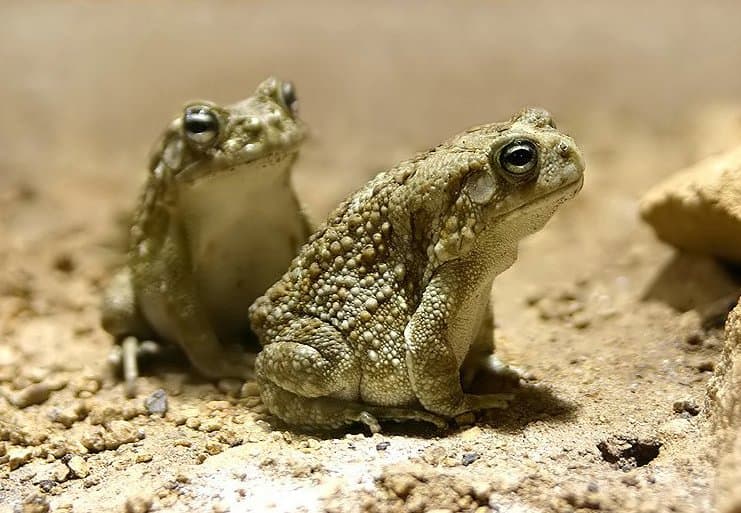
Amietophrynus regularis
The African common toad, also known as Sclerophrys regularis, is a widespread amphibian found across much of Sub-Saharan Africa, extending to oases in Algeria and Libya, and northern Egypt. This large, warty toad is distinguished by its dark olive-brown coloration with symmetrical dark patches and a paler spinal band in younger individuals. It is an adaptable species, thriving in diverse habitats from savannas to agricultural areas, and is notable for its bouncing escape behavior and a distinct rattling vocalization.
Amietophrynus
Sclerophrys is a genus of "true toads" found in Africa and the southern Arabian Peninsula. These toads were originally classified under the genus Bufo, but were later separated into Amietophrynus due to significant taxonomic differences. The genus name Amietophrynus is now considered a junior synonym of Sclerophrys.
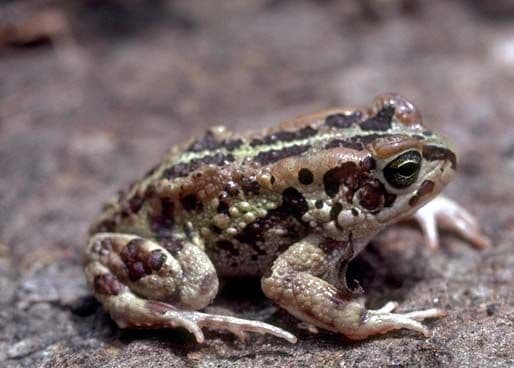
Amietophrynus buchneri
Sclerophrys buchneri, commonly known as Buchner's toad, is a species of toad belonging to the Bufonidae family. Its known distribution is limited to the Cabinda Province of Angola and the western Republic of the Congo, with presumed presence in the Democratic Republic of the Congo. The biology of this species remains largely unstudied, and there is speculation that it might be a synonym for Sclerophrys funereus.