
Anaxyrus boreas halophilus
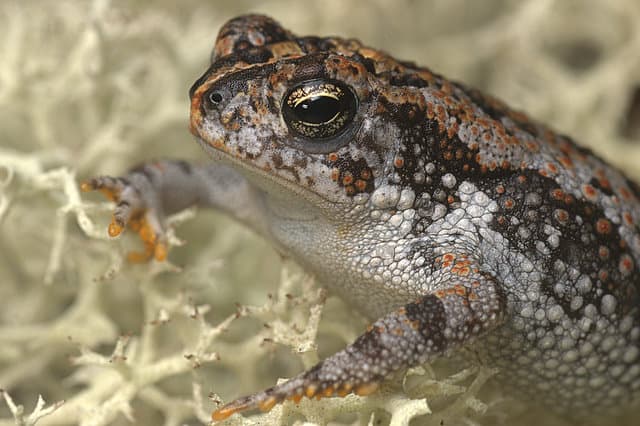
The California toad (Anaxyrus boreas halophilus) is a subspecies of the western toad found throughout California, excluding some southeastern desert regions. It is distinguished from its boreal relative by having fewer dorsal blotches, a wider head, larger eyes, and smaller feet. This toad is an opportunistic feeder, consuming a variety of insects and other invertebrates.
Key Facts
- ›Found throughout California, except for southeastern desert areas.
- ›Less blotched dorsally compared to the boreal toad.
- ›Possesses a wider head, larger eyes, and smaller feet than the boreal toad.
- ›Adult size ranges from two to five inches (50-127 MM) in length.
- ›Feeds on a diverse diet including grasshoppers, beetles, flies, and mosquitos.
- ›Breeds in various aquatic environments like lakes, ponds, and streams.

California Western Toad
Woodland, Grassland, Meadows, Suburban, Ponds, Streams, Lakes, Canals
California, Baja California
- Less Blotched Dorsal Coloration Than Boreal Toad
- Wider Head
- Larger Eyes
- Smaller Feet
- Walks Rather Than Hops
About Anaxyrus boreas halophilus
The California Toad (Anaxyrus boreas halophilus)
The California toad, scientifically known as Anaxyrus boreas halophilus, is a distinct subspecies of the western toad. It is primarily found throughout the state of California, with the notable exception of the southeastern desert regions. This subspecies is recognized for its less blotched dorsal pattern compared to the boreal toad, a wider head, larger eyes, and smaller feet. Typically, adult California toads measure between two to five inches in length.
Habitat and Distribution
The range of the California toad extends from northern California down into Baja California. While they generally avoid extensive desert areas, scattered populations can be found in isolated desert locales, such as within the Mojave Desert. Their preferred habitats are varied, encompassing woodlands, grasslands, and meadows, as well as more developed areas like suburban backyards and parks. For reproduction, they seek out aquatic environments including lakes, creeks, ponds, reservoirs, slowly flowing streams, and canals.
Diet and Behavior
As an opportunistic feeder, the California toad consumes a broad spectrum of insects and other invertebrates. Their diet commonly includes grasshoppers, beetles, flies, and mosquitos. An interesting behavioral characteristic is their mode of locomotion; they walk rather than hop.
Reproduction
The breeding season for the California toad typically spans from January to July, with spawning events occurring later at higher elevations. Many populations are known for aggregation breeding, where large numbers of toads congregate at suitable marsh or pond spawning sites. During this period, males recognize females through amplexus. Females lay a substantial number of eggs, often exceeding 16,000 per individual, in shallow water, typically arranged in long strings.
Source: Wikipedia ↗
Frequently Asked Questions
What is the scientific name of the California toad?
The scientific name of the California toad is Anaxyrus boreas halophilus. The genus name Anaxyrus is derived from Greek, and 'boreas' means 'north wind' or 'northern', while 'halophilus' combines 'halos' meaning 'sea' or 'salt' with 'philos' meaning 'having affinity for'.
Where does the California toad live?
The California toad inhabits most of California, extending south into Baja California. While generally avoiding deep desert regions like Death Valley, scattered populations can be found in isolated desert areas such as the Mojave Desert.
What does the California toad eat?
Like the boreal toad, the California toad has a varied diet consisting of many types of insects and other invertebrates. Common prey includes grasshoppers, beetles, flies, and mosquitos.
How can I identify a California toad?
California toads are less blotched on their backs than boreal toads and have a wider head, larger eyes, and smaller feet. Their dorsal coloration can range from light gray to green or dull black, though most are brownish-gray. They are also characterized by walking rather than hopping.
When and where do California toads breed?
California toads breed from January to July, with spawning occurring later at higher elevations. They are often aggregation breeders, gathering in large numbers at suitable marsh or pond sites. Females lay over 16,000 eggs per clutch in shallow water, typically in strings.
Related Frogs
Anaxyrus quercicus
The oak toad (Anaxyrus quercicus) is the smallest toad species in North America, endemic to the coastal regions of the southeastern United States. It is distinguished by its light mid-dorsal stripe, variable spots, and large parotoid glands, and it primarily inhabits sandy pine flatwoods and oak scrub. This species is mostly diurnal and known for its burrowing behavior and a distinctive chirping call produced by males during the breeding season.

Anaxyrus terrestris
The southern toad (Anaxyrus terrestris) is a large true toad found in the southeastern United States, commonly inhabiting areas with sandy soils. It is distinguished by knobs on its head and backward-pointing spurs, and its coloration can vary from brick red to mottled gray, brown, or black. This nocturnal species spends its days in burrows and is considered a generalist in its habitat preferences.

American toad
The American toad (Anaxyrus americanus) is a widespread amphibian found across eastern Canada and the United States. It is characterized by its variable coloration, which can range from yellow to brown to black, and its ability to change skin color based on environmental factors. This species is known for its distinctive trilling call during breeding season and its ability to hibernate through the winter.