
Anaxyrus fowleri
Anaxyrus·Not Specified by text, but noted as 'species at risk in Ontario', 'species of special concern in New Jersey', and 'regionally threatened or endangered species in New Hampshire and Vermont'.
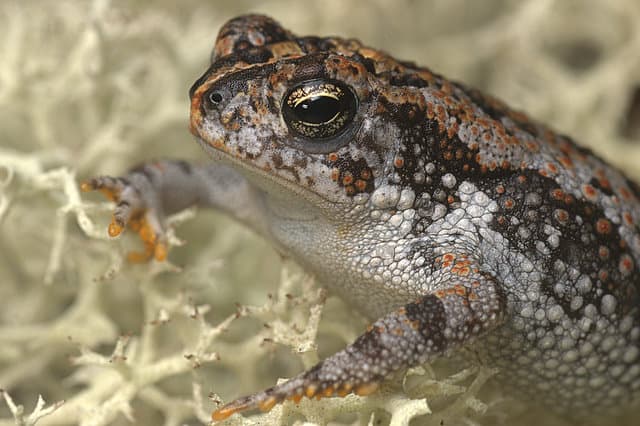
Fowler's toad (Anaxyrus fowleri) is a species of toad native to eastern North America, found across much of the eastern United States and parts of Canada. Distinguished by its variable coloration, warty spots, and a pale stripe on the back of adults, it was once considered a subspecies of Woodhouse's toad. This species inhabits open woodlands, meadows, and beaches, often near temporary or permanent wetlands, and is known for its unique breeding calls and defensive behaviors.
Key Facts
- ›Fowler's toad is typically brown, grey, olive green, or rust red with darkened, warty spots.
- ›Adults measure between 5 to 9.5 CM (2.0 to 3.7 in) in head-body length.
- ›They inhabit open woodlands, sand prairies, meadows, and beaches, often near wetlands.
- ›Fowler's toads are known to secrete a noxious compound from their warts to deter predators.
- ›This species regularly hybridizes with the American toad and Woodhouse's toad.
- ›Conservation concerns include habitat damage from off-road vehicles and agricultural chemicals.

Fowler's Toad
Wetlands, Forests, Grasslands, Beaches, Meadows, Sand Prairies
United States, Canada
Snakes, Birds, Small Mammals
- Darkened Warty Spots
- Pale Stripe On the Back
- Uniformly Whitish Belly With A Potential Dark Spot
About Anaxyrus fowleri
Fowler's Toad
Fowler's toad, scientifically known as Anaxyrus fowleri, is a species of toad native to eastern North America. Its range spans across much of the eastern United States and extends into parts of southeastern Canada. Historically, it was considered a subspecies of Woodhouse's toad (Anaxyrus woodhousii).
Description and Appearance
This toad is typically characterized by its variable coloration, which can include shades of brown, grey, olive green, and rust red, often overlaid with darkened, warty spots. Adult Fowler's toads are usually identifiable by a pale stripe that runs down their back. Their undersides are generally a uniform whitish color, though a single dark spot may be present. Males may appear darker overall than females. Adult toads commonly measure between 5 to 9.5 cm (2.0 to 3.7 inches) in head-body length. The tadpoles are oval-shaped with elongated tails and possess distinct upper and lower fins, reaching lengths of 1 to 1.4 cm (0.39 to 0.55 inches).
Habitat and Distribution
Fowler's toads inhabit a diverse range of open environments, including woodlands, sand prairies, meadows, and beaches. They are frequently found in areas adjacent to temporary or permanent wetlands, such as ponds, lakeshores, and marshes, which are critical for their reproduction. During hot, dry periods and throughout the winter, they exhibit burrowing behavior, seeking refuge underground. They also commonly hide beneath broad-leaved plants, within grass clumps, or in and under logs. At specific locations, such as Long Point in Ontario, Canada, they utilize shallow marshes and pools for breeding before moving to nearby dune and beach habitats during the summer.
Diet
The diet of adult Fowler's toads primarily consists of insects and other small terrestrial invertebrates. Interestingly, they tend to avoid earthworms, differentiating them from closely related species like the American toad. Tadpoles, in their aquatic phase, feed by scraping algae and bacterial mats from surfaces using specialized mouth structures.
Reproduction and Behavior
Breeding typically occurs during warmer months, particularly in May and June, within shallow aquatic settings like ponds and marshes. Male toads produce calls to attract females, and these vocalizations can also draw the attention of other males. A unique aspect is the "release call" emitted by a male when he mistakenly attempts to mate with another male. The effectiveness of male calls is influenced by their body size and ambient temperature, with females often selecting larger males. Males generally spend more time at breeding sites than females. After mating, females can lay between 7,000 to 10,000 eggs, which hatch within two to seven days. Fowler's toads are known to breed multiple times throughout the spring. Tadpoles may reach sexual maturity in one season, but this process can extend up to three years. The species is also known to hybridize with the American toad and Woodhouse's toad.
Fowler's toads employ several defensive strategies. They utilize camouflage coloration to blend with their surroundings and secrete a noxious compound from the warts on their backs. This secretion, containing toxic bufadienolides, is distasteful to predators and can be lethal to small mammals. They are also known to feign death. When relocated, they have been observed to move back in their original direction of travel rather than proceeding with normal movement patterns.
Conservation Status
Fowler's toad faces several conservation challenges. The protection of its breeding sites is considered a crucial conservation measure. Off-road vehicle use in beach and dune habitats poses a significant threat, as do agricultural chemicals, which have led to population declines in certain areas. Habitat-specific requirements, combined with excessive human activity, can result in local extinctions. The invasive Common Reed (Phragmites australis) is also a threat to some breeding habitats used by Canadian populations. Consequently, the species is recognized as being at risk in Ontario, a species of special concern in New Jersey, and regionally threatened or endangered in New Hampshire and Vermont. Efforts to raise public awareness, such as a 2024 Canada Post stamp featuring the toad, are underway.
Source: Wikipedia ↗
Frequently Asked Questions
What is Fowler's toad?
Fowler's toad is a species of toad found in eastern North America. It is characterized by its warty skin, variable color patterns, and a distinctive pale stripe on its back in adults. They are known for their unique breeding calls and defensive behaviors.
Where does Fowler's toad live?
Fowler's toads are native to eastern North America, with their range extending throughout much of the eastern United States and into parts of southeastern Canada. They prefer habitats such as open woodlands, sand prairies, meadows, and beaches, often in proximity to temporary or permanent wetlands.
What does Fowler's toad eat?
Adult Fowler's toads primarily consume insects and other small terrestrial invertebrates, notably avoiding earthworms. Their tadpoles feed by scraping algae and bacterial mats from surfaces.
How does Fowler's toad reproduce?
Fowler's toads breed in warmer months, typically May and June, in shallow waters like ponds and marshes. Males attract females with calls that are influenced by body size and temperature. Females can lay up to 7,000 to 10,000 eggs, which hatch within two to seven days.
What are the conservation concerns for Fowler's toad?
Conservation efforts for Fowler's toad focus on protecting their breeding sites, as they are vulnerable to damage from off-road vehicles and agricultural chemicals. Habitat invasion by Common Reed is also a threat in some Canadian populations. They are considered a species at risk in Ontario and have special concern or threatened status in several U.S. states.
Related Frogs
Anaxyrus quercicus
The oak toad (Anaxyrus quercicus) is the smallest toad species in North America, endemic to the coastal regions of the southeastern United States. It is distinguished by its light mid-dorsal stripe, variable spots, and large parotoid glands, and it primarily inhabits sandy pine flatwoods and oak scrub. This species is mostly diurnal and known for its burrowing behavior and a distinctive chirping call produced by males during the breeding season.

Anaxyrus terrestris
The southern toad (Anaxyrus terrestris) is a large true toad found in the southeastern United States, commonly inhabiting areas with sandy soils. It is distinguished by knobs on its head and backward-pointing spurs, and its coloration can vary from brick red to mottled gray, brown, or black. This nocturnal species spends its days in burrows and is considered a generalist in its habitat preferences.

American toad
The American toad (Anaxyrus americanus) is a widespread amphibian found across eastern Canada and the United States. It is characterized by its variable coloration, which can range from yellow to brown to black, and its ability to change skin color based on environmental factors. This species is known for its distinctive trilling call during breeding season and its ability to hibernate through the winter.