
Anaxyrus woodhousii
Woodhouse's toad (Anaxyrus woodhousii) is a medium-sized toad found across the United States and Mexico, known for its distinctive sheep-like call. It inhabits a variety of environments, from riparian corridors to urban areas, and is notable for its ability to hybridize with other toad species where their ranges overlap.
Key Facts
- ›Native to the United States and Mexico.
- ›Can grow up to 127 MM (5 inches) in snout-vent length.
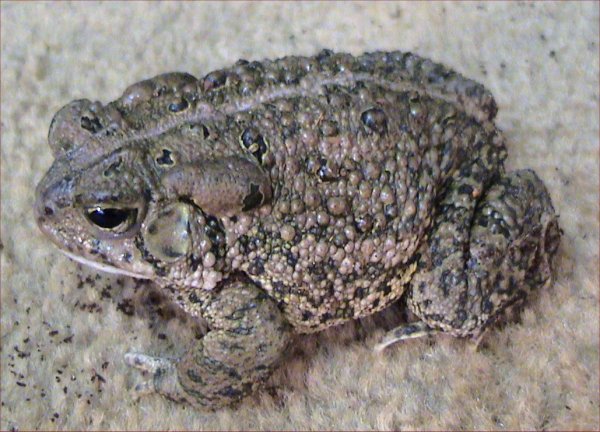
- ›Characterized by a gray-brown to yellowish-brown dorsal surface with dark spots and a pale spinal line.
- ›Primarily nocturnal and feeds on insects and other small invertebrates.
- ›Breeds in still-water habitats like ditches, ponds, and lakes.
- ›Assessed as 'least concern' by the IUCN due to a wide range and stable population.
Woodhouse's Toad
Riparian Corridors, Wooded Land, Wet Meadows, Ponds, Reservoirs, Lakes, Urban Environments, Canals, Irrigated Agricultural Land
Arizona, Arkansas, California, Colorado, Idaho, Kansas, Montana, Nebraska, Nevada, New Mexico, North Dakota, Oklahoma, Oregon, South Dakota, Texas, Utah, Washington, Wyoming, Mexico
Prominent Cranial Crests, Long and Large Parotoid Glands, Pale Line Running Along the Spine, Male With A Single Vocal Sac, Sheep-Like Call
About Anaxyrus woodhousii
Woodhouse's Toad (Anaxyrus woodhousii)
Woodhouse's toad, scientifically known as Anaxyrus woodhousii, is a widespread amphibian species native to the United States and Mexico. This medium-sized toad, reaching up to 127 mm (5 inches) in snout-vent length, is recognized for its robust build and a distinctive vocalization that resembles the bleat of a sheep.
Taxonomy and Subspecies
First described in 1854 by Charles Frédéric Girard, who named it Bufo woodhousii in honor of naturalist Samuel Washington Woodhouse, the species was later reclassified into the genus Anaxyrus in 2006. Anaxyrus woodhousii has three recognized subspecies: the Rocky Mountain toad (A. w. woodhousii), the East Texas toad (A. w. velatus), and the Southwestern Woodhouse's toad (A. w. australis). Historically, Fowler's toad (Anaxyrus fowleri) was once considered a subspecies.
Description and Characteristics
The dorsal surface of Woodhouse's toad typically displays a grayish-brown or yellowish-brown coloration, speckled with small dark spots, and often features a narrow pale line running along the spine. Its belly is usually paler and unspotted. Notable physical features include prominent cranial crests on the head, located in front of and between the eyes, and long, large parotoid glands. Male toads possess a single vocal sac on their throat.
Distribution and Habitat
Woodhouse's toad inhabits a broad geographical range across North America, extending from Mexico northward to Washington state, and found at altitudes up to 2,500 meters (8,200 ft). Its habitat preferences are diverse, encompassing lowland riparian corridors, wooded areas adjacent to streams and rivers, wet meadows, ponds, reservoirs, and lakes. The species also demonstrates adaptability by colonizing human-modified environments such as urban areas, canals, and irrigated agricultural land.
Behavior and Diet
Predominantly nocturnal, Woodhouse's toad feeds on insects and other small invertebrates. They are known to take advantage of human presence, often congregating under outdoor lights to prey on insects attracted to the illumination. This opportunistic feeding behavior contributes to their ecological success.
Reproduction
Breeding activities vary seasonally across the toad's extensive range. Males call from or near bodies of standing water, such as ditches, ponds, pools, cattle tanks, and lakes, to attract mates. Following mating, eggs are deposited in gelatinous strings within these still-water environments. The tadpole stage typically lasts for five to eight weeks before metamorphosis into adult toads.
Conservation Status
The International Union for Conservation of Nature (IUCN) has assessed Woodhouse's toad as 'least concern'. This classification is based on its very wide distribution, presumed large total population, ability to thrive in various habitat types, and a seemingly stable population trend with no significant identified threats. In some areas, such as central Arizona, it has been observed to be displacing or hybridizing with the Arizona toad (Anaxyrus microscaphus).
Source: Wikipedia ↗
Frequently Asked Questions
What is Woodhouse's toad?
Woodhouse's toad (Anaxyrus woodhousii) is a medium-sized amphibian native to the United States and Mexico. It is known for its robust build and a distinctive call that resembles a sheep's bleat.
Where can Woodhouse's toad be found?
This toad has a broad distribution, ranging from Mexico north to Washington state. In the United States, it is found in states like Arizona, California, Colorado, Texas, and Wyoming, inhabiting diverse environments from lowlands to higher altitudes.
What does Woodhouse's toad look like?
Woodhouse's toad typically has a grayish-brown or yellowish-brown back speckled with dark spots, and a pale line running down its spine. Its belly is usually unspotted and paler. It possesses prominent cranial crests and long, large parotoid glands.
What does Woodhouse's toad eat?
Woodhouse's toad is a nocturnal predator that feeds on insects and other small invertebrates. They are often found near human habitations, congregating under outdoor lights to catch attracted insects.
How does Woodhouse's toad reproduce?
Breeding occurs in standing water, with males calling from or near these areas. Eggs are laid in gelatinous strings in still water environments such as ditches, ponds, and lakes. Tadpoles typically metamorphose in five to eight weeks.
What is the conservation status of Woodhouse's toad?
Woodhouse's toad is classified as 'least concern' by the IUCN. This is due to its very wide distribution, presumed large population size, adaptability to various habitats, and a seemingly stable population without identified major threats.
Related Frogs

Anaxyrus terrestris
The southern toad (Anaxyrus terrestris) is a large true toad found in the southeastern United States, commonly inhabiting areas with sandy soils. It is distinguished by knobs on its head and backward-pointing spurs, and its coloration can vary from brick red to mottled gray, brown, or black. This nocturnal species spends its days in burrows and is considered a generalist in its habitat preferences.

American toad
The American toad (Anaxyrus americanus) is a widespread amphibian found across eastern Canada and the United States. It is characterized by its variable coloration, which can range from yellow to brown to black, and its ability to change skin color based on environmental factors. This species is known for its distinctive trilling call during breeding season and its ability to hibernate through the winter.

Anaxyrus boreas
The western toad (Anaxyrus boreas) is a large toad species native to western North America. It is characterized by a white or cream dorsal stripe, dusky gray or greenish coloring, and widely separated parotoid glands. This species is frequently encountered near water and can jump considerable distances, with breeding occurring between March and July.