
Andinobates claudiae
Andinobates claudiae is a species of terrestrial frog native to Panama, belonging to the family Dendrobatidae. It inhabits lowland forests and is distinguished by its terrestrial egg-laying and the parental care of carrying tadpoles to phytotelmata for development. The species is currently classified as endangered due to habitat loss and potential involvement in the illegal pet trade.
Key Facts
- ›Endemic to Panama.
- ›Inhabits lowland forests between 5 and 145 meters above sea level.
- ›Females lay eggs on the ground.
- ›Adults transport tadpoles to phytotelmata for development.
- ›Classified as endangered by the IUCN.
- ›Threatened by deforestation for agriculture and the illegal pet trade.

Lowland Forests
Panama
- Terrestrial Egg-Laying
- Parental Transport of Tadpoles To Phytotelmata
About Andinobates claudiae
Andinobates claudiae is a species of frog that is endemic to Panama. This terrestrial amphibian belongs to the family Dendrobatidae, a group often recognized for its vibrant colors and, in some species, potent toxins, though specific details on toxicity for this species are not provided.
Habitat and Habits
The frog inhabits lowland forests, where it has been observed at elevations ranging from 5 to 145 meters above sea level. A distinctive aspect of its reproductive behavior is the terrestrial laying of eggs by the female. Following hatching, adult frogs undertake the crucial task of carrying the tadpoles to phytotelmata—small water-filled cavities within plants—where the tadpoles can continue their development in a protected environment.
Conservation Status and Threats
Andinobates claudiae is classified as endangered by the International Union for Conservation of Nature (IUCN). Significant threats to its survival include considerable deforestation occurring in Panama, primarily driven by agricultural expansion, particularly on the mainland. Scientists also suspect the species is impacted by the illegal pet trade, although the extent of this involvement is not yet fully understood. The known range of this frog includes one protected area, Bastimentos Island National Park, which offers some refuge.
Source: Wikipedia ↗
Frequently Asked Questions
What is the scientific name of this frog?
The scientific name of this frog species is Andinobates claudiae.
Where is Andinobates claudiae found?
Andinobates claudiae is endemic to Panama. It has been observed in lowland forests within this region.
What are the main threats to Andinobates claudiae?
The primary threats to Andinobates claudiae are deforestation for agricultural purposes and potential involvement in the illegal pet trade. These factors contribute to its endangered status.
How does Andinobates claudiae reproduce?
Female Andinobates claudiae lay their eggs on the ground. Once the eggs hatch, adult frogs carry the tadpoles to phytotelmata, which are small water-filled cavities in plants, for further development.
What is the conservation status of Andinobates claudiae?
The International Union for Conservation of Nature (IUCN) classifies Andinobates claudiae as endangered. This status reflects the significant threats facing the species.
Related Frogs

Andinobates fulguritus
The Andinobates fulguritus, commonly known as the yellow-bellied poison frog, is a small amphibian found in the tropical moist lowland forests of northwestern Colombia and east-central Panama. Its distinctive coloration features a black dorsum with striking gold, yellow, or yellow-green stripes and a yellow or gold venter with black marbling. This species plays a unique role in parental care, with males guarding eggs and transporting tadpoles to protective leaf axils.

Andinobates minutus
The blue-bellied poison frog (Andinobates minutus) is a small, terrestrial frog species found in the tropical moist lowland forests of Colombia and Panama. Known for its aposematic coloration and toxic skin secretions, it is a locally abundant species that prefers mature forests and is threatened by habitat loss and pollution.
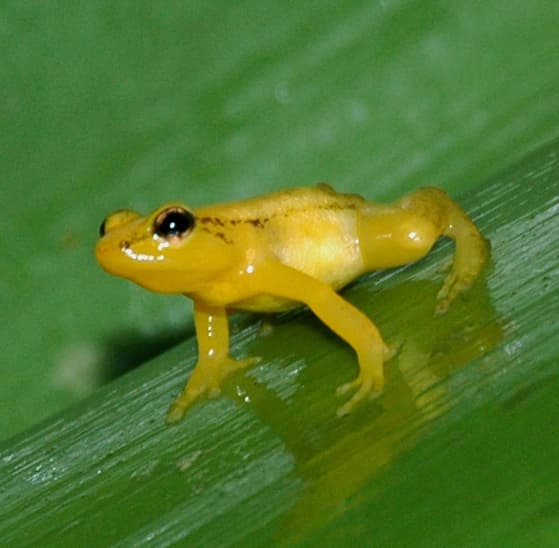
Anomaloglossus beebei
Anomaloglossus beebei, also known as the golden rocket frog, is a small frog species endemic to Guyana's Kaieteur National Park. It is uniquely adapted to living within the phytotelmata, the water-filled leaf axils of the giant bromeliad *Brocchinia micrantha*. This species exhibits reverse sexual dichromatism, with females being more brightly colored than males, and males play a significant role in parental care, defending territories and transporting tadpoles.