
Anomaloglossus beebei
Anomaloglossus beebei, also known as the golden rocket frog, is a small frog species endemic to Guyana's Kaieteur National Park. It is uniquely adapted to living within the phytotelmata, the water-filled leaf axils of the giant bromeliad *Brocchinia micrantha*. This species exhibits reverse sexual dichromatism, with females being more brightly colored than males, and males play a significant role in parental care, defending territories and transporting tadpoles.
Key Facts
- ›Endemic to Kaieteur National Park, Guyana.
- ›Relies on the giant bromeliad *Brocchinia micrantha* for habitat and breeding.
- ›Exhibits reverse sexual dichromatism, with females being more brightly colored.
- ›Males are primarily responsible for parental care, including territorial defense and tadpole transport.
- ›Tadpoles feed on fallen leaves, microorganisms, and sometimes unfertilized eggs laid by females.
- ›Listed as Endangered by the IUCN due to its single-location distribution.
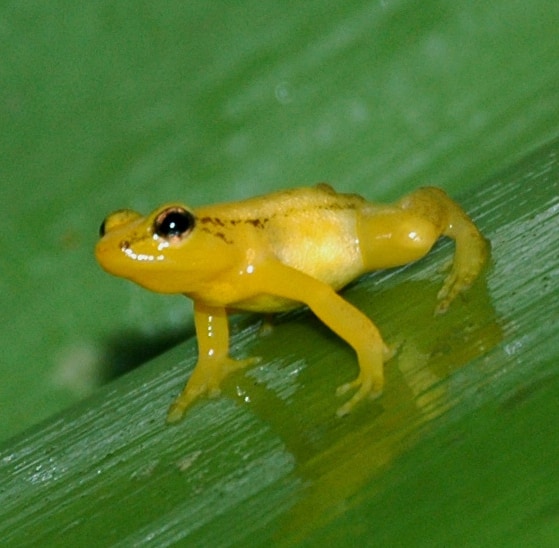
Beebe's Rocket Frog, Golden Rocket Frog
Rainforest, Wetlands, Tropical
Guyana
Grapsid Crabs, Dragonfly Larvae, Spiders
Reverse Sexual Dichromatism, Shorter Finger I Than Finger Ii, Dorsolateral Stripes, Granular Central Skin, Moderate Basal Toe Webbing
About Anomaloglossus beebei
Anomaloglossus beebei, commonly known as the Beebe's rocket frog or golden rocket frog, is a species of frog that inhabits a highly specialized niche within Guyana's Kaieteur National Park. This small amphibian is endemic to this single location, making its conservation status particularly critical.
Habitat and Lifestyle
The golden rocket frog's existence is intrinsically linked to the giant bromeliad Brocchinia micrantha. These frogs exclusively utilize the phytotelmata—the water-filled leaf axils of the bromeliad—for shelter, breeding, and raising their young. The water collected in these phytotelmata is often acidic and low in dissolved oxygen, forming a unique microhabitat. The species is found at an elevation of around 450 meters on the Kaieteur plateau, with its distribution density potentially influenced by the mist from Kaieteur Falls.
Appearance and Sexual Dimorphism
Anomaloglossus beebei exhibits a striking form of reverse sexual dichromatism, meaning the females are more brightly colored than the males. Females display a vibrant golden hue, sometimes developing orange coloration as they mature. In contrast, males are a duller tan with brown pigmentation on their dorsal surfaces, flanks, and legs, which becomes more pronounced when they vocalize. Males have a snout-vent length of up to 16.80 mm. Distinctive features that aid in identification include a shorter first finger compared to the second and dorsolateral stripes.
Behavior and Reproduction
Males play a central role in the reproductive cycle of Anomaloglossus beebei. They actively defend territories within the bromeliads, using advertisement calls to attract females. These calls are characterized by rapid, high-pitched pulses. Upon attracting a female, males use close-range courtship calls to encourage mating. The species demonstrates biparental care; after the female deposits eggs, the male transports the tadpoles to separate phytotelmata. Males also ensure the eggs remain moist by squirting fluid from their cloacae. In the absence of a male, females have been observed to take on parental duties, including tadpole transport and laying trophic eggs for nourishment. Males also engage in territorial disputes with other males, sometimes escalating to physical aggression. The species exhibits the 'dear enemy' effect, a form of social recognition where individuals respond more aggressively to unfamiliar conspecifics than to neighbors.
Diet and Predators
Tadpoles of Anomaloglossus beebei feed on fallen leaves, microorganisms, and algal mats within their phytotelmata. They may also consume unfertilized eggs laid by females. Larger tadpoles can occasionally be cannibalistic towards smaller ones. Predators of the eggs and tadpoles include grapsid crabs, dragonfly larvae, and spiders found within the bromeliads. Adult frogs are also preyed upon by grapsid crabs, though they attempt to minimize these risks.
Conservation Status
Anomaloglossus beebei is listed as Endangered by the IUCN Red List of Threatened Species. This status is primarily due to its extremely restricted range; the species is found only in Kaieteur National Park and occupies an area of less than 20 square kilometers within the park.
Source: Wikipedia ↗
Frequently Asked Questions
What is the scientific name for the golden rocket frog?
The scientific name for the golden rocket frog is *Anomaloglossus beebei*. It was formerly known as *Colostethus beebei*.
Where can Anomaloglossus beebei be found?
This species is endemic to Guyana and is found exclusively in Kaieteur National Park, specifically on the Kaieteur plateau. They inhabit elevations around 450 meters.
What makes Anomaloglossus beebei's habitat unique?
Anomaloglossus beebei primarily lives and breeds within the phytotelmata of the giant bromeliad *Brocchinia micrantha*. These are the water-filled pockets formed by the plant's leaves, which provide essential sites for egg-laying and tadpole rearing.
How do males and females of Anomaloglossus beebei differ in appearance?
Anomaloglossus beebei displays reverse sexual dichromatism. Females are a bright golden color, often with orange coloration development in sexually mature individuals. Males are a duller tan with partial brown pigmentation, which can increase when they are calling.
What is the role of males in the reproduction of Anomaloglossus beebei?
Males are crucial in the reproductive cycle. They defend the bromeliad territories to attract females, deposit eggs, and are responsible for transporting the tadpoles to other phytotelmata. Males also moisten eggs if humidity is low.
What do the tadpoles of Anomaloglossus beebei eat?
Tadpoles feed on fallen leaves and microorganisms within the phytotelmata. They also graze on algal mats and catch prey in the water pools. Females may also lay unfertilized eggs, known as trophic eggs, for the tadpoles to consume.
What are the known predators of Anomaloglossus beebei?
Predators of the eggs and tadpoles include grapsid crabs, dragonfly larvae, and spiders found within the bromeliads. Grapsid crabs are also known to consume adult frogs.
Related Frogs
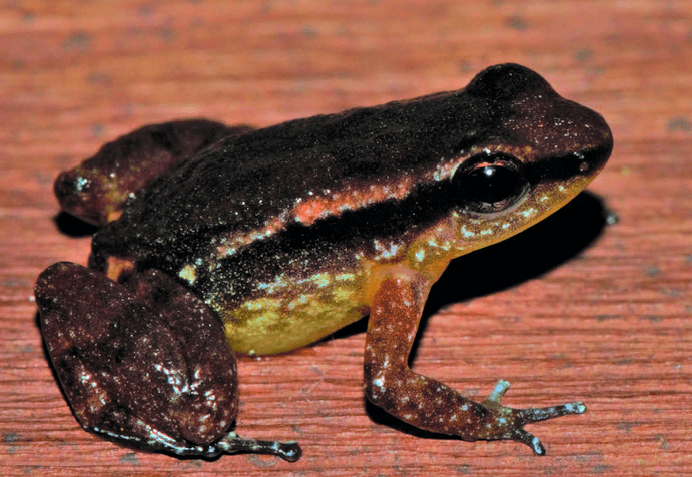
Anomaloglossus baeobatrachus
Anomaloglossus baeobatrachus is a frog species native to the rainforests of northern Brazil, French Guiana, Suriname, and Guyana. This diurnal species is distinguished by its habitat on forest leaf litter and its unique breeding behavior where males call from elevated perches.
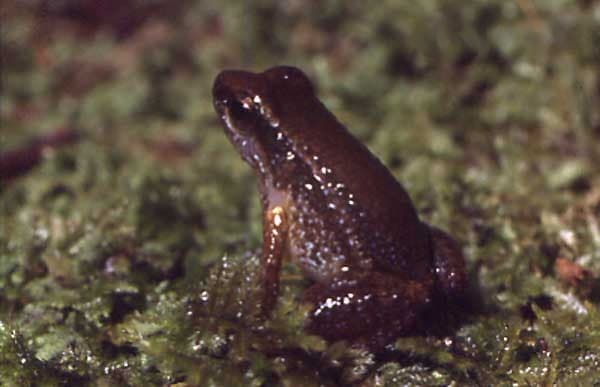
Anomaloglossus stepheni
Anomaloglossus stepheni, also known as Stephen's rocket frog, is a small terrestrial frog native to French Guiana, Suriname, and Brazil. Distinctive for its brown coloration with dark side stripes and bluish-white speckling, it exhibits unique parental care where males guard eggs laid in curled fallen leaves, with tadpoles developing entirely on land.

Andinobates claudiae
Andinobates claudiae is a species of terrestrial frog native to Panama, belonging to the family Dendrobatidae. It inhabits lowland forests and is distinguished by its terrestrial egg-laying and the parental care of carrying tadpoles to phytotelmata for development. The species is currently classified as endangered due to habitat loss and potential involvement in the illegal pet trade.