
Andinobates fulguritus
The Andinobates fulguritus, commonly known as the yellow-bellied poison frog, is a small amphibian found in the tropical moist lowland forests of northwestern Colombia and east-central Panama. Its distinctive coloration features a black dorsum with striking gold, yellow, or yellow-green stripes and a yellow or gold venter with black marbling. This species plays a unique role in parental care, with males guarding eggs and transporting tadpoles to protective leaf axils.
Key Facts
- ›Found in northwestern Colombia and east-central Panama.
- ›Males are 13.5–15 MM and females 14–16.5 MM in snout-vent length.
- ›Dorsum is black with gold, yellow, or yellow-green stripes; venter is gold or yellow with black marbling.
- ›Males deposit sperm before females lay eggs in leaf litter.
- ›Adults transport hatched tadpoles to leaf axils, often bromeliads, for development.
- ›Classified as 'least concern' by the IUCN, but threatened by habitat loss and pollution.

Yellow-Bellied Poison Frog, Yellow-Bellied Poison-Arrow Frog, Yellowbelly Poison Frog
Tropical Moist Lowland Forests
Chocó Department, Westernmost Antioquia, Westernmost Risaralda, East-Central Panama
- Black Dorsum With Gold, Yellow, Or Yellow-Green Lateral Stripes
- Gold Or Yellow Venter With Black Marbling Or Spots
- Small Size
- Slightly Granular Skin On Dorsum, Moderately Granular On Venter
- Fringeless and Web-Less Fingers and Toes
About Andinobates fulguritus
Andinobates fulguritus: The Yellow-Bellied Poison Frog
The Andinobates fulguritus, more commonly known as the yellow-bellied poison frog, is a small amphibian species native to the tropical moist lowland forests of northwestern Colombia and east-central Panama. Its scientific name, "fulguritus," translates to "struck by lightning," possibly alluding to its vibrant coloration.
Description and Appearance
Adult males of the Andinobates fulguritus typically measure between 13.5 and 15 mm in snout-to-vent length, while females are slightly larger, ranging from 14 to 16.5 mm. The frog's dorsal surface is a striking black, contrasted by complete gold, yellow, or yellow-green dorso-lateral and lateral stripes, along with an incomplete median stripe on the anterior part of its back. Its underside, or venter, is a contrasting gold or yellow, often adorned with black marbling or spots. The skin texture is slightly granular on the back and moderately granular on the belly. Both its fingers and toes are devoid of fringes and webbing, and its iris is black.
Habitat and Distribution
This species thrives in tropical moist lowland forest environments. In Colombia, its altitudinal range spans from 160 to 900 meters above sea level, and it may be found at higher elevations in Panama. The Andinobates fulguritus is a terrestrial frog that is considered locally common within its preferred habitats. Its range includes protected areas such as Parque Nacional Chagres and Area de Manejo Especial Nusagandi.
Reproduction and Parental Care
The breeding behavior of the Andinobates fulguritus involves a unique form of parental care. The male frog identifies a suitable site for egg deposition and leads the female to it. Following the male's sperm deposition, the female lays her eggs in the leaf litter. The male then returns periodically to tend to the eggs. Upon hatching, the adult frog takes the tadpoles to leaf axils, often within bromeliads, where they complete their development independently.
Conservation Status
The International Union for Conservation of Nature (IUCN) currently classifies the Andinobates fulguritus as a species of 'Least Concern' for extinction. Despite this classification, the species faces significant threats, primarily from habitat loss due to deforestation for human settlements, logging, and illegal farming. Pollution, particularly from the spraying of pesticides and fertilizers on illegal crops, also poses a risk to its populations. The species does not appear to be widely collected for the pet trade.
Source: Wikipedia ↗
Frequently Asked Questions
What is the Andinobates fulguritus?
The Andinobates fulguritus is a species of frog belonging to the Dendrobatidae family. It is commonly known as the yellow-bellied poison frog and is native to northwestern Colombia and east-central Panama.
What does the Andinobates fulguritus look like?
This frog has a black back with gold, yellow, or yellow-green stripes along its sides and an incomplete median stripe on its back. Its underside is gold or yellow and marked with black spots or marbling. The skin is slightly rough.
Where does the Andinobates fulguritus live?
Its natural habitat consists of tropical moist lowland forests. In Colombia, it is found at altitudes between 160 and 900 meters, and it may occur at higher elevations in Panama.
How does the Andinobates fulguritus reproduce?
The male frog finds a suitable spot for egg-laying and leads the female there. After the male deposits his sperm, the female lays her eggs in the leaf litter. The male then guards the eggs and transports the hatched tadpoles to leaf axils.
What is the conservation status of the Andinobates fulguritus?
The International Union for Conservation of Nature (IUCN) classifies the Andinobates fulguritus as 'least concern' for extinction. However, it faces threats from habitat destruction due to deforestation, logging, and farming, as well as pollution from pesticides and fertilizers.
Related Frogs

Andinobates claudiae
Andinobates claudiae is a species of terrestrial frog native to Panama, belonging to the family Dendrobatidae. It inhabits lowland forests and is distinguished by its terrestrial egg-laying and the parental care of carrying tadpoles to phytotelmata for development. The species is currently classified as endangered due to habitat loss and potential involvement in the illegal pet trade.

Andinobates minutus
The blue-bellied poison frog (Andinobates minutus) is a small, terrestrial frog species found in the tropical moist lowland forests of Colombia and Panama. Known for its aposematic coloration and toxic skin secretions, it is a locally abundant species that prefers mature forests and is threatened by habitat loss and pollution.
Anaxyrus quercicus
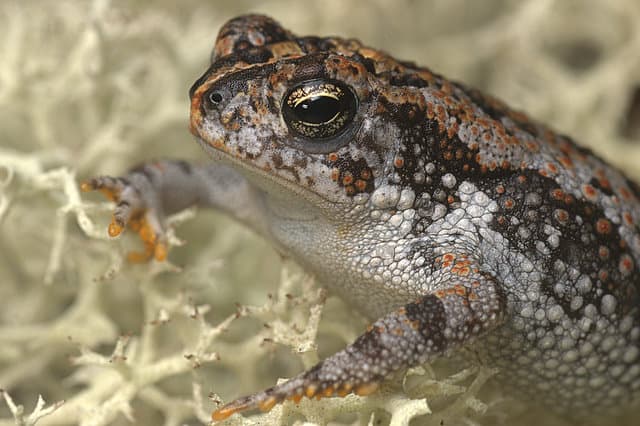
The oak toad (Anaxyrus quercicus) is the smallest toad species in North America, endemic to the coastal regions of the southeastern United States. It is distinguished by its light mid-dorsal stripe, variable spots, and large parotoid glands, and it primarily inhabits sandy pine flatwoods and oak scrub. This species is mostly diurnal and known for its burrowing behavior and a distinctive chirping call produced by males during the breeding season.