
Barbourula kalimantanensis
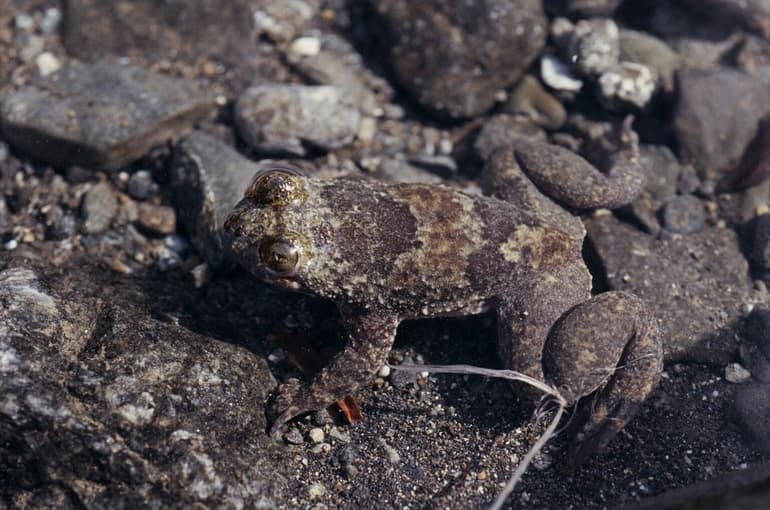
The Bornean flat-headed frog (Barbourula kalimantanensis) is a species endemic to the cold, clear rivers of Kalimantan, Borneo. While once believed to be lungless, subsequent research confirmed it possesses tiny lungs, a characteristic shared with all known frog species. Its flattened body and fully webbed limbs make it well-adapted for its fast-flowing riverine habitat.
Key Facts
- ›Found in cold, clear, fast rivers in remote rainforests of Kalimantan, Borneo.
- ›Possesses a dorsoventrally flattened body with a broad, rounded snout.
- ›Both hands and feet are fully webbed, aiding in its aquatic lifestyle.
- ›General coloration is brown with black mottling.
- ›Listed as Endangered by the IUCN due to habitat loss and degradation.

Bornean Flat-Headed Frog
Rainforest, Rivers
Kalimantan
- Http://Calphotos.Berkeley.Edu/Imgs/512x768/1111_1111/1111/7442.Jpeg
Dorsoventrally Flattened Body, Broad Head With A Rounded Snout, Fully Webbed Hands and Feet, Tiny Lungs
About Barbourula kalimantanensis
The Bornean Flat-Headed Frog: An Aquatic Enigma
The Bornean flat-headed frog, scientifically known as Barbourula kalimantanensis, is a fascinating amphibian species native to the island of Borneo. Its unique morphology and habitat specialization have made it a subject of scientific interest. This species is found exclusively in cold, clear, and fast-flowing rivers nestled within the remote rainforests of Kalimantan, the Indonesian region of Borneo. Its presence has been noted in only a couple of specific locations within the Kapuas River basin.
Physical Characteristics and Adaptations
This frog exhibits a distinctive dorsoventrally flattened body, a broad head with a rounded snout, and robust limbs. These features, combined with fully webbed hands and feet, are clear adaptations for its strictly aquatic lifestyle in turbulent riverine environments. The dorsal skin is smooth, although small tubercles are present on its posterior end and hind legs. The ventral skin is smooth and its general coloration is brown with black mottling, providing camouflage within its riverbed habitat.
A Lunged Frog, Not Lungless
For a significant period, Barbourula kalimantanensis was believed to be the only known frog species lacking lungs, a remarkable evolutionary anomaly. However, more recent investigations using micro CT scanning have revealed that this species does indeed possess lungs, albeit very tiny ones. This finding aligns it with all other known frog species, which also have lungs, however small.
Conservation Concerns
The Bornean flat-headed frog is currently listed as Endangered by the International Union for Conservation of Nature (IUCN). The primary threats to its survival stem from extensive habitat loss and degradation of its vital riverine habitats. These negative impacts are largely driven by increased turbidity and the presence of toxic metals stemming from mining activities, alongside other detrimental consequences of development on the island.
Source: Wikipedia ↗
Frequently Asked Questions
Does the Bornean flat-headed frog have lungs?
Yes, the Bornean flat-headed frog does have lungs. Although it was once thought to be lungless, micro CT scanning revealed that it possesses tiny lungs, similar to other frog species.
What is the habitat of the Bornean flat-headed frog?
This frog is exclusively aquatic and inhabits cold, clear, and fast-flowing rivers. These rivers are typically found in remote areas within the rainforests of Kalimantan, the Indonesian part of Borneo.
What are the main threats to the Bornean flat-headed frog?
The primary threat to this species is habitat loss due to severe degradation of its riverine environment. This degradation is caused by increased turbidity and toxic metals from mining, as well as other negative impacts of development.
What does the Bornean flat-headed frog look like?
It has a flattened body, a broad head with a rounded snout, and robust limbs. Its hands and feet are fully webbed. The dorsal skin is smooth with small tubercles, and its color is typically brown with black mottling.
Related Frogs
Barbourula
Barbourula is a genus of small toads belonging to the fire-bellied toad family, Bombinatoridae. These amphibians are native to the Philippines and Borneo. They are commonly known as jungle toads.

Albanian water frog
The Albanian water frog (Pelophylax shqipericus) is a species of true frog native to western Albania and southern Montenegro. This medium-sized amphibian is characterized by green to light brown coloration with large dark spots, and males may display a distinctive bright green stripe down their backbone. It is an endangered species, with populations declining due to habitat pollution, wetland drainage, and aggressive collection for commercial purposes.

Allobates brunneus
Allobates brunneus, commonly known as the Chupada rocket frog, is a small frog species found in the southern Amazon drainage of Brazil and northern Bolivia. It is distinguished by its varied dorsal coloration, distinct leg striping, and sexually dimorphic throat and belly colors. This species is classified as endangered primarily due to habitat loss.