
Allobates brunneus
Allobates brunneus, commonly known as the Chupada rocket frog, is a small frog species found in the southern Amazon drainage of Brazil and northern Bolivia. It is distinguished by its varied dorsal coloration, distinct leg striping, and sexually dimorphic throat and belly colors. This species is classified as endangered primarily due to habitat loss.
Key Facts
- ›Found in the southern Amazon drainage of Brazil and northern Bolivia.
- ›Adult males range from 14.8–18.3 MM and females from 15.8–19.8 MM in snout-vent length.
- ›Possesses varied markings such as hourglass, diamond, or triangle shapes on its dorsum.
- ›Males have yellow-green throats and chests, while females have white throats and chests with some yellow.
- ›Eggs are laid on living or curled leaves, and adults transport hatched tadpoles to water.
- ›Classified as endangered due to threats like habitat loss from fires, agriculture, and urbanization.

Chupada Rocket Frog
Rainforest, Wetlands, Swamps
Mato Grosso, Amazonas
- Hourglass, Diamond, Or Triangle Markings On Dorsum
- Dark Stripes On Legs
- Sexually Dimorphic Throat and Belly Coloration
- White Stripe From Eye To Groin
- Partially Gold Iris With Black Reticulations
About Allobates brunneus
Allobates brunneus, commonly referred to as the Chupada rocket frog, is a small amphibian species belonging to the Aromobatidae family. It is indigenous to the southern Amazon drainage, with its range extending across parts of Brazil, including Mato Grosso and Amazonas, and into the northernmost regions of Bolivia. This species can be easily confused with other, sometimes undescribed, frog species, making its precise identification crucial.
Description and Characteristics
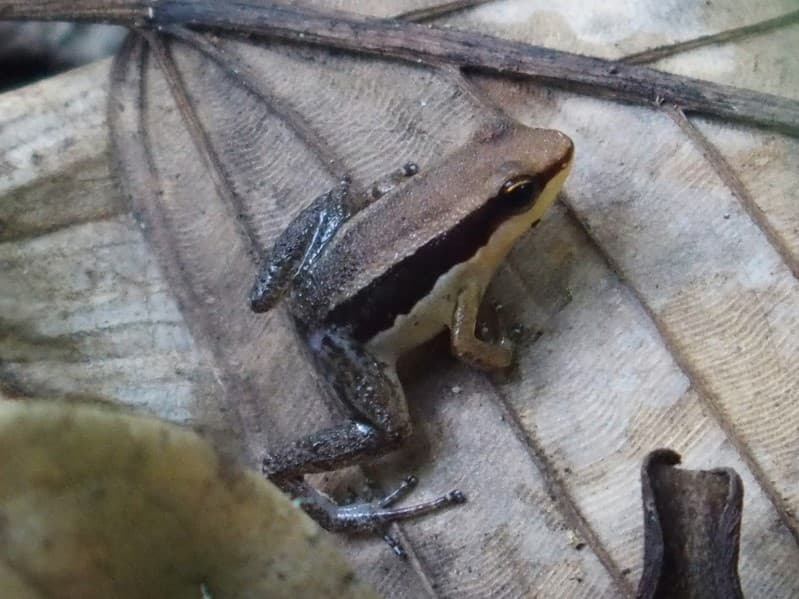
The Chupada rocket frog exhibits distinct physical traits that vary between sexes. Adult males typically measure between 14.8 and 18.3 millimeters in snout-vent length, while females are slightly larger, ranging from 15.8 to 19.8 millimeters. The dorsal skin color can range from light gray to orange-brown and may display unique markings such as hourglass, diamond, or triangular shapes. A notable characteristic is the coloration of their legs: the front legs are orange-brown on top, while the hind legs are gray, both featuring dark stripes. Sexual dimorphism is evident in their ventral coloration; males possess a yellow-green throat and a yellow chest and belly marked with dark spots. Females, conversely, have a white throat with only some yellow coloration, and their chest and belly are also white. A light brown or orange-brown stripe runs along each side of their body, complemented by a white stripe extending from the eye to the groin. The iris of the eye is partially gold with black reticulations, with the remaining portion being brown.
Habitat and Distribution
Allobates brunneus occupies specific microhabitats within its geographic range. In Brazil, it is found in Buritizais within Cerrado swamps. Outside of this specific environment, the frog has been observed near lakes and stagnant pools in rainforests. Its known habitat generally lies between 140 and 380 meters above sea level. The species' range encompasses at least two protected areas: Parque Nacional Chapada dos Guimarães and Area de Proteção Ambiental (APA) da Chapada dos Guimarães. Scientists also believe it may reside in the Area de Proteção Ambiental Municipal Aricá-açu, further indicating its presence in ecologically significant regions.
Reproduction and Life Cycle
The reproductive strategy of Allobates brunneus involves the female laying eggs on living leaves in the understory or on curled leaves found on the ground. Following the hatching of these eggs, adult frogs play an active role in their offspring's survival by carrying the tadpoles to a suitable water source. The tadpoles themselves are characterized by a gray-brown coloration, with additional brown and silver markings.
Conservation Status and Threats
Allobates brunneus is currently classified as endangered by the IUCN. The primary factors contributing to its decline are habitat degradation and loss. These threats include frequent fires, the expansion of agriculture, particularly soybean plantations, livestock cultivation, and illegal logging operations for charcoal production. A significant historical impact on its habitat was the flooding of the site where the species was first described, which was submerged to create the Manso Hydroelectrical Plant's artificial lake. In certain areas within its range, urbanization also poses a considerable threat to the frog's survival.
Source: Wikipedia ↗
Frequently Asked Questions
What is the common name for Allobates brunneus?
Allobates brunneus is commonly known as the Chupada rocket frog. This name likely relates to its appearance or its rapid movements.
Where is Allobates brunneus found?
This species is found in the southern Amazon drainage, specifically in regions of Brazil such as Mato Grosso and Amazonas, extending into extreme northern Bolivia.
What does Allobates brunneus look like?
Adult Allobates brunneus frogs have a dorsum that can be light gray or orange-brown, often with hourglass, diamond, or triangle markings. They have distinct dark stripes on their legs and their throat and belly coloration differs between males and females.
What are the main threats to Allobates brunneus?
The primary threats to Allobates brunneus are habitat loss due to fires, agricultural expansion (especially soybean plantations), livestock cultivation, illegal logging, and urbanization. The creation of hydroelectric dams has also impacted its habitat.
How does Allobates brunneus reproduce?
Female Allobates brunneus typically lay their eggs on living leaves in vegetated areas, or sometimes on leaves on the ground. Adult frogs then carry the newly hatched tadpoles to a water source.
Related Frogs

Albanian water frog
The Albanian water frog (Pelophylax shqipericus) is a species of true frog native to western Albania and southern Montenegro. This medium-sized amphibian is characterized by green to light brown coloration with large dark spots, and males may display a distinctive bright green stripe down their backbone. It is an endangered species, with populations declining due to habitat pollution, wetland drainage, and aggressive collection for commercial purposes.
Allobates conspicuus
Allobates conspicuus is a species of frog native to western Brazil and eastern Peru. This diurnal amphibian inhabits bamboo and other forests, including disturbed and regenerating areas, at elevations between 250 and 550 meters. Despite facing threats from agriculture and logging, its conservation status is currently listed as Least Concern.
Allobates femoralis
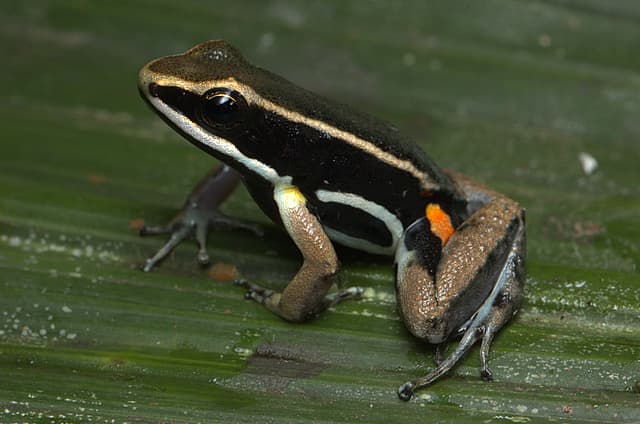
Allobates femoralis, also known as the brilliant-thighed poison frog, is a species of terrestrial frog found in the Amazon basin and tropical eastern South America. This species is distinguished by its vibrant orange-yellow thigh patches and its complex reproductive behaviors, including extended male courtship and the male's role in guarding eggs and transporting tadpoles to water bodies.