
Chacaltaya
Glacier (historical)·Bolivia·South America·Alpine
Chacaltaya was a mountain in the Bolivian Andes, notable for its glacier which served as South America's northernmost and the world's highest lift-served ski resort. The glacier, estimated to be 18,000 years old, experienced rapid melting and disappeared entirely by 2009, highlighting the significant impact of climate change on Andean water resources.
Key Facts
- ›Chacaltaya's glacier was approximately 18,000 years old.
- ›It was the highest lift-served ski area in the world and the northernmost in South America.
- ›The glacier's area decreased from 0.22 km2 in 1940 to 0.01 km2 by 2007.
- ›The glacier completely disappeared by 2009.
- ›The Mount Chacaltaya Laboratory, located at 5,240 meters, is a site for scientific research, including cosmic rays and atmospheric monitoring.
- ›The ski resort restaurant held the Guinness World Record for the highest restaurant in the world.

Known For
- World's highest lift-served ski area
- Northernmost ski resort in South America
- Rapid glacial melt and disappearance
- High-altitude astronomical and atmospheric research
Mount Chacaltaya Laboratory, Highest Restaurant In the World, Rope Tow
About Chacaltaya
Chacaltaya: A Vanished Glacier and a High-Altitude Research Hub
Chacaltaya, a name derived from Mollo and Aymara languages meaning "bridge of winds" or "cold road," is a prominent mountain within the Cordillera Real of the Bolivian Andes. Standing at an elevation of 5,421 meters (17,785 ft), Chacaltaya was once crowned by a glacier estimated to be 18,000 years old. This glacier was not only a significant natural feature but also the foundation for Bolivia's sole ski resort, which held the distinction of being the world's highest lift-served ski area and the northernmost in South America.
The Retreat and Disappearance of the Glacier
In 1940, the Chacaltaya glacier covered an area of 0.22 km² (0.085 sq mi). However, scientific measurements, particularly from the 1990s onwards, revealed a stark and accelerated rate of melting. By 2007, the glacier's area had diminished to a mere 0.01 km² (0.0039 sq mi). The final phase of its meltdown, heavily influenced by reduced precipitation and the El Niño phenomenon, led to its complete disappearance by 2009. This rapid vanishing served as a potent symbol of the vulnerability of Andean glaciers to climate change and the potential threats to water security for millions.
A Legacy of Science and Recreation
Beyond its role as a ski destination, Chacaltaya has been a vital center for scientific research. The Mount Chacaltaya Laboratory, established in 1942 at an elevation of 5,240 meters (17,190 ft), has been instrumental in various fields. It was the site of early cosmic ray research, including the first observations of pions in the 1940s. Currently, the observatory, operated by the Universidad Mayor de San Andrés in collaboration with international institutions, hosts a cosmic ray research group and a Global Atmosphere Watch (GAW) station. This GAW station is crucial for monitoring essential climate variables in the Southern Hemisphere, contributing to a global understanding of atmospheric conditions and climate change. While the ski resort is no longer operational due to the glacier's absence, the mountain remains a popular destination for mountaineers, and its scientific installations continue to operate at high altitude.
Source: Wikipedia ↗
Frequently Asked Questions
What is Chacaltaya?
Chacaltaya is a mountain in the Bolivian Andes, part of the Cordillera Real. It was historically known for its glacier, which supported the world's highest ski resort.
What happened to the Chacaltaya glacier?
The glacier on Chacaltaya experienced rapid melting due to factors including missing precipitation and the warm phase of El Niño. It had significantly reduced in size by 2007 and was completely gone by 2009.
Why was the Chacaltaya glacier important?
The glacier was significant as it hosted Bolivia's only ski resort, which was the highest lift-served ski area globally. Its meltwater also contributed to the water supply for communities in the Altiplano and cities like La Paz.
What scientific research is conducted at Chacaltaya?
The Mount Chacaltaya Laboratory is an important site for scientific research. It has been used for gamma ray research, early observations of pions, and currently hosts a cosmic ray research group and a Global Atmosphere Watch station monitoring climate variables.
Is skiing still possible at Chacaltaya?
Since the glacier's disappearance in 2009, skiing is now restricted to a small, infrequent stretch that sometimes receives enough snowfall during winter. The former ski resort is no longer operational in its historical capacity.
Related Glaciers

Amalia Glacier
Amalia Glacier, also known as Skua Glacier, is a tidewater glacier situated in Bernardo O'Higgins National Park, Chile. Originating from the Southern Patagonian Ice Field, it is notable for its significant retreat between 1945 and 1986, which was among the most dramatic observed in the region during that period. The glacier also plays a role in shaping the landscape by partially surrounding and eroding the northern flank of the Reclus volcano.
Colonia Glacier
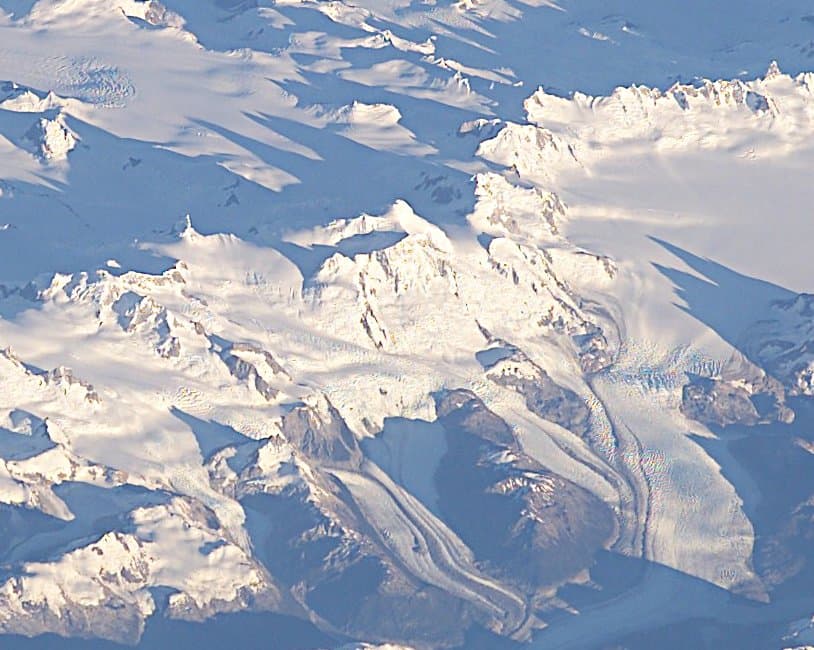
Colonia Glacier is a valley glacier situated in Chile's Northern Patagonian Ice Field. It is notable for damming two lakes, Cachet II and Arco Lake, and is particularly known for the regular glacial lake outburst floods (GLOFs) originating from Lake Cachet II. These floods, caused by perforations in the glacial ice due to rising temperatures, have increased in frequency, highlighting the glacier's sensitivity to climate change.

Jorge Montt Glacier
Jorge Montt Glacier is a significant tidewater glacier located in Chile's Aisén Region, within Bernardo O'Higgins National Park. It is notable for its rapid thinning and substantial retreat, which has been linked to both climate warming and the unique bathymetry of its fjord. The glacier plays a role in the local environment, calving icebergs into the Baker Channel.