
Jorge Montt Glacier
Jorge Montt Glacier is a significant tidewater glacier located in Chile's Aisén Region, within Bernardo O'Higgins National Park. It is notable for its rapid thinning and substantial retreat, which has been linked to both climate warming and the unique bathymetry of its fjord. The glacier plays a role in the local environment, calving icebergs into the Baker Channel.
Key Facts
- ›The glacier is situated at the northern end of the Southern Patagonian Ice Field.
- ›Its total drainage area covers approximately 510 square kilometers.
- ›Ice thinning has been most pronounced at lower elevations, averaging 3.3 meters per year between 1975 and 2000.
- ›The calving front experienced a retreat of 8.5 kilometers between 1975 and 2000.
- ›In 2010-2011, the glacier was observed to shrink by roughly 82 feet daily.
- ›Evidence suggests the glacier advanced over a mature southern beech forest during the Little Ice Age.

Known For
- rapid thinning
- significant retreat
- calving icebergs into Baker Channel
- advancing over a forest during the Little Ice Age
Calving Front
Bernardo O'Higgins National Park
About Jorge Montt Glacier
Jorge Montt Glacier is a significant tidewater glacier located in the Aisén Region of Chile, situated south of the town of Caleta Tortel. It resides at the northern extremity of the vast Southern Patagonian Ice Field and is an integral part of Bernardo O'Higgins National Park. The glacier's calving front is found in close proximity to the mouth of the Pascua River.
Ice Dynamics and Retreat
The glacier's total drainage area encompasses approximately 510 square kilometers. Scientific observations have highlighted a concerning trend of rapid ice thinning, particularly at lower elevations where atmospheric temperatures are highest. Between 1975 and 2000, the ice thinning averaged 3.3 meters per year across the entire glacier, escalating to an alarming 18 meters annually at its lowest points. This accelerated thinning has led to a substantial retreat of the glacier's calving front, which receded by 8.5 kilometers over those 25 years. Further studies in 2010-2011 revealed an even more dramatic daily shrinkage rate of roughly 82 feet, with the glacier receding over half a mile within a single year.
Contributing Factors and Past Environment
Research, including a study presented by glaciologist Andrés Rivera, suggests that the unique rate of retreat is primarily influenced by the peculiar bathymetry of the fjord into which the glacier flows. A warming climate is identified as a secondary contributing factor. In 2010, the discovery and subsequent dating of Nothofagus (southern beech) remnants provided compelling evidence of a past environment. These tree samples, yielding burial ages between 460 and 250 years BP, indicate that the area was once covered by a mature, old-growth forest. This forest, dominated by individuals of Nothofagus betuloides with an average age near 150 years, co-existed for nearly three centuries before being overwhelmed by the advance of Glaciar Jorge Montt during the Little Ice Age period.
Source: Wikipedia ↗
Frequently Asked Questions
Where is Jorge Montt Glacier located?
Jorge Montt Glacier is located in the Aisén Region of Chile, south of Caleta Tortel. It is part of Bernardo O'Higgins National Park and lies at the northern edge of the Southern Patagonian Ice Field.
What is the rate of retreat for Jorge Montt Glacier?
The glacier has experienced significant retreat. Between 1975 and 2000, its calving front retreated 8.5 km. More recently, between February 2010 and January 2011, it was observed to be receding more than half a mile (over 80 feet per day).
What causes Jorge Montt Glacier to retreat so rapidly?
The rapid retreat is primarily attributed to the peculiar bathymetry of the fjord in which the glacier terminates, and secondarily to a warming climate. Ice thinning is most severe at lower elevations due to higher air temperatures.
Is Jorge Montt Glacier a tidewater glacier?
Yes, Jorge Montt Glacier is a tidewater glacier. It terminates in a fjord and calves icebergs into the Baker Channel.
What evidence exists of past forest cover near Jorge Montt Glacier?
In 2010, remnants of nothofagus (southern beech) were discovered near the glacier. Radiocarbon dating of these remnants yielded ages between 460 and 250 years BP, indicating the area was once covered by a mature, old-growth forest that was destroyed by the glacier's advance during the Little Ice Age.
Related Glaciers

Bernardo Glacier
Bernardo Glacier is a significant glacier situated within Bernardo O'Higgins National Park in Chile. It is one of the largest glaciers in the Southern Patagonian Ice Field and flows westward into Bernardo Fjord, making it a notable feature of the region's glacial landscape.
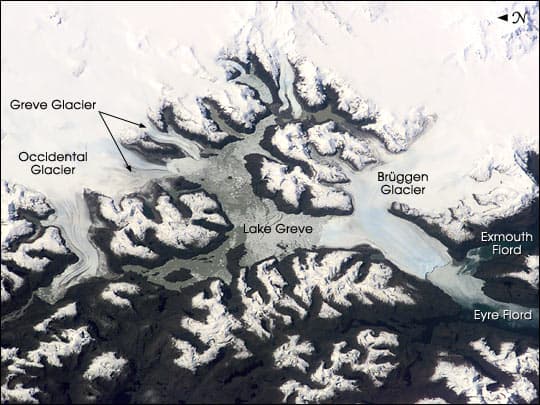
Brüggen Glacier
Brüggen Glacier, also known as Pío XI Glacier, is the largest western outflow from the Southern Patagonian Ice Field in southern Chile. It holds the distinction of being the longest glacier in the Southern Hemisphere outside of Antarctica, with a length of approximately 66 km. Notably, unlike many glaciers globally, Brüggen Glacier experienced significant advancement between 1945 and 1976, surging several kilometers and altering the local fjord landscape.
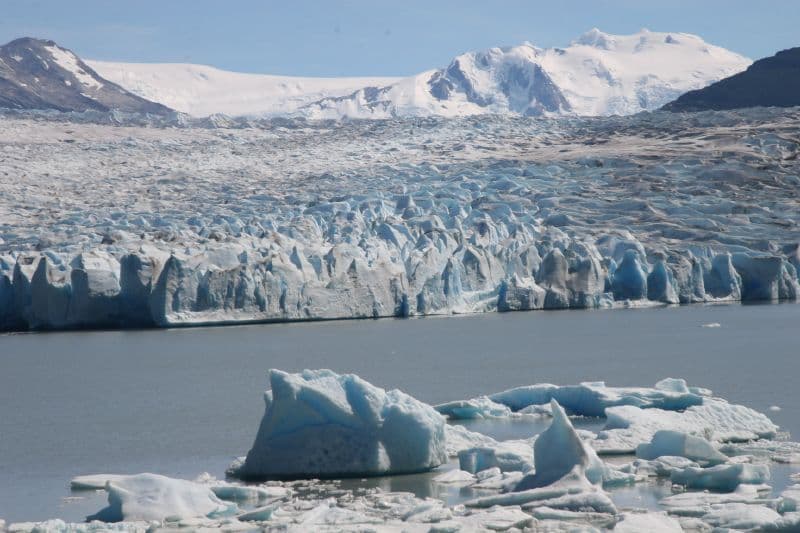
Grey Glacier
Grey Glacier is a significant glacier located in the Southern Patagonian Ice Field, west of the Cordillera del Paine. It flows southward into the lake of the same name, a process that can result in large icebergs calving off its front. The glacier is a notable feature within the Torres del Paine National Park, offering dramatic views for visitors.