
Fox Glacier
Maritime Glacier·New Zealand·Oceania·Temperate Maritime
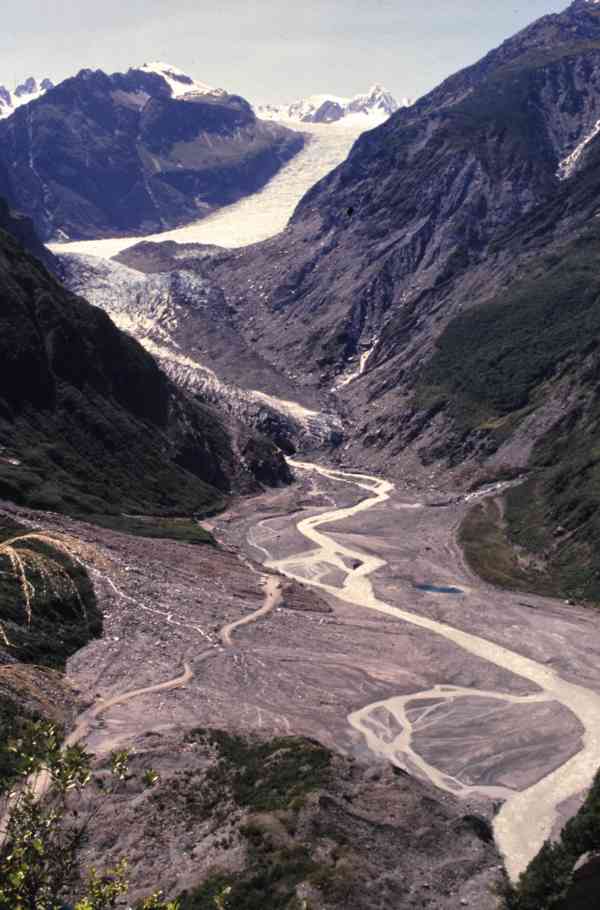
Fox Glacier, known to Māori as Te Moeka o Tuawe, is an 11.7-kilometer-long temperate maritime glacier situated in Westland Tai Poutini National Park on New Zealand's South Island. It is one of the most accessible glaciers globally, with its terminal face descending to a low elevation, making it a significant tourist attraction and a key indicator of climate change.
Key Facts
- ›It is 11.7 km long, making it the third largest glacier in New Zealand.
- ›Its terminal face reaches as low as 300 meters above sea level.
- ›Fox Glacier advanced between 1985 and 2009 but has been significantly retreating since then.
- ›The glacier is fed by four alpine glaciers and descends 2,600 meters from the Southern Alps.
- ›Heavy precipitation, often over 8 meters annually, significantly influences the glacier and its valley.
- ›Access to the glacier has been severely impacted or closed due to landslides and flooding.
Known For
- Accessibility
- Low terminal face elevation
- Tourist attraction
- Sensitivity to climate change
Lake Matheson, Moraines Left From Past Ice Ages
Westland Tai Poutini National Park
About Fox Glacier
What is Fox Glacier?
Fox Glacier, known in Māori as Te Moeka o Tuawe, is a significant temperate maritime glacier located within Westland Tai Poutini National Park on the rugged West Coast of New Zealand's South Island. Stretching approximately 11.7 kilometers and covering about 32 square kilometers with its tributaries, it ranks as the third-largest glacier in New Zealand. Its remarkable accessibility, with a terminal face descending to as low as 300 meters above sea level near the village of Fox Glacier, has established it as a major draw for tourists.
Geography and Climate
Fed by four alpine glaciers, Fox Glacier descends a dramatic 2,600 meters from the Southern Alps, carving its path towards the coast and ending remarkably close to a temperate rainforest. The glacier lies within the Fox Glacier / Te Moeka o Tuawe catchment, an area characterized by extreme relief, rising from sea level to peaks around 3,000 meters within a short distance. The region receives substantial precipitation, with the higher alpine areas receiving over 10 meters annually, a factor that significantly shapes the glacier and its valley. This heavy rainfall, often intensified by atmospheric rivers, can trigger landslides and debris flows, impacting the landscape and glacier dynamics.
Advance and Retreat
Fox Glacier has exhibited dynamic behavior in recent history. After retreating for much of the preceding century, it experienced an advance phase between 1985 and 2009, with its terminal face still advancing in early 2009. However, since then, the glacier has undergone a significant retreat. By 2022, it had retreated beyond its 1984 minimum, reaching its shortest recorded length. This rapid response to climate variability, with an estimated time lag of 3 to 9 years, makes Fox Glacier a crucial indicator of climate change.
Tourism and Accessibility
Historically, Fox Glacier has been a prime destination for tourists, with guided tours and easy access to view its impressive ice face. However, recent extreme weather events have severely impacted accessibility. In March 2019, heavy rains caused extensive flooding and a massive landslide that destroyed sections of the glacier access road and car park. This has led to the indefinite closure of the road, with access to the glacier now primarily facilitated by helicopter. Despite these challenges, efforts are underway to develop alternative tourism projects around the Fox Glacier area.
Source: Wikipedia ↗
Frequently Asked Questions
What is the Māori name for Fox Glacier?
The glacier is known by local Māori as Te Moeka o Tuawe, which translates to 'The bed of Tuawe'. This name originates from an oral tradition about Hine Hukatere and her lover Tuawe.
When was Fox Glacier first explored by Europeans?
In 1857, local Māori guided Europeans Leonard Harper and Edwin Fox to the glaciers, marking the first European sighting. German geologist Julius von Haast was the first to extensively explore and survey the glaciers in 1865.
Why is Fox Glacier considered accessible?
Fox Glacier is one of the most accessible glaciers in the world because its terminal face descends to a very low altitude, as low as 300 meters above sea level, situated close to the village of Fox Glacier.
Has Fox Glacier always been retreating?
No, Fox Glacier has experienced cycles of advance and retreat. It advanced between 1985 and 2009, with its terminal face still advancing in January 2009. However, it has retreated significantly since then, reaching its shortest recorded length by 2022.
What is the impact of climate change on Fox Glacier?
Human-induced climate change is affecting precipitation patterns around the glacier, leading to increased rainfall intensity. These events can cause landslides and floods, impacting the glacier's environment and access. The glacier's sensitivity to climate variability causes its terminus to respond rapidly to changes in mass balance.
What caused the recent closure of access roads to Fox Glacier?
On March 26, 2019, heavy rains triggered an enormous landslide in the Fox River valley. This landslide washed away a significant portion of the northern glacier access road and destroyed the car park, leading to its indefinite closure.
Related Glaciers

Franz Josef Glacier
Franz Josef Glacier, or Kā Roimata o Hine Hukatere in Māori, is a temperate maritime glacier located in Westland Tai Poutini National Park on New Zealand's South Island. It is notable for its rapid descent from high-altitude snowfields to near sea level, allowing it to coexist with temperate rainforest and making it a significant tourist attraction. The glacier is known for its dynamic behavior, exhibiting cycles of advance and retreat influenced by precipitation patterns.

Hooker Glacier
Hooker Glacier is a significant glacial feature situated near Aoraki / Mount Cook in New Zealand's Southern Alps. Despite being smaller than its neighbor, the Tasman Glacier, it plays a crucial role in the local hydrology, forming the source of the Hooker River. Its accessibility makes it a popular destination for both casual walkers and serious mountaineers.

Tasman Glacier
The Tasman Glacier is New Zealand's largest glacier, located within Aoraki / Mount Cook National Park on the South Island. It is a significant geographical feature, flowing south and east from the Southern Alps, and is a prominent subject of study due to its rapid recent retreat.