
Northern Ice Field (Mount Kilimanjaro)
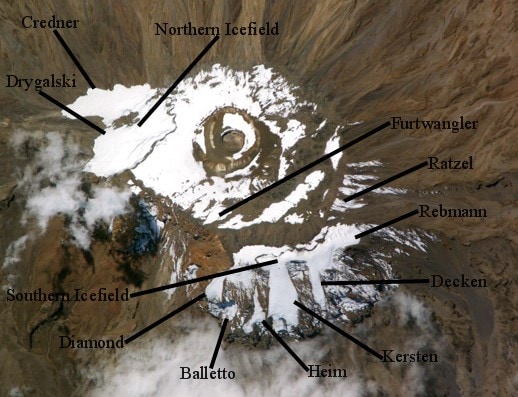
The Northern Ice Field is a significant remnant of glacial ice located on the western slope of Mount Kilimanjaro in Tanzania. Historically connected to other ice fields, it has substantially shrunk, serving as a crucial indicator of climate change in tropical regions.
Key Facts
- ›The Northern Ice Field is the largest remaining ice body on Mount Kilimanjaro.
- ›Its area has decreased significantly, with an 85 percent loss in glaciated areas on the mountain by 2011 compared to 1912.
- ›Ice core samples from the Northern Ice Field date back to approximately 11,500 years ago.
- ›The ice field has experienced thinning, with an average reduction of 1.9 meters between 2000 and 2007.
- ›By 2011, the Northern Ice Field had split into two distinct sections.
- ›The current retreat is attributed to warmer and drier climatic conditions.
Known For
- Being the largest remaining ice body on Mount Kilimanjaro
- Its significant retreat as an indicator of climate change
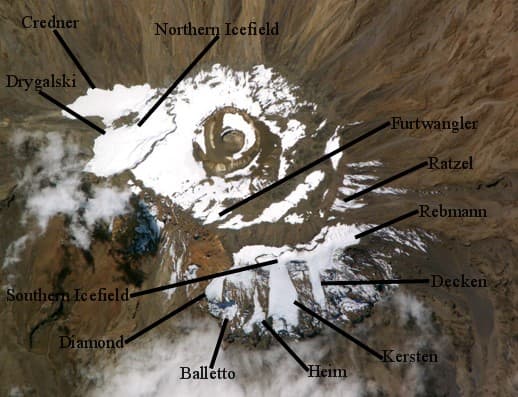
Credner Glacier, Drygalski Glacier, Great Penck Glacier, Little Penck Glacier
About Northern Ice Field (Mount Kilimanjaro)
The Northern Ice Field is one of the significant remaining glacial bodies situated on Mount Kilimanjaro in Tanzania, located on the peak's western slope. Historically, it was connected to other ice fields, forming a continuous expanse of glacial ice atop the mountain when first scientifically documented in 1912. This ice field serves as a critical indicator of global climate change, particularly in tropical regions.
Historical Context and Changes
When first studied in 1912, the glaciated areas of Mount Kilimanjaro covered approximately 11.40 square kilometers. By 2011, this had drastically reduced to 1.76 square kilometers, representing an 85 percent loss. The Northern Ice Field, once part of a larger connected system, separated from the Southern Ice Field by 1962 and from the Eastern Ice Field by 1975. In 2007, it was measured as the largest remaining ice mass on Kilimanjaro, spanning 0.95 square kilometers.
Climate and Ice Core Records
Ice core samples extracted from the Northern Ice Field provide insights into past climatic conditions. Samples date back to the end of the Younger Dryas period, approximately 11,500 years ago. These cores reveal dust deposits that coincide with periods of suspected warming, such as the Medieval Warm Period (1000–1270 AD). Evidence also suggests that during the Little Ice Age (1270–1850 AD), the Northern Ice Field and other glacial areas likely expanded due to both lower temperatures and increased precipitation.
Current Retreat and Future Outlook
The current rapid retreat of the glaciers on Mount Kilimanjaro is primarily attributed to warmer and drier climatic conditions. While tropical glaciers are more sensitive to moisture than those in other latitudes, the increase in radiational heating due to drier air exacerbates glacial loss. This pattern of decline is projected to continue, with forecasts suggesting that most of Kilimanjaro's ice could disappear by 2040. Notably, since 1984, the Northern Ice Field has developed a central hole that evolved into a canyon by 2003, exposing bedrock unseen for millennia. By 2011, the ice field had divided into two separate sections, and between 2000 and 2007, it thinned by an average of 1.9 meters.
Source: Wikipedia ↗
Frequently Asked Questions
Where is the Northern Ice Field located?
The Northern Ice Field is situated on Mount Kilimanjaro in Tanzania, specifically on the west slope near the summit.
How large is the Northern Ice Field?
As of 2007, the Northern Ice Field was the largest body of ice remaining on Mount Kilimanjaro, covering an area of 0.95 square kilometers (0.37 sq mi).
What is the history of the Northern Ice Field's size?
When first scientifically examined in 1912, the glaciated areas of Mount Kilimanjaro covered 11.40 square kilometers. By 2011, this had reduced to 1.76 square kilometers, an 85 percent loss. The Northern and Eastern Ice Fields separated from the Southern Ice Field by 1975.
What do ice cores from the Northern Ice Field reveal?
Ice core samples date back to the end of the Younger Dryas, around 11,500 years ago. They also show dust deposits coinciding with warming periods like the Medieval Warm Period and indicate expansion during the Little Ice Age due to cooler and wetter conditions.
Why are glaciers on Mount Kilimanjaro retreating?
The retreat is attributed to warmer and drier conditions compared to the Little Ice Age. Tropical glaciers are particularly sensitive to moisture, and drier conditions increase radiational heating, though a warming climate is the primary driver of glacial loss.
What is the future outlook for the Northern Ice Field?
The current pattern of retreat is expected to continue, with projections suggesting that most or all of the ice on Mount Kilimanjaro could be gone by 2040.
Are there any notable changes to the ice field's structure?
Since 1984, a hole developed near the center of the Northern Ice Field, which by 2003 had opened into a canyon, exposing rocks for the first time in 11,000 years. By 2011, the ice field had split into two sections.
Related Glaciers

Northern Patagonian Ice Field
The Northern Patagonian Ice Field is a significant remnant of the larger Patagonian Ice Sheet, located in southern Chile. It is the second-largest continuous ice mass outside of the polar regions and plays a crucial role in the regional hydrology, feeding numerous rivers and lakes.

Southern Patagonian Ice Field
The Southern Patagonian Ice Field is the world's second-largest contiguous extrapolar ice field, situated in the Southern Patagonic Andes between Chile and Argentina. It is a significant remnant of the much larger Patagonian Ice Sheet that covered the region during the last glacial period, feeding numerous glaciers that flow into both the Pacific and Atlantic oceans.
Arrow Glacier
Arrow Glacier is a small, recently named glacial remnant located on the west slope of Mount Kilimanjaro in Tanzania. It represents a tiny fraction of the icecap that once covered the mountain's summit and is situated at a very high elevation.