
Southern Patagonian Ice Field
Ice Field·Chile and Argentina·South America·Alpine
The Southern Patagonian Ice Field is the world's second-largest contiguous extrapolar ice field, situated in the Southern Patagonic Andes between Chile and Argentina. It is a significant remnant of the much larger Patagonian Ice Sheet that covered the region during the last glacial period, feeding numerous glaciers that flow into both the Pacific and Atlantic oceans.
Key Facts
- ›It is the world's second-largest contiguous extrapolar ice field.
- ›It extends approximately 350 kilometers (220 MI) from south to north.
- ›Its total area is approximately 16,480 km², with the majority belonging to Chile.
- ›It feeds major glaciers such as Upsala, Viedma, Perito Moreno, Pío XI, O'Higgins, Grey, and Tyndall.
- ›Two volcanoes, Lautaro and Viedma, are located beneath the ice field.
- ›The border demarcation within the ice field remains a point of contention between Chile and Argentina.

Known For
- its size as the world's second-largest contiguous extrapolar ice field
- feeding numerous large glaciers
- its role in territorial disputes between Chile and Argentina
- Lautaro Volcano
- Viedma Volcano
- Circo De Los Altares
- Numerous Outlet Glaciers Flowing To Fjords and Lakes
Bernardo O'Higgins National Park, Torres Del Paine National Park, Los Glaciares National Park
About Southern Patagonian Ice Field
The Southern Patagonian Ice Field, known in Spanish as Campo de Hielo Patagónico Sur, is a monumental glacial system situated in the Southern Patagonic Andes, straddling the border between Chile and Argentina. It holds the distinction of being the world's second-largest contiguous extrapolar ice field, a vast remnant of the expansive Patagonian Ice Sheet that once covered much of southern Chile during the last glacial period. This immense ice mass is a critical source of freshwater, feeding dozens of significant glaciers that flow in various directions.
Geography and Hydrology
Extending approximately 350 kilometers (220 miles) from north to south, the Southern Patagonian Ice Field covers an area of roughly 16,480 square kilometers (6,360 sq mi), with the majority of its territory falling within Chile. The ice field serves as the origin for numerous glaciers, including the well-known Upsala, Viedma, and Perito Moreno in Argentina, and the Pío XI (Bruggen), O'Higgins, Grey, and Tyndall in Chile. Glaciers flowing westward from the ice field drain into the fjords of the Patagonian channels leading to the Pacific Ocean, while those flowing eastward empty into the Patagonian lakes Viedma and Argentino, eventually reaching the Atlantic Ocean via the Santa Cruz River.
Exploration and Boundary Disputes
Despite its size, significant portions of the Southern Patagonian Ice Field remain largely unexplored. Early aerial reconnaissance began in the late 1920s, followed by more comprehensive aerial surveys in the mid-1940s. Ground expeditions have also charted its terrain, with the first north-south crossing of the entire field achieved in 1998. A notable aspect of the ice field's context is the ongoing territorial dispute between Argentina and Chile over its demarcation, stemming from historical treaties and agreements that have left a section of the border undefined. This unresolved boundary has led to diplomatic friction and controversies regarding cartography and national claims.
Glacial Dynamics and Climate Impact
The Southern Patagonian Ice Field is a dynamic system experiencing complex glacial changes. While some glaciers, like the Pío XI, have shown periods of growth, the majority are exhibiting significant melting and mass loss, consistent with global warming trends. The region experiences high precipitation, but a warming climate has led to record rates of thinning and retreat. Scientific observations indicate substantial ice loss annually, with projections suggesting further shrinkage under various climate emission scenarios. The retreat of these glaciers has profound ecological and socio-cultural implications, affecting water resources, geological stability, ecosystems, and the cultural heritage of Indigenous communities who consider these ice masses sacred.
Protected Areas
An important part of the Southern Patagonian Ice Field and its surrounding environment is protected within national parks. These include Bernardo O'Higgins and Torres del Paine National Parks in Chile, and Los Glaciares National Park in Argentina, safeguarding the unique biodiversity and geological features of this vital region.
Source: Wikipedia ↗
Frequently Asked Questions
What is the Southern Patagonian Ice Field?
The Southern Patagonian Ice Field is a vast expanse of ice in the Southern Patagonic Andes, representing the second-largest continuous ice mass outside of the polar regions. It is a remnant of the ancient Patagonian Ice Sheet.
Where is the Southern Patagonian Ice Field located?
It is located in the Southern Patagonic Andes, straddling the border between Chile and Argentina.
How large is the Southern Patagonian Ice Field?
The ice field covers approximately 16,480 square kilometers (6,360 sq mi) and extends for about 350 kilometers (220 mi).
Which major glaciers originate from the Southern Patagonian Ice Field?
It is the source for numerous glaciers, including the Upsala, Viedma, Perito Moreno, Pío XI (Bruggen), O'Higgins, Grey, and Tyndall glaciers.
What is the significance of the Southern Patagonian Ice Field's meltwater?
Its meltwater feeds major rivers and lakes in the region, contributing significantly to water resources for drinking, agriculture, and hydropower. It also influences the ecosystems of fjords and inland waters.
Is the border between Chile and Argentina clearly defined within the ice field?
No, a section of the border within the Southern Patagonian Ice Field remains undemarcated and has been a source of ongoing dispute and diplomatic discussions between Chile and Argentina.
What is the recent trend of glaciers within the Southern Patagonian Ice Field?
While some glaciers like Pio XI have shown growth, the majority of glaciers in the region are experiencing significant melting and retreat due to global warming, with some showing record rates of thinning.
Are there any volcanoes under the ice field?
Yes, there are two known volcanoes, Lautaro and Viedma, located beneath the Southern Patagonian Ice Field, which are among the least researched due to their inaccessibility.
Related Glaciers

Northern Patagonian Ice Field
The Northern Patagonian Ice Field is a significant remnant of the larger Patagonian Ice Sheet, located in southern Chile. It is the second-largest continuous ice mass outside of the polar regions and plays a crucial role in the regional hydrology, feeding numerous rivers and lakes.
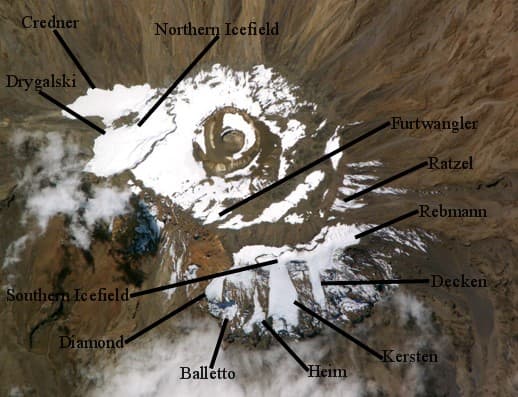
Northern Ice Field (Mount Kilimanjaro)
The Northern Ice Field is a significant remnant of glacial ice located on the western slope of Mount Kilimanjaro in Tanzania. Historically connected to other ice fields, it has substantially shrunk, serving as a crucial indicator of climate change in tropical regions.

Amalia Glacier
Amalia Glacier, also known as Skua Glacier, is a tidewater glacier situated in Bernardo O'Higgins National Park, Chile. Originating from the Southern Patagonian Ice Field, it is notable for its significant retreat between 1945 and 1986, which was among the most dramatic observed in the region during that period. The glacier also plays a role in shaping the landscape by partially surrounding and eroding the northern flank of the Reclus volcano.