
Northern Patagonian Ice Field
The Northern Patagonian Ice Field is a significant remnant of the larger Patagonian Ice Sheet, located in southern Chile. It is the second-largest continuous ice mass outside of the polar regions and plays a crucial role in the regional hydrology, feeding numerous rivers and lakes.
Key Facts
- ›It is a vestige of the Quaternary-era Patagonian Ice Sheet.
- ›It is the second largest continuous ice mass outside of the polar regions.
- ›The ice field has 28 exit glaciers.
- ›Two largest glaciers, San Quintin and San Rafael, reach the Pacific Ocean.
- ›It is located within Laguna San Rafael National Park.
- ›Its survival is attributed to high elevation, favorable terrain, and a cool, moist oceanic climate.

Known For
- being the second largest continuous mass of ice outside of the polar regions
- its numerous exit glaciers
San Quintin Glacier, San Rafael Glacier, San ValentíN Glacier, Nef Glacier
Laguna San Rafael National Park
About Northern Patagonian Ice Field
The Northern Patagonian Ice Field is a significant remnant of the larger Patagonian Ice Sheet, located in the Andes Mountains of southern Chile. It is a crucial component of the region's geography and hydrology, representing the second-largest continuous mass of ice outside of the Earth's polar regions.
Description and Significance
As a vestige of the Patagonian Ice Sheet that covered extensive areas during the Quaternary glaciations, the Northern Patagonian Ice Field currently spans an area of approximately 4,200 km². Its continued existence is supported by its elevation, ranging from 1,100 to 1,500 meters, favorable terrain, and a cool, moist oceanic climate. The ice field is a vital source of meltwater, with 28 exit glaciers feeding numerous rivers and glacially carved lakes. The largest of these, the San Quintin and San Rafael glaciers, extend westward to the Pacific Ocean.
Exploration and Geological Context
Historical expeditions have traversed the ice cap, including a crossing from the San Raphael Glacier into Argentina in 1963–64. Scientific research has been conducted on and around the ice field, with glaciologists returning to study specific glaciers like the Benito Glacier. Geologically, the Northern Patagonian Ice Field is situated within a fault-bounded crustal block marked by several significant fault zones, including the Liquiñe-Ofqui Fault Zone to the west and the Exploradores Fault Zone to the north.
Source: Wikipedia ↗
Frequently Asked Questions
What is the Northern Patagonian Ice Field?
The Northern Patagonian Ice Field is a large, continuous mass of ice situated in southern Chile. It represents a surviving portion of the ancient Patagonian Ice Sheet, which once covered a much larger area during past glaciations.
How large is the Northern Patagonian Ice Field?
The ice field currently covers an area of approximately 4,200 square kilometers. Despite its reduced size compared to its historical extent, it remains the second-largest single mass of ice found outside of Earth's polar regions.
Where is the Northern Patagonian Ice Field located?
This ice field is situated in southern Chile, within the Andes Mountains. It is entirely contained within the boundaries of Laguna San Rafael National Park, a protected area in the region.
Which glaciers flow from the Northern Patagonian Ice Field?
The Northern Patagonian Ice Field has 28 exit glaciers. The most notable are the San Quintin and San Rafael glaciers, which extend westward to the Pacific Ocean. Others, such as San Valentín and Nef, supply meltwater to rivers and lakes to the east.
Why is the Northern Patagonian Ice Field important?
It is significant as one of the largest ice masses outside the polar regions. Its meltwater is vital for numerous rivers and lakes, supporting regional ecosystems and hydrology. Its survival is dependent on specific climatic and geographic conditions.
Related Glaciers

Southern Patagonian Ice Field
The Southern Patagonian Ice Field is the world's second-largest contiguous extrapolar ice field, situated in the Southern Patagonic Andes between Chile and Argentina. It is a significant remnant of the much larger Patagonian Ice Sheet that covered the region during the last glacial period, feeding numerous glaciers that flow into both the Pacific and Atlantic oceans.
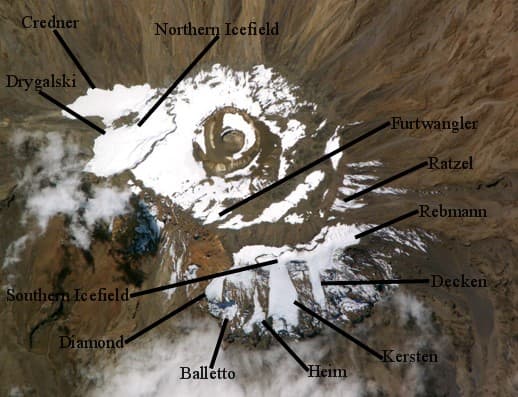
Northern Ice Field (Mount Kilimanjaro)
The Northern Ice Field is a significant remnant of glacial ice located on the western slope of Mount Kilimanjaro in Tanzania. Historically connected to other ice fields, it has substantially shrunk, serving as a crucial indicator of climate change in tropical regions.

Amalia Glacier
Amalia Glacier, also known as Skua Glacier, is a tidewater glacier situated in Bernardo O'Higgins National Park, Chile. Originating from the Southern Patagonian Ice Field, it is notable for its significant retreat between 1945 and 1986, which was among the most dramatic observed in the region during that period. The glacier also plays a role in shaping the landscape by partially surrounding and eroding the northern flank of the Reclus volcano.