
Arctictis
Viverridae·Omnivorous, feeding on small mammals, rodents, birds, fish, earthworms, insects, and fruits, with figs being a major component.·Vulnerable
The binturong, also known as the bearcat, is an arboreal viverrid native to South and Southeast Asia. This species is unique for its popcorn-scented musk glands and its long, prehensile tail, which aids in its arboreal lifestyle. Primarily nocturnal, the binturong is an omnivore facing threats from habitat loss and illegal hunting, leading to its Vulnerable conservation status.
Key Facts
- ›The binturong is the sole species in the genus Arctictis.
- ›It is distinguishable by a unique popcorn-like scent emitted from its musk glands.
- ›The species possesses a long, bushy, and prehensile tail adapted for arboreal movement.
- ›Binturongs are omnivores, with figs being a significant part of their diet.
- ›Habitat loss and illegal hunting are the primary threats to the binturong.
- ›It is classified as Vulnerable on the IUCN Red List.
Primary Lowland Forest, Secondary Lowland Forest, Forested Hills, Grassland-Forest Mosaic
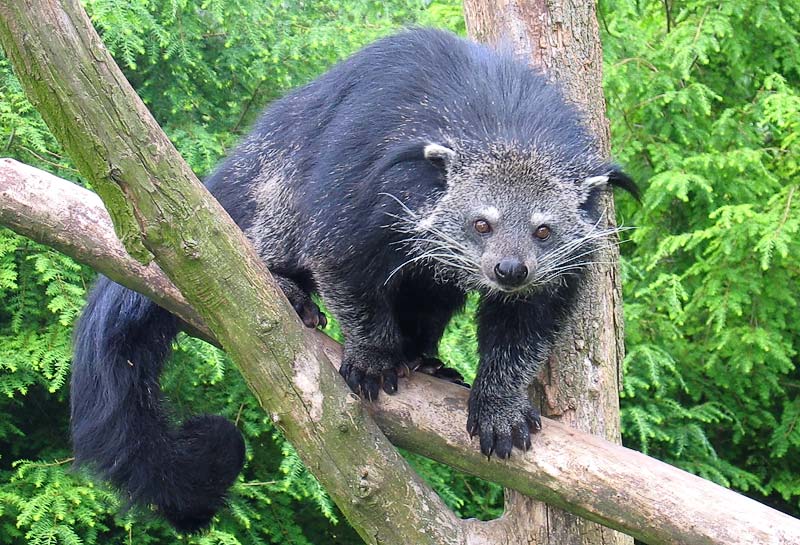
- Long, Thick, Coarse Black Hair
- Bushy, Prehensile Tail, Nearly As Long As the Body
- Short, Pointed Snout With A Slight Upward Curve
- Large, Black, Prominent Eyes
- Short, Rounded Ears Edged With White Hair and Black Tufts
- Plantigrade, Bare-Soled Limbs With Five Clawed Digits
- Syndactylous Third and Fourth Digits
- Body Length: 71-84 cm
- Tail Length: 66-69 cm
- Body Speckled With White Or Buff, Sometimes Appearing Straw-Colored Or Grey
- Newborns Are Paler Than Adults
- Conspicuously White Long Vibrissae
- White Rim On the Summit of the Otherwise Black Ear
- Whitish Glandular Area
- Primarily Nocturnal, Also Exhibits Crepuscular Behavior
- Arboreal Lifestyle, Climbing Skillfully But Slowly
- Uses Prehensile Tail For Climbing and Balance
- Can Descend To the Ground Frequently To Move Between Trees
- Exhibits Arrhythmic Activity With Peaks In Early Morning and Late Evening
- Growls Fiercely When Irritated
- Periodically Utters Low Grunts Or A Hissing Sound When On the Prowl
- Uses Tail To Communicate and Maintain Balance
- Shows Comfort Behaviors Like Shaking Hair, Grooming, and Scratching
- Females Are Larger Than Males and Dominant In Interactions
- Can Enact Delayed Implantation As A Reproductive Strategy
Growls, Grunts, Hissing Sound, Purring Sound
Tigers, Dholes
Small Mammals, Rodents, Birds, Fish, Earthworms, Insects
About Arctictis
Arctictis: The Binturong
The binturong, scientifically known as Arctictis binturong and also referred to as the bearcat, is a distinctive arboreal mammal native to the diverse landscapes of South and Southeast Asia. It is the sole member of the genus Arctictis, recognized for its unique physical traits, most notably its popcorn-scented musk glands and its long, bushy, prehensile tail, which is crucial for its life in the trees. The binturong's pelage is typically dark and thick, though it can also feature whitish speckling.
Characteristics and Behavior
Morphologically, the binturong is characterized by a heavy body, short stout legs, and a tail that is nearly as long as its body. Its snout is short and pointed, with prominent black eyes and short, rounded ears edged with white hair and black tufts. The species has syndactylous digits on its feet, a trait that sets it apart from many other viverrids. While primarily nocturnal, the binturong also exhibits crepuscular activity, being active during dawn and dusk. They are skilled climbers, moving slowly but with confidence along branches, often using their prehensile tail as a vital aid for balance and support. When agitated, they emit fierce growls, and when hunting or moving, they may produce low grunts or a hissing sound.
Diet and Ecological Role
As an omnivore, the binturong's diet is varied, encompassing small mammals, birds, fish, insects, and a significant amount of fruit, particularly figs. This dietary habit positions the binturong as a keystone species, especially in seed dispersal. Its ability to scarify the tough outer covering of seeds, particularly those of strangler figs, makes it instrumental in the propagation of these plants. While it may encounter fish and earthworms opportunistically, its primary sustenance is derived from plant matter.
Reproduction and Conservation
Reproductive behaviors of the binturong are often observed in captive settings. Females are capable of delayed implantation, a strategy that allows them to control the timing of gestation based on favorable environmental conditions, thereby increasing the likelihood of successful reproduction. Litters typically range from one to six young, with an average of two. The binturong faces significant threats, primarily habitat loss and degradation due to logging and agricultural expansion. Illegal hunting for meat and skins, as well as capture for the pet trade, further endanger populations. Consequently, the binturong is classified as Vulnerable on the IUCN Red List, necessitating conservation efforts to protect its dwindling numbers and habitats.
Source: Wikipedia ↗
Frequently Asked Questions
What is a binturong also known as?
The binturong is also commonly known as the bearcat. This name reflects its appearance, which can resemble a bear, and its cat-like agility in trees.
What makes the binturong's scent unique?
Binturongs possess musk glands that emit an odor reminiscent of popcorn or corn chips. This scent is believed to be due to the volatile compound 2-acetyl-1-pyrroline.
What is the binturong's natural diet?
The binturong is an omnivore, feeding on a variety of food items including small mammals, birds, fish, insects, and fruits. Figs are a particularly important component of their diet.
What are the main threats to binturong populations?
The primary threats to the binturong are habitat loss and degradation, largely due to logging and conversion of forests for plantations. Illegal hunting and trade also pose significant risks.
What is the conservation status of the binturong?
The binturong is listed as Vulnerable on the IUCN Red List. This status reflects the significant decline in its populations due to human-induced threats.
Related Hyenas, Civets & Mongooses

Chrotogale
Owston's palm civet (Chrotogale owstoni) is a viverrid species native to Vietnam, Laos, and a small part of southern China. It is distinguished by its tawny buff-grey body with contrasting black markings on its back and tail and is currently listed as endangered due to habitat loss and over-exploitation.

Civettictis
Civettictis is a genus of viverrid that encompasses the extant African civet and a recently identified extinct relative. The African civet, Civettictis civetta, is a solitary and nocturnal animal native to sub-Saharan Africa, known for its distinctive appearance and scent secretions.

Arctogalidia
The small-toothed palm civet (Arctogalidia trivirgata), also known as the three-striped palm civet, is a viverrid species native to dense forests across Southeast Asia and several Indonesian islands. Its name, Arctogalidia, translates to 'bear-weasel,' reflecting its appearance, and it is distinguished by three dark longitudinal stripes on its back and a long, fluffy tail.