
Chrotogale
Viverridae·Fruits and soft-bodied animals, with a particular fondness for insects and earthworms.·Endangered
Owston's palm civet (Chrotogale owstoni) is a viverrid species native to Vietnam, Laos, and a small part of southern China. It is distinguished by its tawny buff-grey body with contrasting black markings on its back and tail and is currently listed as endangered due to habitat loss and over-exploitation.
Key Facts
- ›Native to Vietnam, Laos, and a small region of southern China.
- ›Characterized by a tawny buff-grey coat with prominent black markings.
- ›Primarily terrestrial and nocturnal, foraging on the forest floor.
- ›Diet consists mainly of fruits, insects, and earthworms.
- ›Listed as endangered on the IUCN Red List.
- ›Faces significant threats from hunting and habitat fragmentation.

Lowland Evergreen Forests, Moist Tropical Evergreen Forests, Subtropical Forests, Limestone Forests
- Tawny Buff-Grey Body
- Contrasting Black Markings On Back and Tail
- Four Bands On Back Running From Eyes To First Third of Tail
- Large Rounded Ears
- Black Eyes
- Last Two-Thirds of Tail Is Completely Black
- Black Spots On Legs
- Skinny Build For Both Sexes
- Females Have Orange Pelage On Lower Bellies
- Males Have An Orange Patch On the Chest, Differing In Hue From Females
- Solitary, Except During Mating Season
- Nocturnal, Active During Complete Darkness In the Wild
- Mainly Terrestrial, Foraging On the Forest Floor
- May Climb Trees and Shrubbery To Sleep
- Marks Objects With Urine and Scent Glands
- Marking Occurs Most Often During Breeding Season
Insects, Earthworms, Fruits
About Chrotogale
What is Owston's Palm Civet?
Owston's palm civet, scientifically known as Chrotogale owstoni, is a viverrid species native to the evergreen forests of Vietnam, Laos, and a small region in southern China's Yunnan province. This mid-sized civet is characterized by its tawny buff-grey body adorned with striking black markings on its back and tail, including four distinct bands running along its back. It possesses large, rounded ears and black eyes.
Habitat and Distribution
The species inhabits lowland evergreen forests where dry seasons are not overly harsh. Its restricted range is primarily confined to Vietnam, Laos, and the Annamite mountains, with a very small presence in three counties of China's Yunnan province. Based on research, its distribution is likely limited to specific types of moist tropical evergreen, subtropical, and limestone forests within these regions.
Behavior and Diet
Owston's palm civet is predominantly a solitary and nocturnal animal, active only during complete darkness in its natural habitat, though it may exhibit activity from sundown to dawn in captivity. It is mainly terrestrial, spending most of its time foraging on the forest floor. While it occasionally climbs trees and shrubbery to rest, its primary food sources are fruits and soft-bodied invertebrates such as insects and earthworms. Its dentition indicates it is not adapted to consuming large or bony prey.
Reproduction and Threats
Information regarding the reproductive habits of Owston's palm civet in the wild is scarce. In captivity, females give birth to litters of one to three cubs after a gestation period of 75 to 90 days. Pups are born blind and develop rapidly, reaching independence between 12 to 18 weeks. The species is listed as Endangered on the IUCN Red List due to significant population decline, largely attributed to over-exploitation and habitat fragmentation. Hunting, particularly through non-specific snares, and the demand for wild meat pose major threats, even within protected areas.
Conservation Efforts
Conservation efforts include the establishment of protected areas in the Yunnan province and regulated exploitation policies in Vietnam. Hunting is prohibited in Laos. Conservationists are working on a 10-year plan to reduce snaring and wild meat consumption through governmental policy changes and by establishing a genetically diverse captive population for potential reintroduction into the wild. The Carnivore and Pangolin Conservation Program in Cúc Phương National Park operates as a rehabilitation and breeding center for the species.
Source: Wikipedia ↗
Frequently Asked Questions
What is Owston's palm civet?
Owston's palm civet is a viverrid species native to Southeast Asia, specifically Vietnam, Laos, and a small part of southern China. It is a mid-sized civet known for its distinctive markings.
Where does Owston's palm civet live?
This species is found in lowland evergreen forests within Vietnam, Laos, and a limited area of the Yunnan province in southern China. Its range appears to be restricted to specific moist tropical evergreen, subtropical, and limestone forests.
What does Owston's palm civet eat?
Its diet primarily consists of fruits, insects, and earthworms, which it forages for on the ground. Its dentition suggests it is not capable of consuming large or bony animals.
What are the main threats to Owston's palm civet?
The primary threats include over-exploitation through hunting, particularly snares set for other mammals, and habitat destruction and degradation. Urban demand for wild meat also contributes to increased hunting pressure.
What is the conservation status of Owston's palm civet?
Owston's palm civet is listed as endangered on the IUCN Red List. This status is due to a significant and ongoing population decline inferred from various threats.
Related Hyenas, Civets & Mongooses
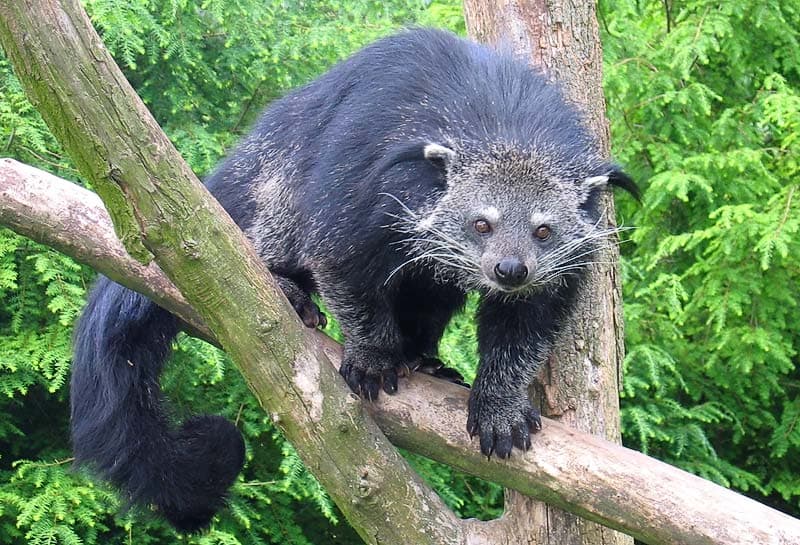
Arctictis
The binturong, also known as the bearcat, is an arboreal viverrid native to South and Southeast Asia. This species is unique for its popcorn-scented musk glands and its long, prehensile tail, which aids in its arboreal lifestyle. Primarily nocturnal, the binturong is an omnivore facing threats from habitat loss and illegal hunting, leading to its Vulnerable conservation status.

Civettictis
Civettictis is a genus of viverrid that encompasses the extant African civet and a recently identified extinct relative. The African civet, Civettictis civetta, is a solitary and nocturnal animal native to sub-Saharan Africa, known for its distinctive appearance and scent secretions.

Arctogalidia
The small-toothed palm civet (Arctogalidia trivirgata), also known as the three-striped palm civet, is a viverrid species native to dense forests across Southeast Asia and several Indonesian islands. Its name, Arctogalidia, translates to 'bear-weasel,' reflecting its appearance, and it is distinguished by three dark longitudinal stripes on its back and a long, fluffy tail.