
Aorounga Central
Chad·Carboniferous·multi-ring
Aorounga Crater is an impact structure located in northern Chad, characterized by a multi-ring morphology and an estimated age of less than 345 million years. Its geological investigation has revealed shock metamorphic effects, confirming its extraterrestrial impact origin and making it a site of significant scientific interest for understanding impact processes.
Key Facts
- ›The exposed remnant of Aorounga Crater has a diameter of approximately 12.6 km.
- ›Its age is estimated to be less than 345 million years, placing it in the Carboniferous period or younger.
- ›The crater exhibits a multi-ring structure with an outer and inner ring, rising about 100 meters above the surrounding plain.
- ›It is situated in northern Chad, about 110 km southeast of the Emi Koussi volcano.
- ›Shock deformation, including shocked quartz grains, has been observed in samples from the crater.
- ›A maximum diameter of 16 km has been proposed for the Aorounga structure.

Gweni-Fada Crater
Shocked Quartz, Breccia
About Aorounga Central
Aorounga Crater
Aorounga Crater is an impact structure located in northern Chad, recognized for its distinct multi-ring morphology. The exposed remnant of the crater measures approximately 12.6 kilometers in diameter, with its age estimated to be less than 345 million years, placing it within the Carboniferous period or younger. The crater's geological features include outer and inner rings that rise about 100 meters above the surrounding plain, separated by a relatively flat depression. A possible central uplift structure, about 1.5 kilometers in diameter, is also noted within the depression.
Geological Significance
The impact origin of Aorounga is supported by the observation of shock deformation and shock metamorphic effects in quartz grains from the surrounding sandstones. Photogeological investigations initially suggested either a granite diapir or an impact crater, but later research, including sample collection and analysis, confirmed the impact hypothesis. The structure is composed of fine-grained, well-sorted, slightly carbonate-bearing sandstone, possibly of Upper Devonian age. The crater is recognized as a multi-ring structure, with a central complex, a strong elevation ring, a flat annulus, and an outer ring.
Location and Associated Features
Aorounga Crater is situated in northern Chad, approximately 110 kilometers southeast of the Emi Koussi volcano in the Tibesti Massif. The crater is accompanied by two nearby circular features revealed by Space Shuttle SIR-C radar, which may be related impact craters, suggesting Aorounga might be part of a crater chain. If this hypothesis holds true, the exposed Aorounga crater is sometimes referred to as Aorounga South. The landscape around the crater is characterized by linear rock ridges called yardangs, formed by wind erosion, and actively migrating sand dunes.
Source: Wikipedia ↗
Frequently Asked Questions
Where is Aorounga Crater located?
Aorounga Crater is situated in northern Chad, Africa. It lies approximately 110 km southeast of the Emi Koussi volcano in the Tibesti Massif.
What is the size of Aorounga Crater?
The exposed remnant of Aorounga Crater has a diameter of about 12.6 km (7.8 miles). A maximum diameter of 16 km has been proposed for the entire structure.
How old is Aorounga Crater?
The age of Aorounga Crater is estimated to be less than 345 million years, meaning it is from the Carboniferous period or more recent. Cosmogenic nuclide exposure dating suggests a minimum age of 500,000 years for the impact event.
What type of geological structure is Aorounga Crater?
Aorounga Crater is recognized as a multi-ring impact structure. It features a central complex surrounded by distinct rings and an annulus, indicating a complex formation process from the impact.
What evidence confirms Aorounga as an impact crater?
Geological investigations have reported the first observation of shock deformation in samples from the structure. Shock metamorphic effects have been observed in quartz grains from the surrounding sandstones, which are characteristic of impact events.
What are the geological features of Aorounga Crater?
The crater is characterized by outer and inner rings that rise about 100 meters above the surrounding plain, separated by a depression of uniform width. The ring walls consist of steeply outward dipping sandstone layers, with breccia found on the inner rim.
Related Impact Craters

Gweni-Fada
Gweni-Fada Crater is an eroded impact structure located in the Ennedi Plateau of Chad. First identified in aerial photographs in the 1950s, its impact origin was later supported by evidence of shock metamorphism found in collected rock samples. The crater exhibits a complex morphology with an outer depression and an inner rugged terrain.
Ilyinets
The Ilyinets crater, located in Ukraine's Vinnytsia Oblast, is an impact structure with a diameter of 8.5 kilometers. Its age is estimated to be around 378 million years, dating back to the Upper Devonian period. The crater is not currently visible on the surface, with its geological significance lying in its formation and location within the Ukrainian Shield.
Haughton
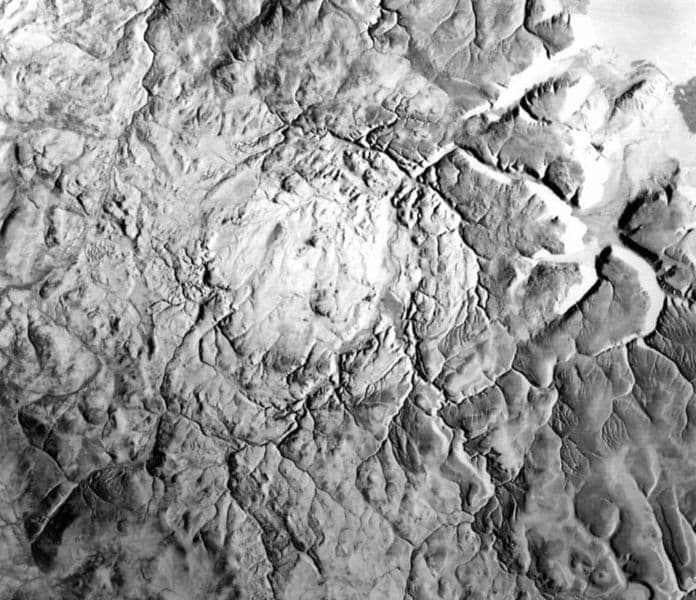
The Haughton impact crater, located on Devon Island in far Northern Canada, is a significant geological site due to its well-preserved features resulting from its high-latitude, cold environment. Formed approximately 31-32 million years ago, it serves as a valuable terrestrial analogue for Martian impact craters, prompting extensive research by space exploration organizations.