
Campo del Cielo
Argentina·iron meteorite·crater field
Campo del Cielo is a significant iron meteorite strewn field and impact crater area located in Argentina, discovered in 1576. The site encompasses at least 26 craters and has yielded approximately 100 tonnes of meteorite fragments, making it the most recovered meteorite material on Earth.
Key Facts
- ›The Campo del Cielo crater field spans 18.5 by 3 kilometers and contains at least 26 craters.
- ›The craters are estimated to be 4,000 to 5,000 years old.
- ›Approximately 100 tonnes of iron meteorite fragments have been recovered from the site.
- ›The two largest fragments, Gancedo (30.8 tonnes) and El Chaco (28.8 tonnes), are among the heaviest single-piece meteorite masses found.
- ›First reported to the public in 1576, the site was already known to indigenous peoples.
- ›The meteorite fragments are primarily composed of iron, with significant amounts of nickel.

RíO Cuarto Craters
Iron, Nickel
About Campo del Cielo
Campo del Cielo, translating to "Field of Heaven" or "Field of the Sky," is a renowned impact structure located in Argentina, distinguished by its extensive crater field and the immense quantity of iron meteorite fragments recovered from its vicinity. This significant site spans the provinces of Chaco and Santiago del Estero, situated approximately 1,000 kilometers north-northwest of Buenos Aires.
Discovery and History
The existence of the iron masses at Campo del Cielo was first formally reported to the public in 1576. A Spanish governor commissioned a military expedition to investigate reports from the indigenous peoples about a mass of iron that had fallen from the sky. This expedition located a large metallic mass protruding from the ground, and initial samples were collected. While the governor's report was filed, its details were largely forgotten, and subsequent accounts relied on local legends.
Later rediscoveries occurred in the 18th century. In 1774, Don Bartolomé Francisco de Maguna identified the iron mass, calling it "el Mesón de Fierro" (the Table of Iron), initially believing it to be part of an iron vein. An expedition in 1783 led by Rubin de Celis attempted to excavate the mass, using explosives. While this revealed it to be a single stone, Celis incorrectly attributed its formation to a volcanic eruption and estimated its mass at 15 tonnes. However, samples sent to the Royal Society in London were analyzed and confirmed to be of meteoritic origin, containing approximately 90% iron and 10% nickel.
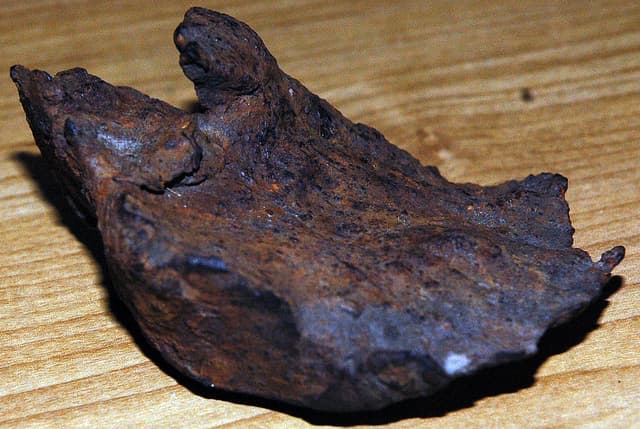
Since these early investigations, hundreds of iron pieces, ranging from tiny fragments to several tonnes, have been unearthed. Notable large fragments include the Otumpa (approximately 1 tonne), El Taco, the 28.8-tonne El Chaco (discovered in 1969 and extracted in 1980), and the 30.8-tonne Gancedo meteorite (unearthed in 2016). As of recent discoveries, over 100 tonnes of Campo del Cielo fragments have been found, making it the most substantial collection of meteorite material recovered from a single impact event on Earth.
The Impact Event and Craters
The Campo del Cielo impact event created a field of at least 26 distinct craters, spread across an area of 18.5 by 3 kilometers, with a wider strewn field for smaller fragments extending an additional 60 kilometers. The largest crater measures approximately 115 by 91 meters. Scientific analysis, including carbon-14 dating of charred wood found beneath meteorite fragments, suggests the impact occurred roughly 4,000 to 5,000 years ago (or 2,200–2,700 years BC). The original celestial body that caused these impacts is estimated to have been an iron meteorite larger than 4 meters in diameter.
The composition of the recovered fragments is primarily iron, with notable percentages of nickel, cobalt, and phosphorus, along with trace amounts of iridium, gallium, and germanium. The high density of inclusions within these iron meteorites may have contributed to the fragmentation of the original body upon atmospheric entry and impact.
Source: Wikipedia ↗
Frequently Asked Questions
What is Campo del Cielo?
Campo del Cielo, meaning 'Field of Heaven' or 'Field of the Sky,' refers to a group of iron meteorites and the impact crater area in Argentina where they were found. It is known for the extensive recovery of meteorite fragments.
Where is Campo del Cielo located?
The Campo del Cielo site is located in Argentina, straddling the provinces of Chaco and Santiago del Estero. It is situated 1,000 kilometers north-northwest of Buenos Aires.
How old are the Campo del Cielo craters?
The craters at Campo del Cielo are estimated to be between 4,000 and 5,000 years old. Carbon-14 analysis of charred wood beneath meteorite fragments indicates the fall occurred around 4,200–4,700 years ago.
What is the size of the Campo del Cielo impact site?
The crater field covers an area of 18.5 by 3 kilometers and includes at least 26 craters. The largest of these craters measures 115 by 91 meters.
How much meteorite material has been found at Campo del Cielo?
A significant amount of meteorite material has been recovered from Campo del Cielo, totaling approximately 100 tonnes. This is the most meteorite material recovered from any single finding location on Earth.
What are the largest meteorite fragments found at Campo del Cielo?
The two largest known fragments are the Gancedo meteorite, weighing 30.8 tonnes, and the El Chaco meteorite, weighing 28.8 tonnes. These are among the heaviest single-piece meteorite masses ever found.
When was Campo del Cielo discovered?
The site was officially reported to the public in 1576 by a Spanish governor who commissioned a military expedition. However, the indigenous peoples were already aware of the iron masses.
Related Impact Craters

Henbury
The Henbury Meteorites Conservation Reserve in Australia's Northern Territory preserves a field of over a dozen impact craters, formed by a fragmented meteorite. It is recognized as one of the world's best-preserved small crater fields and was the earliest documented impact site in Australia, holding cultural significance for local Aboriginal peoples.

Macha
The Macha crater field in Siberia, Russia, comprises five meteorite craters ranging from 60 to 300 meters in diameter. The two largest craters form a pear-shaped feature known as Abram Lake. This field is significant as it contains the second-largest Holocene-era crater discovered to date, with an estimated age of approximately 7,300 years.
Whitecourt
The Whitecourt crater is a well-preserved impact structure in central Alberta, Canada, notable for its small size and young age. Discovered in 2007, the crater has yielded over 3,000 fragments of the impacting iron meteorite, providing valuable insights into impact events.