
Dalgaranga
The Dalgaranga crater is a small, exceptionally well-preserved impact structure located in Western Australia. Discovered in 1921, it is unique as the only known impact crater formed by a mesosiderite meteorite, with fragments of the stony-iron projectile found at the site. Its small size and pristine condition suggest a relatively young age.
Key Facts
- ›Diameter: 24 meters (79 feet)
- ›Depth: 3 meters (9.8 feet)
- ›Discovered in 1921 by an Aboriginal stockman named Billy Seward.
- ›Unique as the only known impact crater caused by a mesosiderite meteorite.
- ›Located on Dalgaranga pastoral station, Western Australia.
- ›Bedrock at the site is weathered Archaean granite.

Henbury Crater Field
Mesosiderite
About Dalgaranga
Dalgaranga Crater
The Dalgaranga crater is a small but geologically significant impact structure located on Dalgaranga pastoral station in Western Australia. It is recognized as Australia's smallest confirmed impact crater, with the exception of some very small examples within the Henbury crater field. Its discovery in 1921 marked a notable find, though it was not formally reported in scientific literature until 1938.
Discovery and Uniqueness
The crater was first identified by an Aboriginal stockman named Billy Seward in 1921. Gerard Wellard, the station manager, was subsequently shown the site by Seward, and meteorite fragments were found shortly thereafter. The discovery of these fragments, which are composed of mesosiderite stony-iron meteorite, is particularly important. This finding confirms the origin of the crater and makes Dalgaranga unique as the only impact crater known to have been created by a mesosiderite projectile.
Description and Preservation
The Dalgaranga crater measures approximately 24 meters (79 feet) in diameter and is 3 meters (9.8 feet) deep. The bedrock at the site consists of weathered Archaean granite belonging to the Yilgarn craton. Asymmetries observed in the crater's structure and ejecta blanket suggest that the impacting projectile struck at a low angle from the south-southeast. The crater's pristine condition for its small size indicates a relatively young age, with some researchers suggesting it could be as young as 3,000 years old, as the meteorite fragments have not significantly weathered away.
Source: Wikipedia ↗
Frequently Asked Questions
Where is the Dalgaranga crater located?
The Dalgaranga crater is situated on Dalgaranga pastoral station in Western Australia. It is approximately 75 km (47 mi) northwest of Mount Magnet.
How large is the Dalgaranga crater?
The Dalgaranga crater is quite small, measuring only 24 meters (79 feet) in diameter and 3 meters (9.8 feet) deep. It is considered Australia's smallest impact crater, excluding some smaller examples from the Henbury crater field.
When was the Dalgaranga crater discovered?
The crater was first discovered in 1921 by an Aboriginal stockman named Billy Seward. While found in 1921, it was not officially reported in scientific literature until 1938.
What makes the Dalgaranga crater unique?
Dalgaranga is unique because fragments of a mesosiderite stony-iron meteorite found around the crater confirm it was formed by such a projectile. It is the only impact crater known to have been produced by a mesosiderite impactor.
What is the estimated age of the Dalgaranga crater?
The precise age of the Dalgaranga crater is not accurately determined. However, its excellent preservation for its small size suggests it is relatively young, with some researchers proposing an age as recent as 3,000 years.
Related Impact Craters

Wolfe Creek
Wolfe Creek Crater, also known as Kandimalal by the local Djaru people, is a remarkably well-preserved meteorite impact crater located in Western Australia. Its pristine condition makes it a significant geological site, comparable to the Barringer Crater in Arizona, and it holds deep cultural importance for Indigenous Australians.

Boxhole
Boxhole is a young impact crater located in the Northern Territory, Australia, approximately 180 km northeast of Alice Springs. Discovered in 1937, it is a Holocene-era impact event, estimated to be around 5,400 years old. The crater is notable for being the second impact structure described in Australia and for the discovery of nickel-bearing metallic fragments and an 82 kg iron mass.
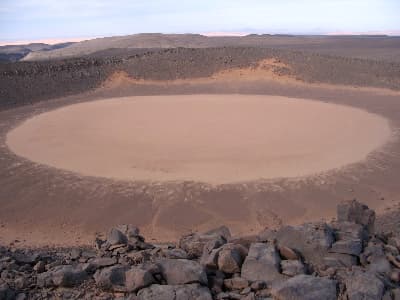
Amguid
Amguid is a well-preserved impact crater situated in the Central Sahara of Algeria. Its relatively young age, estimated to be less than 100,000 years, and its pristine condition due to the arid desert environment make it a significant site for studying impact events. The crater's morphology and geological features, including shatter cones and breccia, provide insights into the low-velocity impact event.