
Hiawatha
The Hiawatha impact structure is a large, probable impact crater discovered beneath the Hiawatha Glacier in northwest Greenland. Identified through airborne radar surveys and confirmed by shocked quartz and melt rock findings, it dates back approximately 57.99 million years to the late Paleocene epoch. Its discovery holds significant implications for understanding Earth's impact history.
Key Facts
- ›Discovered beneath the Hiawatha Glacier in northwest Greenland.
- ›Diameter of approximately 31 km (19 MI).
- ›Dated to 57.99 ± 0.54 million years ago.
- ›Occurred during the late Paleocene geological epoch.
- ›The impactor is inferred to have been a strongly fractionated iron asteroid about 1.5 km across.
- ›Confirmed by the presence of shocked quartz and melt rock clasts.

Shocked Quartz, Shocked Zircon, Melt Rock
About Hiawatha
Hiawatha Impact Structure
The Hiawatha impact structure is a significant geological feature located beneath the Hiawatha Glacier in northwest Greenland. Its presence was revealed through advanced airborne radar surveys, which detected a distinct circular depression in the bedrock beneath the ice sheet. Further investigation, including fieldwork and sample analysis, has provided compelling evidence for its extraterrestrial origin.
Discovery and Confirmation
The identification of the Hiawatha structure began in 2016 when the Alfred Wegener Institute conducted airborne radar surveys. These data, combined with existing information from NASA's Program for Arctic Regional Climate Assessment and Operation IceBridge, clearly showed a circular bedrock depression that mirrored a feature on the ice surface. Subsequent fieldwork and the analysis of sediment samples from the river draining the crater yielded crucial evidence: shocked quartz grains exhibiting multiple planar deformation features and clasts of melt rock containing shocked zircon grains. These findings are hallmarks of a high-pressure impact event.
Age and Impactor
Scientific dating of the Hiawatha impact structure has placed its formation at approximately 57.99 ± 0.54 million years ago, during the late Paleocene epoch. This age was determined through precise argon-argon dating of quartz grains and uranium-lead dating of zircon crystals found within the impact melt rocks. The nature of the celestial body that caused this impact has been inferred from the collected samples. Scientists suggest the impactor was a strongly fractionated iron asteroid, estimated to be about 1.5 kilometers (0.93 miles) in diameter, to account for the observed crater size.
Morphology and Significance
The Hiawatha impact structure presents as a large, complex crater. The circular depression measures approximately 31 kilometers (19 miles) across, featuring a well-defined rim and a central uplift approximately 50 meters high. While the structure itself is buried beneath kilometers of ice and not directly visible on the surface, its discovery is of immense geological importance. It adds a critical data point to our understanding of impact cratering on Earth and its potential effects on planetary history and climate.
Source: Wikipedia ↗
Frequently Asked Questions
Where is the Hiawatha impact structure located?
The Hiawatha impact structure is located beneath the Hiawatha Glacier in northwest Greenland. It was identified using airborne radar surveys that revealed a crater-like depression in the bedrock below the ice.
How large is the Hiawatha impact crater?
The circular depression of the Hiawatha impact structure measures approximately 31 kilometers (19 miles) in diameter. It has a well-defined rim and a rim-to-floor depth of about 320 meters (1,050 feet).
When did the Hiawatha impact event occur?
The Hiawatha impact event is dated to 57.99 ± 0.54 million years ago. This age was determined through argon-argon and uranium-lead dating of zircon crystals found in melt rock from the impact site.
What evidence confirms the Hiawatha structure is an impact crater?
Evidence for the Hiawatha structure being an impact crater includes a clearly defined circular depression in the bedrock. Field samples from sediments draining the crater have yielded shocked quartz grains with planar deformation features and clasts of melt rock containing shocked zircon grains.
What type of celestial body caused the Hiawatha impact?
Based on field samples, the celestial body responsible for the Hiawatha impact is inferred to have been a strongly fractionated iron asteroid. For the observed crater size, an impactor of about 1.5 kilometers (0.93 miles) across is indicated.
What geological period does the Hiawatha impact structure belong to?
The Hiawatha impact structure dates to the late Paleocene geological epoch. This places the impact event firmly within the Paleocene, part of the broader Paleogene period.
Related Impact Craters

Connolly Basin
Connolly Basin is a 9 km-diameter impact crater situated in the remote Gibson Desert of central Western Australia. Initially mistaken for a diapir, its impact origin was identified in 1985. The crater features a distinct topographic rim and a central uplift exposing deformed bedrock, with surrounding sedimentary rocks dating from the Early Cretaceous to Paleogene and uplifted central rocks likely from the Early Permian.

Marquez
The Marquez crater is a buried impact structure located in Leon County, Texas. Estimated to be 58 million years old, its buried nature means it is not visible on the surface, though surface formations like the Marquez Dome are believed to be parts of its central uplift.
Lappajärvi
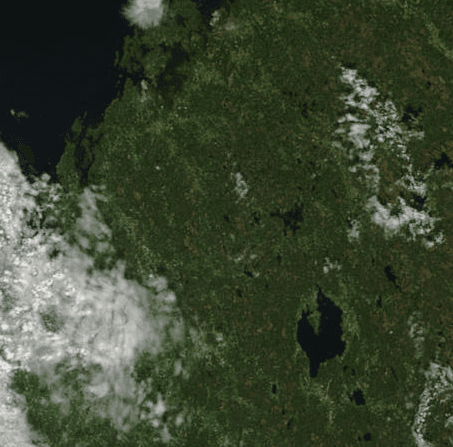
The Lappajärvi impact structure is a large, partly eroded meteorite crater in Finland, now occupied by a lake of the same name. It is one of the largest and youngest impact craters in Finland and is significant for scientific research, including projections for future landscapes. The area has also been recognized with a UNESCO Global Geopark application.