
Keurusselkä
The Keurusselkä impact structure is a remnant of an ancient crater discovered in 2003 on the western shore of Lake Keurusselkä in Central Finland. Identified through shatter cones and shock metamorphic features in quartz, it is one of the oldest known impact structures in Europe, dating back approximately 1.14 to 1.15 billion years. Despite significant erosion, evidence suggests potential ring structures and a negative gravity anomaly, making it a subject of ongoing geological investigation.
Key Facts
- ›Discovered in 2003 by amateur geologists.
- ›Located on the western shore of Lake Keurusselkä, Central Finland.
- ›Shatter cones and shock metamorphic features in quartz have been found.
- ›Estimated age of 1.14-1.15 billion years (late Mesoproterozoic).
- ›Potential diameter of ring structures ranges from 10 km to 30 km.
- ›One of the oldest impact structures known in Europe.
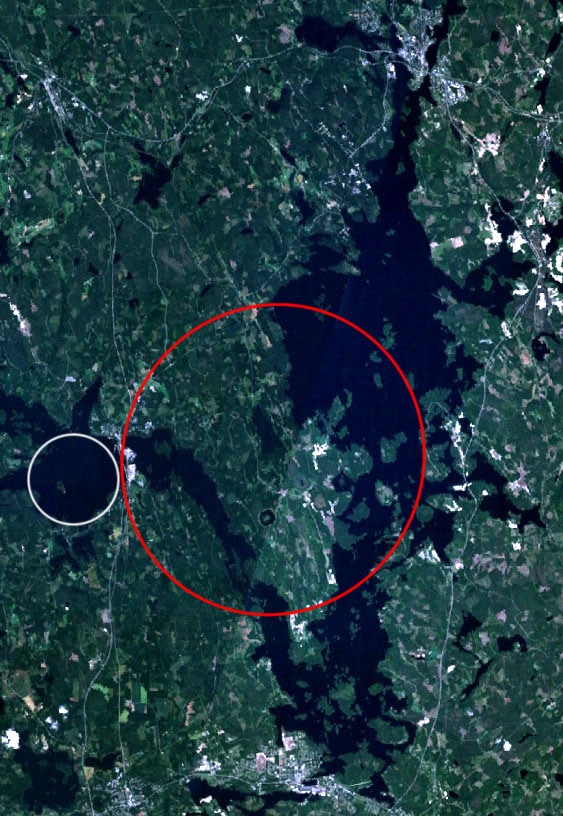
Karikkoselkä
Shocked Quartz
About Keurusselkä
Keurusselkä Impact Structure
Keurusselkä is recognized as the remnant of an ancient impact crater located in Central Finland, situated on the western shores of Lake Keurusselkä. Discovered in 2003 by amateur geologists, the structure has garnered international attention due to its age and geological significance. The impact event that formed Keurusselkä occurred approximately 1.14 to 1.15 billion years ago, during the late Mesoproterozoic era, making it one of Europe's oldest known impact sites.
Geological Evidence
Key evidence supporting the identification of Keurusselkä as an impact structure includes the presence of shatter cones, distinctive rock formations that are exclusively created by the immense shock pressures of meteorite impacts. Furthermore, microscopic analysis of breccia samples has revealed shock metamorphic features within quartz grains, specifically planar fractures and planar deformation features, which are indicative of pressures between 7–35 GPa. While significant erosion has obscured the original morphology, digital elevation data suggests the existence of potential ring structures with diameters ranging from 10 km to as wide as 30 km. Sparse gravity data reveals a negative anomaly in the area, though its direct relation to the impact is still under investigation.
Age and Erosion
The age of the Keurusselkä impact structure is well-constrained by argon-argon dating of pseudotachylitic breccia, which points to a late Mesoproterozoic age. This age contrasts with the local granite bedrock of the Central Finland Granite Complex, which is dated to 1.88 Ga (Paleoproterozoic). The impact structure has undergone substantial erosion since its formation, with an estimated 7–8 km of rock having been removed. Consequently, unlike some younger and less eroded craters, Keurusselkä does not present a visible depression on the Earth's surface.
Source: Wikipedia ↗
Frequently Asked Questions
When and how was the Keurusselkä impact structure discovered?
The Keurusselkä impact structure was discovered in 2003 by amateur geologists. Its presence was revealed through geological evidence found on the western shore of Lake Keurusselkä.
What is the estimated age of the Keurusselkä impact structure?
The Keurusselkä impact structure is estimated to be very old, with argon-argon dating of pseudotachylitic breccia yielding a late Mesoproterozoic age of 1.14 to 1.15 billion years. This makes it one of the oldest known impact structures in Europe.
What evidence indicates Keurusselkä is an impact structure?
Evidence includes the discovery of shatter cones, which are rock formations specifically created by meteorite impacts. Microscopic studies have also revealed shock metamorphic features, such as planar fractures and deformation features in quartz grains, indicating extreme shock pressures.
What is the size of the Keurusselkä impact structure?
While significant erosion has occurred, digital elevation data suggests possible ring structures ranging from 10 km to about 30 km in diameter. Shatter cones have been found in an 11.5 km wide area, which might represent the central uplift of the crater.
Has the Keurusselkä impact structure been confirmed?
Yes, the presence of shatter cones and shock metamorphic features in quartz grains strongly supports its confirmation as an impact structure. Dating has also placed the event in the late Mesoproterozoic era.
Is the Keurusselkä impact structure visible on the surface today?
Due to extensive erosion of 7–8 km of rock since the impact, no visible depressions remain on the surface, unlike some other impact craters. The evidence is primarily geological and subsurface.
Related Impact Craters
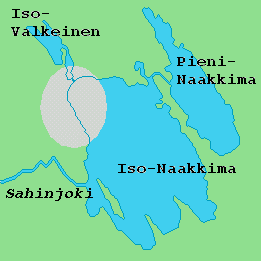
Iso-Naakkima
Iso-Naakkima is a lake in Southern Savonia, Finland, notable for concealing an eroded impact crater beneath its northwestern section. It is recognized as one of the oldest known impact structures on Earth, estimated at 1200 million years old, and is also among the smallest confirmed craters of its age, measuring approximately 3 km in diameter.

Paasselkä
Paasselkä is an eroded impact crater located in Southern Savonia, Finland, forming an oval-shaped lake. The impact event occurred approximately 1800 million years ago, affecting ancient crystalline rocks and sandstones. Its unusual shape and associated magnetic anomalies led to its suspicion as an impact origin, later confirmed by deep drilling, making it the ninth known impact crater in Finland.

Söderfjärden
Söderfjärden is a polder in western Finland, recognized as an impact crater that formed over 640 million years ago. Despite its significant size and the buried central uplift, the crater is primarily visible today as a large, hexagonal cultivated field due to its filling with Cambrian sandstones. This unique surface visibility distinguishes it from other Finnish impact structures.