
Paasselkä
Finland·Paleoproterozoic·Proterozoic·Eroded impact crater
Paasselkä is an eroded impact crater located in Southern Savonia, Finland, forming an oval-shaped lake. The impact event occurred approximately 1800 million years ago, affecting ancient crystalline rocks and sandstones. Its unusual shape and associated magnetic anomalies led to its suspicion as an impact origin, later confirmed by deep drilling, making it the ninth known impact crater in Finland.
Key Facts
- ›Located in Southern Savonia, Finland, as part of the Greater Saimaa lake system.
- ›The impact event occurred approximately 1800 million years ago.
- ›The crater formed an oval-shaped lake that is unusually deep, reaching 75 meters at its deepest point.
- ›Confirmed as an impact structure after deep drilling in 1999.
- ›Associated with unusual magnetic anomalies and the local folklore phenomenon of 'Paasselkä devils' (will-o'-the-wisps).

About Paasselkä
Paasselkä Impact Structure
Paasselkä is an eroded impact crater located in Southern Savonia, Finland, which has formed an oval-shaped lake. This unique geological feature is part of the Orivesi lake, which in turn belongs to the Greater Saimaa lake system. Unlike many other lakes in the region, Paasselkä is devoid of islands and is noted for its unusual depth, reaching a maximum of 75 meters.
Geological History and Confirmation
The impact event that created Paasselkä is estimated to have occurred approximately 1800 million years ago, during the Statherian period of the Paleoproterozoic Era. The impact affected the underlying Paleoproterozoic crystalline rocks and some overlying sandstones of the Baltic Shield. For a long time, the unusual shape of the lake and associated magnetic anomalies suggested an impact origin. This hypothesis was confirmed after deep drilling operations were conducted in 1999, solidifying Paasselkä's status as the ninth known impact crater in Finland. Notably, unlike many Finnish craters, Paasselkä does not appear to have been buried under significant layers of sediment.
Local Folklore: Paasselkä Devils
Paasselkä is also associated with a local folklore phenomenon known as 'Paasselkä devils' (Paasselän pirut). This claimed will-o'-the-wisp phenomenon is described as spheres of light that sometimes appear at the lake and in the surrounding marsh and forest areas. Documented since the 18th century, these shining spheres are part of local folk tales, where they were attributed to evil beings. It is speculated that the magnetic anomalies present within the impact crater might be related to the occurrence of this mysterious phenomenon.
Source: Wikipedia ↗
Frequently Asked Questions
What is Paasselkä and where is it located?
Paasselkä is a lake in Southern Savonia, Finland, which formed within an eroded impact crater. It is part of the Orivesi lake, which is itself part of the larger Saimaa lake system.
When did the impact event that formed Paasselkä occur?
The impact event that created the Paasselkä crater is estimated to have occurred roughly 1800 million years ago. This places the event within the Statherian period of the Paleoproterozoic Era.
What is the significance of Paasselkä's geological features?
Paasselkä is notable for its unusual oval shape and associated magnetic anomalies. These features led to its suspicion as an impact structure long before it was confirmed.
Is Paasselkä a confirmed impact crater?
Yes, Paasselkä is a confirmed impact structure. Its origin was suspected due to its unique shape and magnetic anomalies, and it was definitively identified after deep drilling in 1999.
What is the phenomenon known as 'Paasselkä devils'?
Paasselkä devils, or Paasselän pirut, refers to a claimed will-o'-the-wisp phenomenon observed at the lake and its surrounding areas. These lights, described as moving spheres, are part of local folk tales and may be related to the magnetic anomalies of the impact crater.
Related Impact Craters
Iso-Naakkima
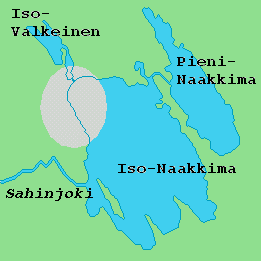
Iso-Naakkima is a lake in Southern Savonia, Finland, notable for concealing an eroded impact crater beneath its northwestern section. It is recognized as one of the oldest known impact structures on Earth, estimated at 1200 million years old, and is also among the smallest confirmed craters of its age, measuring approximately 3 km in diameter.
Keurusselkä
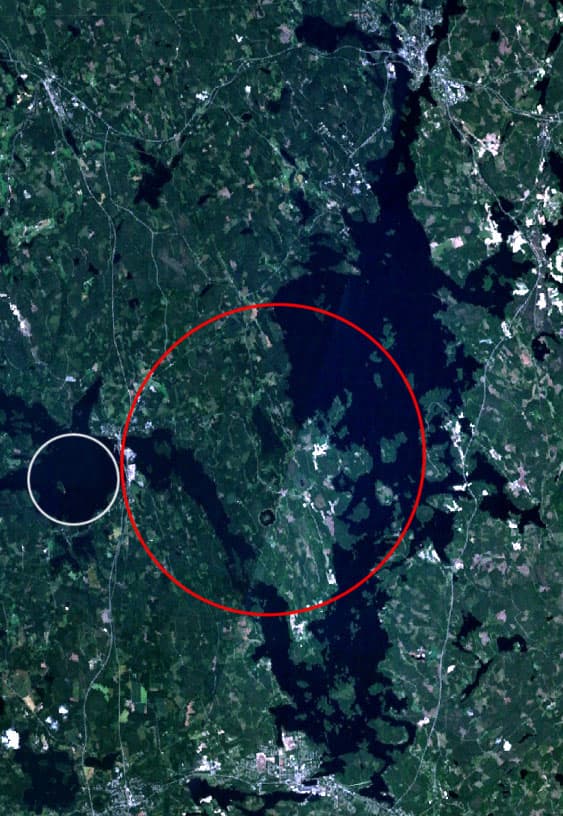
The Keurusselkä impact structure is a remnant of an ancient crater discovered in 2003 on the western shore of Lake Keurusselkä in Central Finland. Identified through shatter cones and shock metamorphic features in quartz, it is one of the oldest known impact structures in Europe, dating back approximately 1.14 to 1.15 billion years. Despite significant erosion, evidence suggests potential ring structures and a negative gravity anomaly, making it a subject of ongoing geological investigation.

Söderfjärden
Söderfjärden is a polder in western Finland, recognized as an impact crater that formed over 640 million years ago. Despite its significant size and the buried central uplift, the crater is primarily visible today as a large, hexagonal cultivated field due to its filling with Cambrian sandstones. This unique surface visibility distinguishes it from other Finnish impact structures.