
Morasko
Morasko is a meteorite nature reserve in Poznań, Poland, notable for containing seven impact craters formed approximately 5,000 years ago. The largest crater measures about 100 meters in diameter and 11 meters deep, with five of the craters containing lakes. The site has yielded numerous meteorite fragments, including significant finds in 1956, 2006, and 2012.
Key Facts
- ›Contains seven impact craters, the largest being approximately 100 meters in diameter.
- ›The formation of the craters is estimated to be about 5,000 years ago.
- ›Five of the craters, including the largest, are filled with lakes.
- ›The largest meteorite fragment found weighed 300 kilograms, recovered in 2012.
- ›The reserve was established in 1976 and covers 55 hectares.
- ›Located in Morasko, on the northern edge of Poznań, Poland.

Silicates
About Morasko
Morasko: A Meteorite Crater Reserve in Poland
The Morasko meteorite nature reserve, located in Morasko on the northern outskirts of Poznań, Poland, is a significant geological site characterized by the presence of seven impact craters. Established in 1976, this reserve spans 55 hectares and protects a unique natural environment.
Impact and Formation
The formation of the Morasko craters is estimated to have occurred approximately 5,000 years ago, placing the impact event within the Holocene epoch. The largest of the seven craters is a prominent feature, measuring about 100 meters (330 feet) in diameter and approximately 11 meters (36 feet) deep. A distinctive aspect of the site is that five of these craters, including the largest, are now filled with lakes, creating a unique landscape.
Meteorite Discoveries
Morasko has yielded substantial evidence of its extraterrestrial origins through the discovery of numerous meteorite fragments. The first meteorite was uncovered in 1914 by German soldiers. Subsequent finds include a 78-kilogram fragment in 1956, a 164-kilogram specimen in 2006 which was then the largest discovered in Poland, and a 300-kilogram meteorite recovered in 2012. Analysis of these meteorites has revealed a composition of iron-nickel alloy along with small quantities of silicates, such as pyroxenes, not naturally found on Earth.
Natural Environment and Accessibility
The reserve is covered by a forest of oak and hornbeam trees, supporting uncommon plant species like the Martagon lily and wild ginger, as well as bird species such as the European nightjar and black woodpecker. Adding to the local geography, the reserve contains Mount Moraska, the highest point in Poznań. The site is accessible via local bus lines 188 and 902.
Source: Wikipedia ↗
Frequently Asked Questions
What is the Morasko meteorite nature reserve?
The Morasko meteorite nature reserve is a protected area in Morasko, Poland, established in 1976. It is known for its unique geological feature of seven impact craters created by meteorite strikes.
How old are the Morasko impact craters?
The formation of the Morasko impact craters is estimated to have occurred approximately 5,000 years ago, during the Holocene epoch.
What is the size of the largest crater at Morasko?
The largest of the seven craters at Morasko has a diameter of about 100 meters (330 feet) and a depth of approximately 11 meters (36 feet).
Have meteorites been found at Morasko?
Yes, numerous meteorite fragments have been discovered at Morasko since the first was found in 1914. Notable finds include a 164-kilogram fragment in 2006 and a 300-kilogram fragment in 2012.
What is found within the Morasko craters?
Five of the seven impact craters at Morasko contain lakes. The surrounding land is covered by an oak and hornbeam forest with uncommon plant and bird species.
Related Impact Craters
Deep Bay
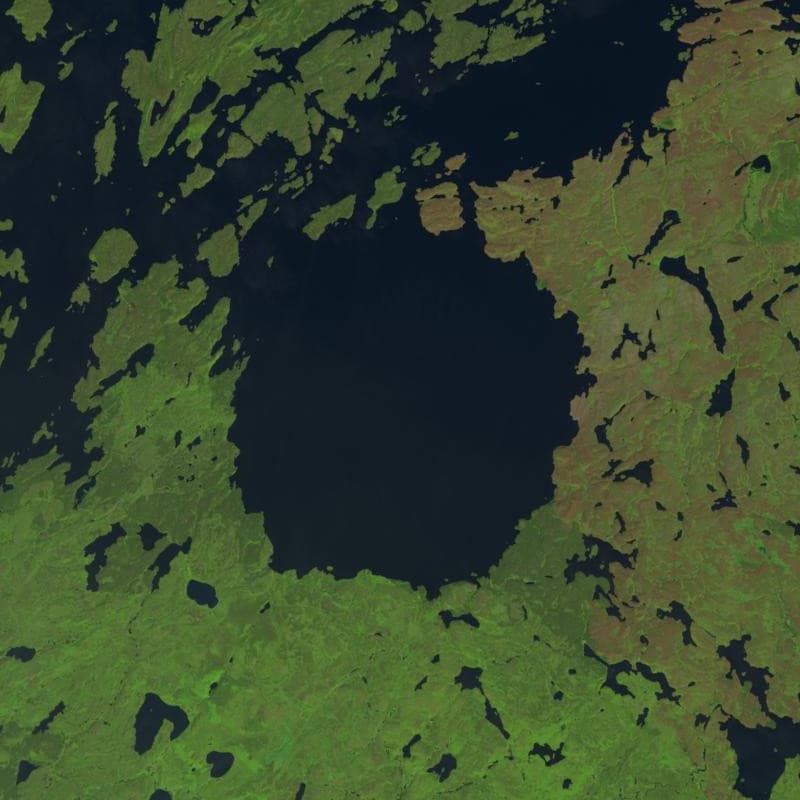
Deep Bay is a remarkably circular and deep bay located near the southwestern tip of Reindeer Lake in Saskatchewan, Canada. It is the deepest body of water in the province and was formed by a 13 km wide impact crater estimated to be 99 ± 4 million years old.

Kaali
The Kaali crater group, located on the Estonian island of Saaremaa, is a significant impact structure formed by a meteorite event. The largest of the nine craters contains Lake Kaali and is surrounded by eight smaller impact features. Its formation, estimated to be shortly after 1530-1450 BC, is notable for occurring in a populated area and has been linked to regional mythology as a sacred site.

Boxhole
Boxhole is a young impact crater located in the Northern Territory, Australia, approximately 180 km northeast of Alice Springs. Discovered in 1937, it is a Holocene-era impact event, estimated to be around 5,400 years old. The crater is notable for being the second impact structure described in Australia and for the discovery of nickel-bearing metallic fragments and an 82 kg iron mass.