
Serpent Mound
Serpent Mound crater, also known as the Serpent Mound Disturbance, is an eroded, complex meteorite impact crater located in Adams County, Ohio, with parts extending into Highland and Pike Counties. Its original rim diameter is estimated to be around 8 km, and it is dated to less than 320 million years old. The crater is notable for its proximity to the Serpent Mound, an effigy mound, leading to speculation that the unique geological features may have inspired its construction.
Key Facts
- ›Located in Adams, Highland, and Pike Counties, Ohio, United States.
- ›Classified as a complex impact crater.
- ›Original rim diameter estimated at 8 km, with some suggestions of up to 14 km.
- ›Age estimated to be less than 320 million years.
- ›Designated a National Natural Landmark in 1980.
- ›Named after the effigy mound located within its boundaries.

Serpent Mound
About Serpent Mound
Serpent Mound Crater
The Serpent Mound crater, also referred to as the Serpent Mound Disturbance, is an eroded impact structure located in the state of Ohio, United States. Its geographical boundaries span across Adams County, with its northern extent reaching into Highland County and a small northeastern section situated in Pike County. This crater is classified as a complex crater, characterized by the presence of a central uplift, a transitional zone, and a ring graben, which is a ring-shaped trough found in the outer regions of the impact site.
Geological Characteristics and Age
Despite significant erosion, the original rim diameter of the Serpent Mound crater is estimated to have been approximately 8 kilometers (5.0 miles). However, some research has proposed a maximum rim diameter of up to 14 kilometers (8.7 miles). The age of the impact event is estimated to be less than 320 million years, placing it within or after the Mississippian period. The crater's geological features have contributed to its designation as a National Natural Landmark by the National Park Service in 1980.
Association with Serpent Mound Effigy
A notable aspect of the Serpent Mound crater is its location relative to the Serpent Mound, a famous effigy mound. The effigy mound is situated on a plateau within the Brush Creek Valley, directly on the crater site. European-American explorers noted the unusual terrain in the 19th century, and it is widely speculated that the distinctive geological formations of the crater may have influenced Native Americans to construct the effigy mound at this specific location. The crater itself is named after this prominent effigy mound.
Source: Wikipedia ↗
Frequently Asked Questions
Where is the Serpent Mound crater located?
The Serpent Mound crater is located in Ohio, United States. It is situated primarily in Adams County, with portions extending into Highland County and a small part in Pike County.
What is the estimated size of the Serpent Mound crater?
The original rim diameter of the Serpent Mound crater has been estimated at 8 kilometers (5.0 miles). Some research has suggested a maximum rim diameter of up to 14 kilometers (8.7 miles).
How old is the Serpent Mound crater?
The Serpent Mound crater is estimated to be less than 320 million years old. This age places its formation in the Mississippian period or later.
What type of impact crater is the Serpent Mound crater?
Serpent Mound crater is classified as a complex crater. This classification indicates features such as a central uplift, a transition zone, and a ring graben.
Is the Serpent Mound crater visible on the surface?
The Serpent Mound crater is described as eroded. While the geological features exist, significant erosion has likely altered its surface visibility.
Why is the Serpent Mound crater significant?
The Serpent Mound crater is significant due to its geological classification as a complex impact structure and its proximity to the well-known Serpent Mound effigy mound. It was designated a National Natural Landmark in 1980.
Related Impact Craters

Crooked Creek
Crooked Creek is a 7 km diameter impact crater located in Crawford County, Missouri, United States. Estimated to be 320 million years old, it is one of several circular depressions forming the "38th parallel structures" across the central United States, which are theorized to be the result of a serial impact event.
Chesapeake Bay
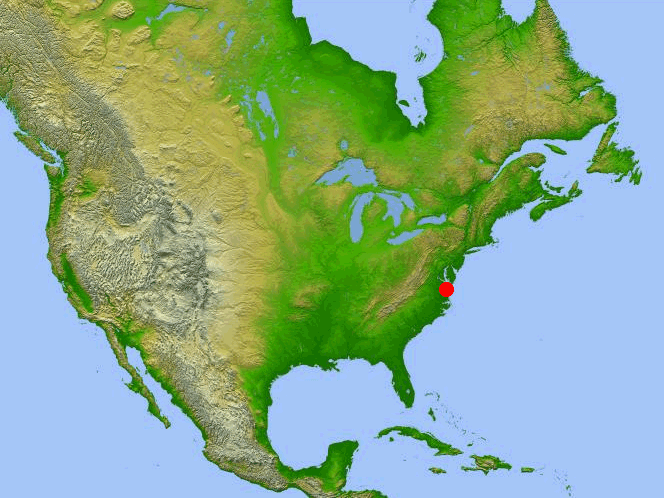
The Chesapeake Bay impact crater is a large, deeply buried structure located beneath the mouth of the Chesapeake Bay in the United States. Formed by a high-speed bolide impact approximately 35.5 million years ago, it is one of the best-preserved "wet-target" impact craters globally and has significantly influenced the region's geology, including the formation of the Chesapeake Bay itself.

Flynn Creek
The Flynn Creek crater, located in Jackson County, Tennessee, is a well-preserved impact structure formed approximately 360 million years ago. It is notable for its complex morphology, including a significant central uplift and folded rim strata, and its importance in understanding ancient impact events.