
Stac Fada Member
Scotland·Proterozoic·chondritic·ejecta blanket
The Stac Fada Member is a significant geological unit in northwest Scotland, recognized as evidence of a major meteorite impact event approximately 1 billion years ago. This layer, found within the Mesoproterozoic Bay of Stoer Formation, is composed of impactite, including suevite and impact melt rocks, and contains distinctive dark green glassy fragments. Its discovery and analysis have provided crucial insights into ancient impact processes and the geological history of the region.
Key Facts
- ›The Stac Fada Member is a rock unit within the Mesoproterozoic Bay of Stoer Formation in northwest Scotland.
- ›It is composed of impactite, a mixture of suevite and clast-poor impact melt rocks.
- ›The unit contains dark green glassy fragments of mafic composition and accretionary lapilli.
- ›Evidence suggests a meteorite impact occurred in the vicinity around 1 billion years ago.
- ›The Stac Fada Member is exposed along the coast of Wester Ross, extending for about 50 km.
- ›The estimated age of the deposit is around 990 ± 22 million years ago, based on shocked zircon crystals.
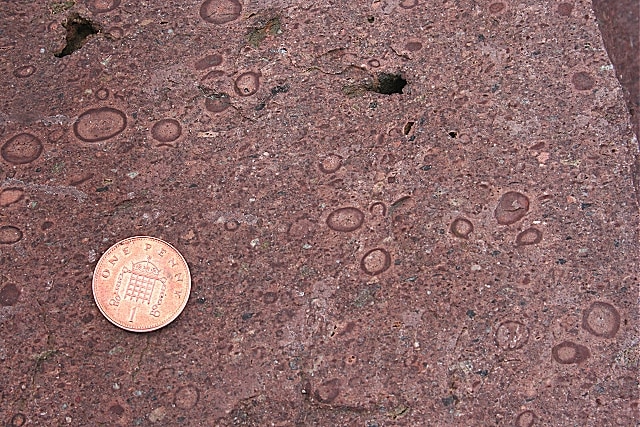
Shocked Quartz, Reidite, Accretionary Lapilli, Potassium Feldspar
About Stac Fada Member
The Stac Fada Member is a significant geological deposit in northwest Scotland, recognized as evidence of a major meteorite impact that occurred approximately 1 billion years ago. This distinct layer is part of the Mesoproterozoic Bay of Stoer Formation and is characterized by its composition of impactite, a mixture of suevite and clast-poor impact melt rocks. The unit is notable for containing dark green glassy fragments of mafic composition and accretionary lapilli, which are small, rounded masses of volcanic ash or rock fragments that form around a nucleus.
Geological Context and Discovery
The Stac Fada Member's interpretation as an impactite evolved over time. Initially considered a conglomerate or a volcanic deposit, its true nature was revealed through the identification of key impact indicators. These include shocked quartz, a higher-than-expected concentration of platinum-group metals, and a non-terrestrial chromium isotope. Further evidence came from the discovery of reidite, a high-pressure mineral formed in zircon grains, which indicates pressures of at least 30 GPa, consistent with a powerful impact.
Impact Event and Crater Location
The impact event associated with the Stac Fada Member is estimated to have occurred around 990 ± 22 million years ago, based on dating of shocked zircon crystals. The impact crater itself is believed to be preserved beneath younger sedimentary layers. Current interpretations suggest the crater likely lies to the west, under the Minch waterway, or is responsible for the Lairg Gravity Low to the east. Analysis of ejecta direction and rock fabric points towards an impact location in the Minch as being more probable. The estimated diameter of the crater is approximately 13–14 kilometers (8–9 miles).
Extent and Significance
The Stac Fada Member is exposed at various localities along the coast of Wester Ross, extending for about 50 kilometers from Loch Ewe to the Stoer peninsula. The thickness of the unit varies, generally ranging from 10 to 15 meters, but can reach over 30 meters in some areas. The study of the Stac Fada Member provides valuable insights into ancient impact events on Earth, their geological consequences, and the early geological history of Scotland.
Source: Wikipedia ↗
Frequently Asked Questions
What is the Stac Fada Member?
The Stac Fada Member is a distinctive layer of rock found in northwest Scotland, recognized as evidence of a large meteorite impact. It is part of the Mesoproterozoic Bay of Stoer Formation and consists of impactite, a mixture of suevite and impact melt rocks.
When did the impact event that formed the Stac Fada Member occur?
The impact event associated with the Stac Fada Member is estimated to have occurred around 1 billion years ago. More precise dating of shocked zircon crystals suggests an age of approximately 990 ± 22 million years ago.
Where is the Stac Fada Member located?
The Stac Fada Member is found in northwest Scotland, with exposures along the coast of Wester Ross. It extends from the western side of Loch Ewe in the south to the Stoer peninsula in the north, covering a distance of about 50 km.
What evidence supports the Stac Fada Member being from an impact event?
Evidence includes the presence of shocked quartz, a higher-than-expected concentration of platinum-group metals, a non-terrestrial chromium isotope, and the mineral reidite found in zircon grains. These features are characteristic of meteorite impacts.
Where is the impact crater associated with the Stac Fada Member believed to be located?
The impact crater is presumed to be preserved under sedimentary layers and is thought to lie either to the west under the Minch waterway or to be the cause of the Lairg Gravity Low to the east. Current analysis favors an impact location in the Minch.
What is the size of the impact crater?
The impact crater associated with the Stac Fada Member has been estimated to be about 13–14 kilometers (8–9 miles) across.
Related Impact Craters
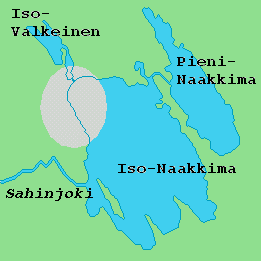
Iso-Naakkima
Iso-Naakkima is a lake in Southern Savonia, Finland, notable for concealing an eroded impact crater beneath its northwestern section. It is recognized as one of the oldest known impact structures on Earth, estimated at 1200 million years old, and is also among the smallest confirmed craters of its age, measuring approximately 3 km in diameter.

Söderfjärden
Söderfjärden is a polder in western Finland, recognized as an impact crater that formed over 640 million years ago. Despite its significant size and the buried central uplift, the crater is primarily visible today as a large, hexagonal cultivated field due to its filling with Cambrian sandstones. This unique surface visibility distinguishes it from other Finnish impact structures.
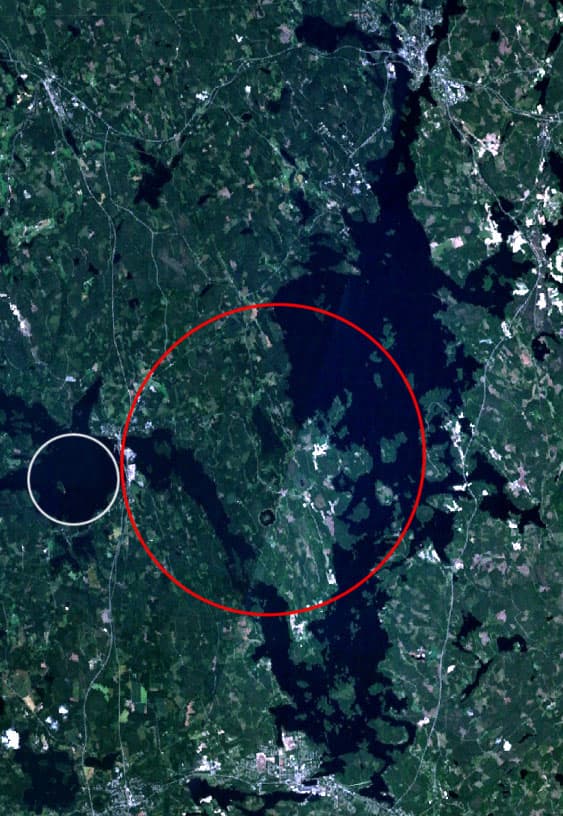
Keurusselkä
The Keurusselkä impact structure is a remnant of an ancient crater discovered in 2003 on the western shore of Lake Keurusselkä in Central Finland. Identified through shatter cones and shock metamorphic features in quartz, it is one of the oldest known impact structures in Europe, dating back approximately 1.14 to 1.15 billion years. Despite significant erosion, evidence suggests potential ring structures and a negative gravity anomaly, making it a subject of ongoing geological investigation.